{"title":"Enhanced absorption in organic solar cells using core-shell iron-ZnO nanoparticles: optical and numerical simulations","authors":"Mahdi Aghlmandi Sadigh Bagheri","doi":"10.1007/s11051-025-06295-1","DOIUrl":null,"url":null,"abstract":"<div><p>This study utilizes the finite-difference time-domain (FDTD) method to reveal the superior potential of cuboid iron (Fe) nanoparticles (NPs) with a zinc oxide (ZnO) shell for absorption enhancement (AE) in the active layer of organic solar cells (OSCs). The dimensions and arrangement of core-shell Fe-ZnO cuboid NPs on a ZnO substrate were meticulously optimized to achieve the highest AE. Unlike other noble metals, Fe NPs maintain or improve their enhancement capabilities even as the core thickness decreases and the shell thickness increases. In the 300–700 nm wavelength range, where the P3HT:PCBM composite has an intrinsic absorption spectrum, the absorption of ZnO nanostructures devoid of a metal core is reduced to 0.9 times the intrinsic value. In contrast, the absorption of the Fe-ZnO NPs increased to 1.282 times, which is 1.13 times greater than that of the Au NPs in the same structure. Additionally, the optical <span>\\(J_{sc}\\)</span> achieved by the Fe NPs is 1.75 times greater than the intrinsic <span>\\(J_{sc}\\)</span>, which is 1.26 times greater than that achieved by the Au NPs. The electric field density and absorption density profiles indicate that Fe NPs significantly enhance organic absorption through localized surface plasmon resonance (LSPR), particularly in the red spectrum (700 nm), where P3HT:PCBM has the lowest intrinsic absorption.</p></div>","PeriodicalId":653,"journal":{"name":"Journal of Nanoparticle Research","volume":"27 4","pages":""},"PeriodicalIF":2.6000,"publicationDate":"2025-04-14","publicationTypes":"Journal Article","fieldsOfStudy":null,"isOpenAccess":false,"openAccessPdf":"","citationCount":"0","resultStr":null,"platform":"Semanticscholar","paperid":null,"PeriodicalName":"Journal of Nanoparticle Research","FirstCategoryId":"88","ListUrlMain":"https://link.springer.com/article/10.1007/s11051-025-06295-1","RegionNum":4,"RegionCategory":"材料科学","ArticlePicture":[],"TitleCN":null,"AbstractTextCN":null,"PMCID":null,"EPubDate":"","PubModel":"","JCR":"Q3","JCRName":"CHEMISTRY, MULTIDISCIPLINARY","Score":null,"Total":0}
引用次数: 0
Abstract
This study utilizes the finite-difference time-domain (FDTD) method to reveal the superior potential of cuboid iron (Fe) nanoparticles (NPs) with a zinc oxide (ZnO) shell for absorption enhancement (AE) in the active layer of organic solar cells (OSCs). The dimensions and arrangement of core-shell Fe-ZnO cuboid NPs on a ZnO substrate were meticulously optimized to achieve the highest AE. Unlike other noble metals, Fe NPs maintain or improve their enhancement capabilities even as the core thickness decreases and the shell thickness increases. In the 300–700 nm wavelength range, where the P3HT:PCBM composite has an intrinsic absorption spectrum, the absorption of ZnO nanostructures devoid of a metal core is reduced to 0.9 times the intrinsic value. In contrast, the absorption of the Fe-ZnO NPs increased to 1.282 times, which is 1.13 times greater than that of the Au NPs in the same structure. Additionally, the optical \(J_{sc}\) achieved by the Fe NPs is 1.75 times greater than the intrinsic \(J_{sc}\), which is 1.26 times greater than that achieved by the Au NPs. The electric field density and absorption density profiles indicate that Fe NPs significantly enhance organic absorption through localized surface plasmon resonance (LSPR), particularly in the red spectrum (700 nm), where P3HT:PCBM has the lowest intrinsic absorption.
期刊介绍:
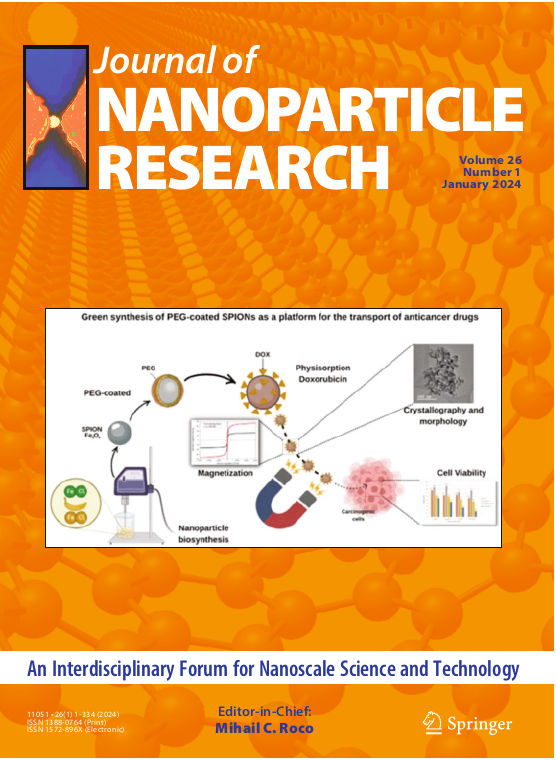
The objective of the Journal of Nanoparticle Research is to disseminate knowledge of the physical, chemical and biological phenomena and processes in structures that have at least one lengthscale ranging from molecular to approximately 100 nm (or submicron in some situations), and exhibit improved and novel properties that are a direct result of their small size.
Nanoparticle research is a key component of nanoscience, nanoengineering and nanotechnology.
The focus of the Journal is on the specific concepts, properties, phenomena, and processes related to particles, tubes, layers, macromolecules, clusters and other finite structures of the nanoscale size range. Synthesis, assembly, transport, reactivity, and stability of such structures are considered. Development of in-situ and ex-situ instrumentation for characterization of nanoparticles and their interfaces should be based on new principles for probing properties and phenomena not well understood at the nanometer scale. Modeling and simulation may include atom-based quantum mechanics; molecular dynamics; single-particle, multi-body and continuum based models; fractals; other methods suitable for modeling particle synthesis, assembling and interaction processes. Realization and application of systems, structures and devices with novel functions obtained via precursor nanoparticles is emphasized. Approaches may include gas-, liquid-, solid-, and vacuum-based processes, size reduction, chemical- and bio-self assembly. Contributions include utilization of nanoparticle systems for enhancing a phenomenon or process and particle assembling into hierarchical structures, as well as formulation and the administration of drugs. Synergistic approaches originating from different disciplines and technologies, and interaction between the research providers and users in this field, are encouraged.




 京公网安备 11010802042870号
京ICP备2023020795号-1
京公网安备 11010802042870号
京ICP备2023020795号-1

 分享
分享
 求助内容:
求助内容: 应助结果提醒方式:
 扫码关注我们
