Seungyeop Choi, Jun Pyo Seo, Jaejin Lim, Cyril Bubu Dzakpasu, Youngjoon Roh, Cheol Bak, Suhwan Kim, Prof. Hongkyung Lee, Prof. Yong Min Lee
{"title":"Optimizing the Power Performance of Lithium-Ion Batteries: The Role of Separator Porosity and Electrode Mass Loading","authors":"Seungyeop Choi, Jun Pyo Seo, Jaejin Lim, Cyril Bubu Dzakpasu, Youngjoon Roh, Cheol Bak, Suhwan Kim, Prof. Hongkyung Lee, Prof. Yong Min Lee","doi":"10.1002/batt.202400638","DOIUrl":null,"url":null,"abstract":"<p>This study investigates the concealed effect of separator porosity on the electrochemical performance of lithium-ion batteries (LIBs) in thin and thick electrode configuration. The effect of the separator is expected to be more pronounced in cells with thin electrodes due to its high volumetric/resistance ratio within the cell. However, the electrochemical analyses show similar power performance regardless of the separator porosity in the thin electrode configuration. In contrast, for cells with thick electrodes, separator porosity significantly impacts the direct current-internal resistance (DC-IR) and the capacity retention at a high rate. This behavior is attributed to ion concentration gradients in the upper regions of thick electrodes, while Li<sup>+</sup> transfer to lower regions is hampered as the electrode thickness increases. These findings suggest that the intrinsic properties of individual cell components, such as separator porosity, are highly dependent on the overall cell design. Moreover, while high-porosity separators enhance power performance, particularly in thick electrode configurations, they exhibit lower thermal stability and tensile strength. In conclusion, this study highlights the need for an integrated approach to optimizing separator characteristics, considering both electrochemical performance and safety trade-offs in LIBs.</p>","PeriodicalId":132,"journal":{"name":"Batteries & Supercaps","volume":"8 4","pages":""},"PeriodicalIF":4.7000,"publicationDate":"2024-12-24","publicationTypes":"Journal Article","fieldsOfStudy":null,"isOpenAccess":false,"openAccessPdf":"","citationCount":"0","resultStr":null,"platform":"Semanticscholar","paperid":null,"PeriodicalName":"Batteries & Supercaps","FirstCategoryId":"88","ListUrlMain":"https://chemistry-europe.onlinelibrary.wiley.com/doi/10.1002/batt.202400638","RegionNum":4,"RegionCategory":"材料科学","ArticlePicture":[],"TitleCN":null,"AbstractTextCN":null,"PMCID":null,"EPubDate":"","PubModel":"","JCR":"Q2","JCRName":"ELECTROCHEMISTRY","Score":null,"Total":0}
引用次数: 0
Abstract
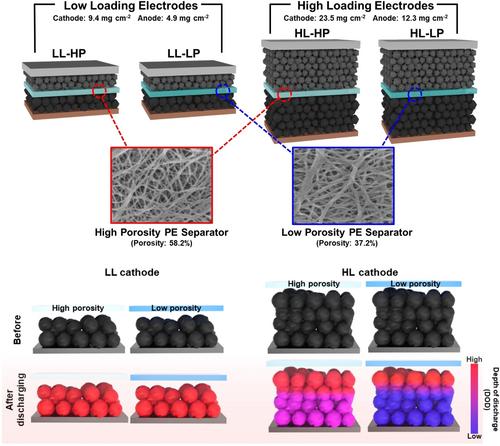
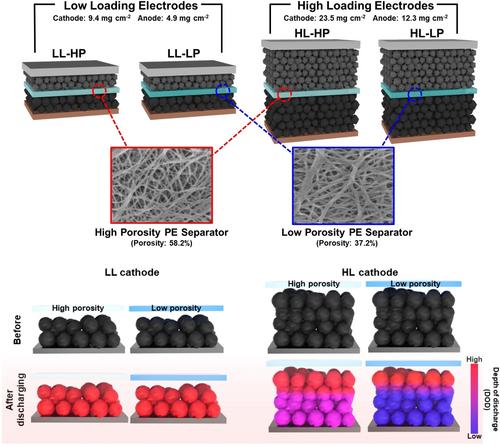
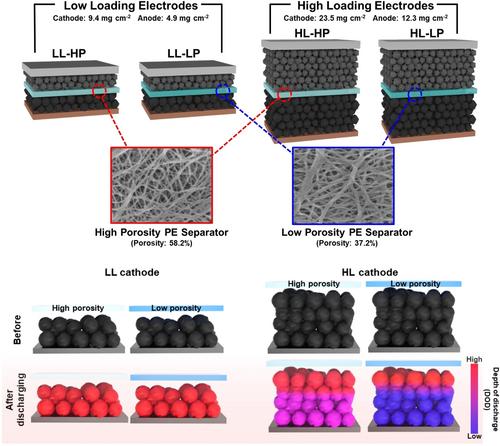
This study investigates the concealed effect of separator porosity on the electrochemical performance of lithium-ion batteries (LIBs) in thin and thick electrode configuration. The effect of the separator is expected to be more pronounced in cells with thin electrodes due to its high volumetric/resistance ratio within the cell. However, the electrochemical analyses show similar power performance regardless of the separator porosity in the thin electrode configuration. In contrast, for cells with thick electrodes, separator porosity significantly impacts the direct current-internal resistance (DC-IR) and the capacity retention at a high rate. This behavior is attributed to ion concentration gradients in the upper regions of thick electrodes, while Li+ transfer to lower regions is hampered as the electrode thickness increases. These findings suggest that the intrinsic properties of individual cell components, such as separator porosity, are highly dependent on the overall cell design. Moreover, while high-porosity separators enhance power performance, particularly in thick electrode configurations, they exhibit lower thermal stability and tensile strength. In conclusion, this study highlights the need for an integrated approach to optimizing separator characteristics, considering both electrochemical performance and safety trade-offs in LIBs.
期刊介绍:
Electrochemical energy storage devices play a transformative role in our societies. They have allowed the emergence of portable electronics devices, have triggered the resurgence of electric transportation and constitute key components in smart power grids. Batteries & Supercaps publishes international high-impact experimental and theoretical research on the fundamentals and applications of electrochemical energy storage. We support the scientific community to advance energy efficiency and sustainability.





 京公网安备 11010802042870号
京ICP备2023020795号-1
京公网安备 11010802042870号
京ICP备2023020795号-1

 分享
分享
 求助内容:
求助内容: 应助结果提醒方式:
 扫码关注我们
