Qianqian Xie, Weihua Chen, Bin Yuan, Yibo Huangfu, Xianjun He, Liqing Wu, Mingkai Liu, Yingchang You, Min Shao, Xuemei Wang
{"title":"Significant but Overlooked: The Role of Anthropogenic Monoterpenes in Ozone Formation in a Chinese Megacity","authors":"Qianqian Xie, Weihua Chen, Bin Yuan, Yibo Huangfu, Xianjun He, Liqing Wu, Mingkai Liu, Yingchang You, Min Shao, Xuemei Wang","doi":"10.1021/acs.est.5c00001","DOIUrl":null,"url":null,"abstract":"Recent observations have revealed unexpectedly high concentrations of monoterpenes (MT) in urban areas, frequently surpassing those in forested regions. These findings suggest significant anthropogenic contributions (MT<sub>ANT</sub>), challenging the traditional view that MT emissions are predominantly natural (MT<sub>NAT</sub>) in current inventories. This oversight likely results in a substantial underestimation of MT’s role in urban ozone (O<sub>3</sub>) production. Therefore, we developed a novel approach to generate a gridded emission inventory (EI) of MT<sub>ANT</sub>, integrating flux measurements of MT and carbon monoxide (CO). Results show that MT<sub>ANT</sub> emission rate in Beijing core areas exceeds MT<sub>NAT</sub> by a factor of 1.83, with household volatile chemical products (VCPs) contributing 56% of total MT<sub>ANT</sub> emissions. Incorporating MT<sub>ANT</sub> emissions into the Weather Research and Forecasting Model coupled with Chemistry (WRF-Chem) model significantly improved the simulation of diurnal MT variations (correlation coefficient, <i>r</i> = 0.985) and reduced the normalized mean bias (<i>NMB</i>) in surface MT concentration predictions by 53%. Notably, the combined effects of anthropogenic and biogenic MT emissions increased summertime maximum daily 8-h average (MDA8) O<sub>3</sub> levels by 12.8 ppb in Beijing core areas, with MT from household VCPs (MT<sub>VCP</sub>) accounting for 62% of the MT<sub>ANT</sub>-driven O<sub>3</sub> increase. This study provides a robust quantitative foundation for assessing the impact of anthropogenic MT emissions on urban air quality and highlights the urgent need for targeted regulatory measures to mitigate their growing contribution to O<sub>3</sub> pollution.","PeriodicalId":36,"journal":{"name":"环境科学与技术","volume":"42 1","pages":""},"PeriodicalIF":11.3000,"publicationDate":"2025-04-14","publicationTypes":"Journal Article","fieldsOfStudy":null,"isOpenAccess":false,"openAccessPdf":"","citationCount":"0","resultStr":null,"platform":"Semanticscholar","paperid":null,"PeriodicalName":"环境科学与技术","FirstCategoryId":"1","ListUrlMain":"https://doi.org/10.1021/acs.est.5c00001","RegionNum":1,"RegionCategory":"环境科学与生态学","ArticlePicture":[],"TitleCN":null,"AbstractTextCN":null,"PMCID":null,"EPubDate":"","PubModel":"","JCR":"Q1","JCRName":"ENGINEERING, ENVIRONMENTAL","Score":null,"Total":0}
引用次数: 0
Abstract
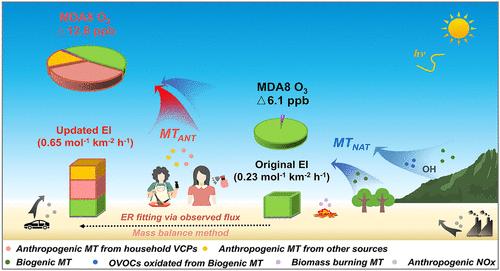
Recent observations have revealed unexpectedly high concentrations of monoterpenes (MT) in urban areas, frequently surpassing those in forested regions. These findings suggest significant anthropogenic contributions (MTANT), challenging the traditional view that MT emissions are predominantly natural (MTNAT) in current inventories. This oversight likely results in a substantial underestimation of MT’s role in urban ozone (O3) production. Therefore, we developed a novel approach to generate a gridded emission inventory (EI) of MTANT, integrating flux measurements of MT and carbon monoxide (CO). Results show that MTANT emission rate in Beijing core areas exceeds MTNAT by a factor of 1.83, with household volatile chemical products (VCPs) contributing 56% of total MTANT emissions. Incorporating MTANT emissions into the Weather Research and Forecasting Model coupled with Chemistry (WRF-Chem) model significantly improved the simulation of diurnal MT variations (correlation coefficient, r = 0.985) and reduced the normalized mean bias (NMB) in surface MT concentration predictions by 53%. Notably, the combined effects of anthropogenic and biogenic MT emissions increased summertime maximum daily 8-h average (MDA8) O3 levels by 12.8 ppb in Beijing core areas, with MT from household VCPs (MTVCP) accounting for 62% of the MTANT-driven O3 increase. This study provides a robust quantitative foundation for assessing the impact of anthropogenic MT emissions on urban air quality and highlights the urgent need for targeted regulatory measures to mitigate their growing contribution to O3 pollution.
期刊介绍:
Environmental Science & Technology (ES&T) is a co-sponsored academic and technical magazine by the Hubei Provincial Environmental Protection Bureau and the Hubei Provincial Academy of Environmental Sciences.
Environmental Science & Technology (ES&T) holds the status of Chinese core journals, scientific papers source journals of China, Chinese Science Citation Database source journals, and Chinese Academic Journal Comprehensive Evaluation Database source journals. This publication focuses on the academic field of environmental protection, featuring articles related to environmental protection and technical advancements.




 京公网安备 11010802042870号
京ICP备2023020795号-1
京公网安备 11010802042870号
京ICP备2023020795号-1

 分享
分享
 求助内容:
求助内容: 应助结果提醒方式:
 扫码关注我们
