Linjie Zhang, Wenyue Wang, Feng Wang, Dong Wu, Yinglong Su, Min Zhan, Kaiyi Li, Huahong Shi, Bing Xie
{"title":"Decoding the Plastic Patch: Exploring the Global Microplastic Distribution in the Surface Layers of Marine Regions with Interpretable Machine Learning","authors":"Linjie Zhang, Wenyue Wang, Feng Wang, Dong Wu, Yinglong Su, Min Zhan, Kaiyi Li, Huahong Shi, Bing Xie","doi":"10.1021/acs.est.4c12227","DOIUrl":null,"url":null,"abstract":"The marine environment is grappling with microplastic (MP) pollution, necessitating an understanding of its distribution patterns, influencing factors, and potential ecological risks. However, the vast area of the ocean and budgetary constraints make conducting comprehensive surveys to assess MP pollution impractical. Interpretable machine learning (ML) offers an effective solution. Herein, we used four ML algorithms based on MP data calibrated to the size range of 20–5000 μm and considered various factors to construct a robust predictive ML model of marine MP distribution. Interpretation of the ML model indicated that biogeochemical and anthropogenic factors substantially influence global marine MP pollution, while atmospheric and physical factors exert lesser effects. However, the extent of the influence of each factor may vary within specific marine regions and their underlying mechanisms may differ across regions. The predicted results indicated that the global marine MP concentrations ranged from 0.176 to 27.055 particles/m<sup>3</sup> and that MPs in the 20–5000-μm size range did not pose a potential ecological risk. The interpretable ML framework developed in this study covered MP data preprocessing, MP distribution prediction, and interpretation of the influencing factors of MPs, providing an essential reference for marine MP pollution management and decision making.","PeriodicalId":36,"journal":{"name":"环境科学与技术","volume":"17 1","pages":""},"PeriodicalIF":11.3000,"publicationDate":"2025-04-14","publicationTypes":"Journal Article","fieldsOfStudy":null,"isOpenAccess":false,"openAccessPdf":"","citationCount":"0","resultStr":null,"platform":"Semanticscholar","paperid":null,"PeriodicalName":"环境科学与技术","FirstCategoryId":"1","ListUrlMain":"https://doi.org/10.1021/acs.est.4c12227","RegionNum":1,"RegionCategory":"环境科学与生态学","ArticlePicture":[],"TitleCN":null,"AbstractTextCN":null,"PMCID":null,"EPubDate":"","PubModel":"","JCR":"Q1","JCRName":"ENGINEERING, ENVIRONMENTAL","Score":null,"Total":0}
引用次数: 0
Abstract
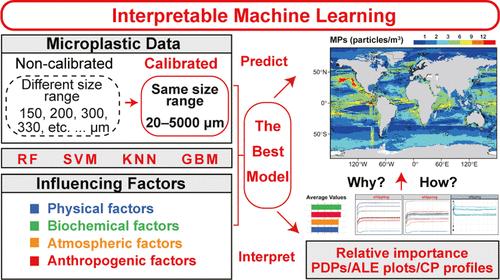
The marine environment is grappling with microplastic (MP) pollution, necessitating an understanding of its distribution patterns, influencing factors, and potential ecological risks. However, the vast area of the ocean and budgetary constraints make conducting comprehensive surveys to assess MP pollution impractical. Interpretable machine learning (ML) offers an effective solution. Herein, we used four ML algorithms based on MP data calibrated to the size range of 20–5000 μm and considered various factors to construct a robust predictive ML model of marine MP distribution. Interpretation of the ML model indicated that biogeochemical and anthropogenic factors substantially influence global marine MP pollution, while atmospheric and physical factors exert lesser effects. However, the extent of the influence of each factor may vary within specific marine regions and their underlying mechanisms may differ across regions. The predicted results indicated that the global marine MP concentrations ranged from 0.176 to 27.055 particles/m3 and that MPs in the 20–5000-μm size range did not pose a potential ecological risk. The interpretable ML framework developed in this study covered MP data preprocessing, MP distribution prediction, and interpretation of the influencing factors of MPs, providing an essential reference for marine MP pollution management and decision making.
期刊介绍:
Environmental Science & Technology (ES&T) is a co-sponsored academic and technical magazine by the Hubei Provincial Environmental Protection Bureau and the Hubei Provincial Academy of Environmental Sciences.
Environmental Science & Technology (ES&T) holds the status of Chinese core journals, scientific papers source journals of China, Chinese Science Citation Database source journals, and Chinese Academic Journal Comprehensive Evaluation Database source journals. This publication focuses on the academic field of environmental protection, featuring articles related to environmental protection and technical advancements.




 京公网安备 11010802042870号
京ICP备2023020795号-1
京公网安备 11010802042870号
京ICP备2023020795号-1

 分享
分享
 求助内容:
求助内容: 应助结果提醒方式:
 扫码关注我们
