Removal of Sulfonamide Antibiotics in Peracetic Acid-Mediated Natural Polyphenol Systems via an Overlooked Polymerization Pathway: Role of ortho-Quinones
Sheng Li, Jing Zou, Jianying Wu, Linfeng He, Chenyu Tang, Fei Li, Bo Sun, Min Zhao, Qingsong Li, Panpan Wang, Lengshen Huang, Qingfeng Cheng, Haoqiang Tan, Jun Ma
{"title":"Removal of Sulfonamide Antibiotics in Peracetic Acid-Mediated Natural Polyphenol Systems via an Overlooked Polymerization Pathway: Role of ortho-Quinones","authors":"Sheng Li, Jing Zou, Jianying Wu, Linfeng He, Chenyu Tang, Fei Li, Bo Sun, Min Zhao, Qingsong Li, Panpan Wang, Lengshen Huang, Qingfeng Cheng, Haoqiang Tan, Jun Ma","doi":"10.1021/acs.est.4c13612","DOIUrl":null,"url":null,"abstract":"Natural polyphenols can be oxidized into reactive quinones, which might play a key role in the removal of specific contaminants in natural polyphenol-related advanced oxidation processes (AOPs). In this study, peracetic acid (PAA) was employed in combination with natural protocatechuic acid (PCA) to remove sulfonamide antibiotics (SAs) from water. More than 95% removal of sulfamethoxazole (SMX) and other SAs was observed in the PCA/PAA system, and neutral pH conditions (5.0–8.0) were more conducive to the removal of SMX. The PCA/PAA system exhibited a great anti-interference ability against complex water matrices. <i>ortho</i>-Quinone, generated from the oxidation of PCA by PAA, played a dominant role in the SMX removal. Electrons tended to transfer from SMX to the generated <i>ortho</i>-quinones and form covalent bonds, resulting in the production of less toxic oligomers via the overlooked polymerization pathway. A reduction in the toxicity of the SMX solution was found following treatment with the PCA/PAA system. More interestingly, several polyphenols structurally related to PCA could also facilitate SMX removal using PAA as the oxidant. Overall, this study proposes a novel strategy for developing reactive quinones dominated AOPs with robust anti-interference performance, as well as enhances the understanding of contaminant removal via an overlooked polymerization pathway in natural polyphenol-related AOPs.","PeriodicalId":36,"journal":{"name":"环境科学与技术","volume":"60 1","pages":""},"PeriodicalIF":11.3000,"publicationDate":"2025-04-14","publicationTypes":"Journal Article","fieldsOfStudy":null,"isOpenAccess":false,"openAccessPdf":"","citationCount":"0","resultStr":null,"platform":"Semanticscholar","paperid":null,"PeriodicalName":"环境科学与技术","FirstCategoryId":"1","ListUrlMain":"https://doi.org/10.1021/acs.est.4c13612","RegionNum":1,"RegionCategory":"环境科学与生态学","ArticlePicture":[],"TitleCN":null,"AbstractTextCN":null,"PMCID":null,"EPubDate":"","PubModel":"","JCR":"Q1","JCRName":"ENGINEERING, ENVIRONMENTAL","Score":null,"Total":0}
引用次数: 0
Abstract
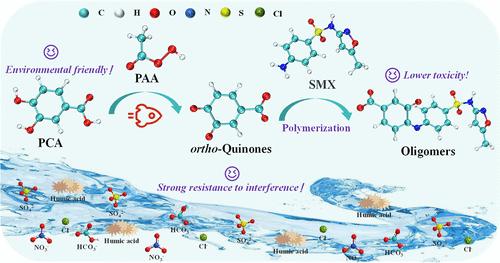
Natural polyphenols can be oxidized into reactive quinones, which might play a key role in the removal of specific contaminants in natural polyphenol-related advanced oxidation processes (AOPs). In this study, peracetic acid (PAA) was employed in combination with natural protocatechuic acid (PCA) to remove sulfonamide antibiotics (SAs) from water. More than 95% removal of sulfamethoxazole (SMX) and other SAs was observed in the PCA/PAA system, and neutral pH conditions (5.0–8.0) were more conducive to the removal of SMX. The PCA/PAA system exhibited a great anti-interference ability against complex water matrices. ortho-Quinone, generated from the oxidation of PCA by PAA, played a dominant role in the SMX removal. Electrons tended to transfer from SMX to the generated ortho-quinones and form covalent bonds, resulting in the production of less toxic oligomers via the overlooked polymerization pathway. A reduction in the toxicity of the SMX solution was found following treatment with the PCA/PAA system. More interestingly, several polyphenols structurally related to PCA could also facilitate SMX removal using PAA as the oxidant. Overall, this study proposes a novel strategy for developing reactive quinones dominated AOPs with robust anti-interference performance, as well as enhances the understanding of contaminant removal via an overlooked polymerization pathway in natural polyphenol-related AOPs.
期刊介绍:
Environmental Science & Technology (ES&T) is a co-sponsored academic and technical magazine by the Hubei Provincial Environmental Protection Bureau and the Hubei Provincial Academy of Environmental Sciences.
Environmental Science & Technology (ES&T) holds the status of Chinese core journals, scientific papers source journals of China, Chinese Science Citation Database source journals, and Chinese Academic Journal Comprehensive Evaluation Database source journals. This publication focuses on the academic field of environmental protection, featuring articles related to environmental protection and technical advancements.



 京公网安备 11010802042870号
京ICP备2023020795号-1
京公网安备 11010802042870号
京ICP备2023020795号-1

 分享
分享
 求助内容:
求助内容: 应助结果提醒方式:
 扫码关注我们
