R. Tamura, T. Abe, S. Yoshida, Y. Shimozaki, S. Suzuki, A. Ishikawa, F. Labib, M. Avdeev, K. Kinjo, K. Nawa, T. J. Sato
{"title":"Observation of antiferromagnetic order in a quasicrystal","authors":"R. Tamura, T. Abe, S. Yoshida, Y. Shimozaki, S. Suzuki, A. Ishikawa, F. Labib, M. Avdeev, K. Kinjo, K. Nawa, T. J. Sato","doi":"10.1038/s41567-025-02858-0","DOIUrl":null,"url":null,"abstract":"Quasicrystals are long-range-ordered materials with atypical rotational symmetries, such as 5-fold, 10-fold or 12-fold symmetries, which are incompatible with crystallographic periodicity. Although spin-glass-like freezing phenomena have been observed in quasicrystals, antiferromagnetic order has not. Here we report experimental evidence for antiferromagnetic order in the icosahedral quasicrystal Au56In28.5Eu15.5. Its magnetization curve shows a sharp cusp at a Néel temperature of 6.5 K, and both metamagnetic anomaly below and specific heat anomaly at this temperature are consistent with an antiferromagnetic transition. The appearance of magnetic Bragg reflections in the neutron diffraction data below the Néel temperature further confirms the long-range antiferromagnetic order in this icosahedral quasicrystal. Our discovery resolves the long-standing issue of whether antiferromagnetic order is possible in real quasicrystals, inviting further studies particularly on antiferromagnetic icosahedral quasicrystals and quasiperiodic magnetic order, as opposed to periodic magnetic order generally in condensed-matter physics. Quasicrystals lack translational symmetry but display rotational order. Whether antiferromagnetic order can exist in quasicrystals has been unclear. Now, long-range antiferromagnetic order is shown in the icosahedral quasicrystal Au56In28.5Eu15.5.","PeriodicalId":19100,"journal":{"name":"Nature Physics","volume":"21 6","pages":"974-979"},"PeriodicalIF":18.4000,"publicationDate":"2025-04-14","publicationTypes":"Journal Article","fieldsOfStudy":null,"isOpenAccess":false,"openAccessPdf":"https://www.nature.comhttps://www.nature.com/articles/s41567-025-02858-0.pdf","citationCount":"0","resultStr":null,"platform":"Semanticscholar","paperid":null,"PeriodicalName":"Nature Physics","FirstCategoryId":"101","ListUrlMain":"https://www.nature.com/articles/s41567-025-02858-0","RegionNum":1,"RegionCategory":"物理与天体物理","ArticlePicture":[],"TitleCN":null,"AbstractTextCN":null,"PMCID":null,"EPubDate":"","PubModel":"","JCR":"Q1","JCRName":"PHYSICS, MULTIDISCIPLINARY","Score":null,"Total":0}
引用次数: 0
Abstract
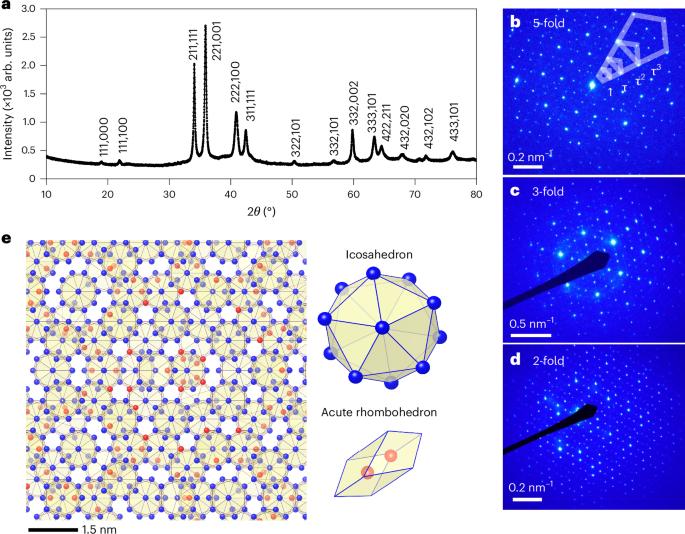
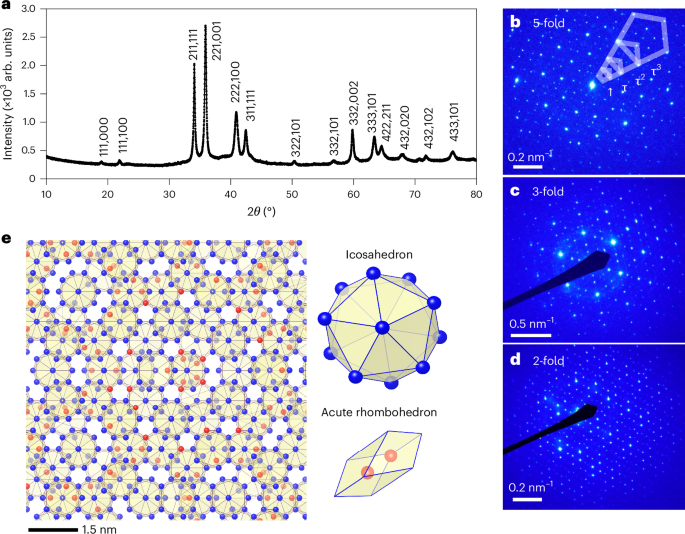
Quasicrystals are long-range-ordered materials with atypical rotational symmetries, such as 5-fold, 10-fold or 12-fold symmetries, which are incompatible with crystallographic periodicity. Although spin-glass-like freezing phenomena have been observed in quasicrystals, antiferromagnetic order has not. Here we report experimental evidence for antiferromagnetic order in the icosahedral quasicrystal Au56In28.5Eu15.5. Its magnetization curve shows a sharp cusp at a Néel temperature of 6.5 K, and both metamagnetic anomaly below and specific heat anomaly at this temperature are consistent with an antiferromagnetic transition. The appearance of magnetic Bragg reflections in the neutron diffraction data below the Néel temperature further confirms the long-range antiferromagnetic order in this icosahedral quasicrystal. Our discovery resolves the long-standing issue of whether antiferromagnetic order is possible in real quasicrystals, inviting further studies particularly on antiferromagnetic icosahedral quasicrystals and quasiperiodic magnetic order, as opposed to periodic magnetic order generally in condensed-matter physics. Quasicrystals lack translational symmetry but display rotational order. Whether antiferromagnetic order can exist in quasicrystals has been unclear. Now, long-range antiferromagnetic order is shown in the icosahedral quasicrystal Au56In28.5Eu15.5.
期刊介绍:
Nature Physics is dedicated to publishing top-tier original research in physics with a fair and rigorous review process. It provides high visibility and access to a broad readership, maintaining high standards in copy editing and production, ensuring rapid publication, and maintaining independence from academic societies and other vested interests.
The journal presents two main research paper formats: Letters and Articles. Alongside primary research, Nature Physics serves as a central source for valuable information within the physics community through Review Articles, News & Views, Research Highlights covering crucial developments across the physics literature, Commentaries, Book Reviews, and Correspondence.



 京公网安备 11010802042870号
京ICP备2023020795号-1
京公网安备 11010802042870号
京ICP备2023020795号-1

 分享
分享
 求助内容:
求助内容: 应助结果提醒方式:
 扫码关注我们
