Adam Gindl, Martin Čmel, František Trojánek, Petr Malý, Martin Kozák
{"title":"Ultrafast room-temperature valley manipulation in silicon and diamond","authors":"Adam Gindl, Martin Čmel, František Trojánek, Petr Malý, Martin Kozák","doi":"10.1038/s41567-025-02862-4","DOIUrl":null,"url":null,"abstract":"Some semiconductors have more than one degenerate minimum of the conduction band in their band structure. These minima—known as valleys—can be used for storing and processing information, if it is possible to generate a difference in their electron populations. However, to compete with conventional electronics, it is necessary to develop universal and fast methods for controlling and reading the valley quantum number of the electrons. Even though selective optical manipulation of electron populations in inequivalent valleys has been demonstrated in two-dimensional crystals with broken time-reversal symmetry, such control is highly desired in many technologically important semiconductor materials, including silicon and diamond. We demonstrate an ultrafast technique for the generation and read-out of a valley-polarized population of electrons in bulk semiconductors on subpicosecond timescales. The principle is based on the unidirectional intervalley scattering of electrons accelerated by an oscillating electric field of linearly polarized infrared femtosecond pulses. Our results are an advance in the development of potential room-temperature valleytronic devices operating at terahertz frequencies and compatible with contemporary silicon-based technology. Control over electron populations in different conduction band minima in semiconductors can be used to store and process information. Now the ultrafast optical manipulation of such electrons at room temperature has been demonstrated in silicon and diamond.","PeriodicalId":19100,"journal":{"name":"Nature Physics","volume":"21 6","pages":"947-952"},"PeriodicalIF":18.4000,"publicationDate":"2025-04-14","publicationTypes":"Journal Article","fieldsOfStudy":null,"isOpenAccess":false,"openAccessPdf":"https://www.nature.comhttps://www.nature.com/articles/s41567-025-02862-4.pdf","citationCount":"0","resultStr":null,"platform":"Semanticscholar","paperid":null,"PeriodicalName":"Nature Physics","FirstCategoryId":"101","ListUrlMain":"https://www.nature.com/articles/s41567-025-02862-4","RegionNum":1,"RegionCategory":"物理与天体物理","ArticlePicture":[],"TitleCN":null,"AbstractTextCN":null,"PMCID":null,"EPubDate":"","PubModel":"","JCR":"Q1","JCRName":"PHYSICS, MULTIDISCIPLINARY","Score":null,"Total":0}
引用次数: 0
Abstract
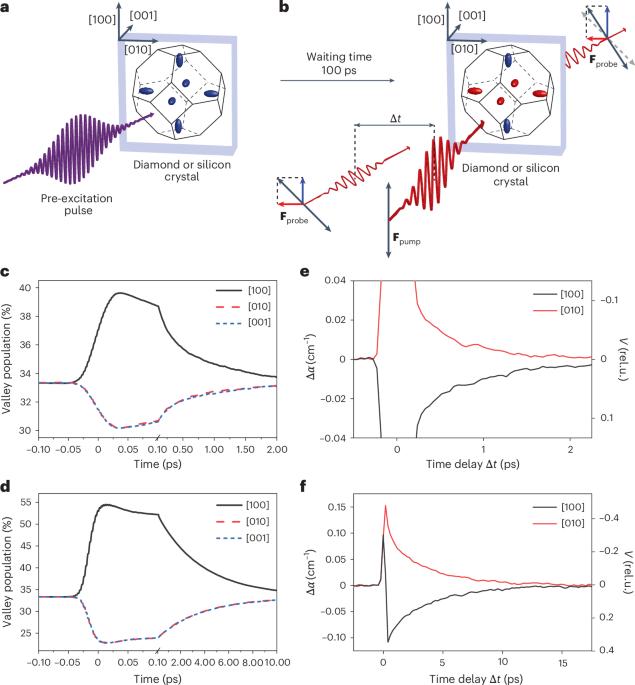
Some semiconductors have more than one degenerate minimum of the conduction band in their band structure. These minima—known as valleys—can be used for storing and processing information, if it is possible to generate a difference in their electron populations. However, to compete with conventional electronics, it is necessary to develop universal and fast methods for controlling and reading the valley quantum number of the electrons. Even though selective optical manipulation of electron populations in inequivalent valleys has been demonstrated in two-dimensional crystals with broken time-reversal symmetry, such control is highly desired in many technologically important semiconductor materials, including silicon and diamond. We demonstrate an ultrafast technique for the generation and read-out of a valley-polarized population of electrons in bulk semiconductors on subpicosecond timescales. The principle is based on the unidirectional intervalley scattering of electrons accelerated by an oscillating electric field of linearly polarized infrared femtosecond pulses. Our results are an advance in the development of potential room-temperature valleytronic devices operating at terahertz frequencies and compatible with contemporary silicon-based technology. Control over electron populations in different conduction band minima in semiconductors can be used to store and process information. Now the ultrafast optical manipulation of such electrons at room temperature has been demonstrated in silicon and diamond.
期刊介绍:
Nature Physics is dedicated to publishing top-tier original research in physics with a fair and rigorous review process. It provides high visibility and access to a broad readership, maintaining high standards in copy editing and production, ensuring rapid publication, and maintaining independence from academic societies and other vested interests.
The journal presents two main research paper formats: Letters and Articles. Alongside primary research, Nature Physics serves as a central source for valuable information within the physics community through Review Articles, News & Views, Research Highlights covering crucial developments across the physics literature, Commentaries, Book Reviews, and Correspondence.



 京公网安备 11010802042870号
京ICP备2023020795号-1
京公网安备 11010802042870号
京ICP备2023020795号-1

 分享
分享
 求助内容:
求助内容: 应助结果提醒方式:
 扫码关注我们
