Operational control strategy on optimal calcium removal in drinking water treatment processes: Insights from reactor experiments, modelling and particle characterization
Sergěj Y.M.H. Seepma , Janou A. Koskamp , Michel G. Colin , Eleftheria Chiou , Rubayat Sobhan , Tim F.J. Bögels , Tom Bastiaan , Hadi Zamanian , Eric T. Baars , Peter J. de Moel , Mariëtte Wolthers , Onno J.I. Kramer
{"title":"Operational control strategy on optimal calcium removal in drinking water treatment processes: Insights from reactor experiments, modelling and particle characterization","authors":"Sergěj Y.M.H. Seepma , Janou A. Koskamp , Michel G. Colin , Eleftheria Chiou , Rubayat Sobhan , Tim F.J. Bögels , Tom Bastiaan , Hadi Zamanian , Eric T. Baars , Peter J. de Moel , Mariëtte Wolthers , Onno J.I. Kramer","doi":"10.1016/j.watres.2025.123647","DOIUrl":null,"url":null,"abstract":"<div><div>Drinking water softening is an essential treatment step that provides multiple benefits, including public health, reduction of environmental impact, decrease in clogging potential and improvement in heating efficiency. With approximately 35 billion cubic meters of water being softened annually worldwide, the predominant methods are conventional lime/soda-ash softening, nanofiltration, ion exchange, and seeded crystallization through pellet-water softening. This study addresses the limitations in existing predictive models for calcium carbonate (CaCO<sub>3</sub>) precipitation kinetics in industrial-scale pellet-water softening by experimentally investigating the integral and multivariate effects of particle-, fluid-, water matrix- and reactor properties, on CaCO₃ precipitation kinetics. Fluid characterization experiments were conducted at lab-scale continuous-stirred tank reactors (CSTR), pilot-scale plug-flow reactors (PFR), and full-scale fluidized bed reactors (FBR) at the Waternet Weesperkarspel treatment plant in Amsterdam, The Netherlands. In parallel, solid characterization was performed with image analysis software on pellets and SEM on fines extracted from water samples, where both pellet and water samples were collected during FBR experiments. The calcium removal data obtained from experiments were compared with modeled CaCO<sub>3</sub> precipitation rates using and extending the most recently developed water softening model for pellet-water softening. The results predominantly highlight the critical role of mixing dynamics — between softening chemicals, hard influent water and seeding material — for accurate CaCO<sub>3</sub> precipitation predictions across various reactor types and other reactor-specific properties such as the residence time of influent hard water. Additional enhancements can be achieved by targeting fluid properties, followed by water matrix properties, and finally particle properties, though these factors exhibit a progressively smaller impact on overall water softening improvement. By implementing these prioritized optimization strategies, the operational control strategy for calcium removal will be enhanced, leading to improvements in cost-effectiveness, sustainability, and reliability in drinking water treatment processes.</div></div>","PeriodicalId":443,"journal":{"name":"Water Research","volume":"282 ","pages":"Article 123647"},"PeriodicalIF":12.4000,"publicationDate":"2025-08-15","publicationTypes":"Journal Article","fieldsOfStudy":null,"isOpenAccess":false,"openAccessPdf":"","citationCount":"0","resultStr":null,"platform":"Semanticscholar","paperid":null,"PeriodicalName":"Water Research","FirstCategoryId":"93","ListUrlMain":"https://www.sciencedirect.com/science/article/pii/S0043135425005573","RegionNum":1,"RegionCategory":"环境科学与生态学","ArticlePicture":[],"TitleCN":null,"AbstractTextCN":null,"PMCID":null,"EPubDate":"2025/4/13 0:00:00","PubModel":"Epub","JCR":"Q1","JCRName":"ENGINEERING, ENVIRONMENTAL","Score":null,"Total":0}
引用次数: 0
Abstract
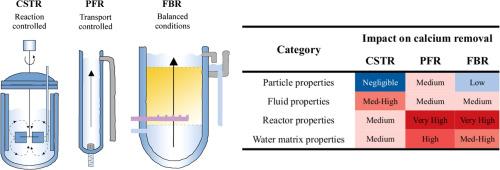
Drinking water softening is an essential treatment step that provides multiple benefits, including public health, reduction of environmental impact, decrease in clogging potential and improvement in heating efficiency. With approximately 35 billion cubic meters of water being softened annually worldwide, the predominant methods are conventional lime/soda-ash softening, nanofiltration, ion exchange, and seeded crystallization through pellet-water softening. This study addresses the limitations in existing predictive models for calcium carbonate (CaCO3) precipitation kinetics in industrial-scale pellet-water softening by experimentally investigating the integral and multivariate effects of particle-, fluid-, water matrix- and reactor properties, on CaCO₃ precipitation kinetics. Fluid characterization experiments were conducted at lab-scale continuous-stirred tank reactors (CSTR), pilot-scale plug-flow reactors (PFR), and full-scale fluidized bed reactors (FBR) at the Waternet Weesperkarspel treatment plant in Amsterdam, The Netherlands. In parallel, solid characterization was performed with image analysis software on pellets and SEM on fines extracted from water samples, where both pellet and water samples were collected during FBR experiments. The calcium removal data obtained from experiments were compared with modeled CaCO3 precipitation rates using and extending the most recently developed water softening model for pellet-water softening. The results predominantly highlight the critical role of mixing dynamics — between softening chemicals, hard influent water and seeding material — for accurate CaCO3 precipitation predictions across various reactor types and other reactor-specific properties such as the residence time of influent hard water. Additional enhancements can be achieved by targeting fluid properties, followed by water matrix properties, and finally particle properties, though these factors exhibit a progressively smaller impact on overall water softening improvement. By implementing these prioritized optimization strategies, the operational control strategy for calcium removal will be enhanced, leading to improvements in cost-effectiveness, sustainability, and reliability in drinking water treatment processes.
期刊介绍:
Water Research, along with its open access companion journal Water Research X, serves as a platform for publishing original research papers covering various aspects of the science and technology related to the anthropogenic water cycle, water quality, and its management worldwide. The audience targeted by the journal comprises biologists, chemical engineers, chemists, civil engineers, environmental engineers, limnologists, and microbiologists. The scope of the journal include:
•Treatment processes for water and wastewaters (municipal, agricultural, industrial, and on-site treatment), including resource recovery and residuals management;
•Urban hydrology including sewer systems, stormwater management, and green infrastructure;
•Drinking water treatment and distribution;
•Potable and non-potable water reuse;
•Sanitation, public health, and risk assessment;
•Anaerobic digestion, solid and hazardous waste management, including source characterization and the effects and control of leachates and gaseous emissions;
•Contaminants (chemical, microbial, anthropogenic particles such as nanoparticles or microplastics) and related water quality sensing, monitoring, fate, and assessment;
•Anthropogenic impacts on inland, tidal, coastal and urban waters, focusing on surface and ground waters, and point and non-point sources of pollution;
•Environmental restoration, linked to surface water, groundwater and groundwater remediation;
•Analysis of the interfaces between sediments and water, and between water and atmosphere, focusing specifically on anthropogenic impacts;
•Mathematical modelling, systems analysis, machine learning, and beneficial use of big data related to the anthropogenic water cycle;
•Socio-economic, policy, and regulations studies.




 京公网安备 11010802042870号
京ICP备2023020795号-1
京公网安备 11010802042870号
京ICP备2023020795号-1

 分享
分享
 求助内容:
求助内容: 应助结果提醒方式:
 扫码关注我们
