Sarah K. Yorke, Zhenze Yang, Elizabeth G. Wiita, Ayaka Kamada, Tuomas P. J. Knowles, Markus J. Buehler
{"title":"Design and sustainability of polypeptide material systems","authors":"Sarah K. Yorke, Zhenze Yang, Elizabeth G. Wiita, Ayaka Kamada, Tuomas P. J. Knowles, Markus J. Buehler","doi":"10.1038/s41578-025-00793-3","DOIUrl":null,"url":null,"abstract":"Some of the highest-performance materials in nature, including spider silk and collagen, are formed through protein self-assembly. These natural materials, which combine function, performance and assembly under mild aqueous conditions, have inspired a generation of technologically useful biomaterials that use natural proteins as the molecular building blocks. The shift from oil-based feedstocks towards renewable materials has accelerated the search for plastic replacements and has stimulated work in the two major classes of abundant natural polymers, proteins and polysaccharides. Whereas polysaccharides are already used in areas from packaging to structural applications, the unique properties of proteins have not yet been fully harnessed for renewable materials. Advances over the past 15 years have highlighted the promise of protein systems for high-performance applications, enabled by a fundamental understanding of polypeptide self-assembly, emerging computational methods such as artificial intelligence, feedstocks, and materials processing. In this Review, we highlight developments in this area and provide a perspective on the potential of this important class of molecules in both fundamental materials science and sustainability. Protein-based materials, formed through self-assembly, are gaining traction as technologically useful biomaterials. This Review surveys the design, assembly, mechanical properties, sourcing and processing of polypeptide materials, with a focus on their application as sustainable plastic alternatives.","PeriodicalId":19081,"journal":{"name":"Nature Reviews Materials","volume":"10 10","pages":"750-768"},"PeriodicalIF":86.2000,"publicationDate":"2025-04-14","publicationTypes":"Journal Article","fieldsOfStudy":null,"isOpenAccess":false,"openAccessPdf":"","citationCount":"0","resultStr":null,"platform":"Semanticscholar","paperid":null,"PeriodicalName":"Nature Reviews Materials","FirstCategoryId":"88","ListUrlMain":"https://www.nature.com/articles/s41578-025-00793-3","RegionNum":1,"RegionCategory":"材料科学","ArticlePicture":[],"TitleCN":null,"AbstractTextCN":null,"PMCID":null,"EPubDate":"","PubModel":"","JCR":"Q1","JCRName":"MATERIALS SCIENCE, MULTIDISCIPLINARY","Score":null,"Total":0}
引用次数: 0
Abstract
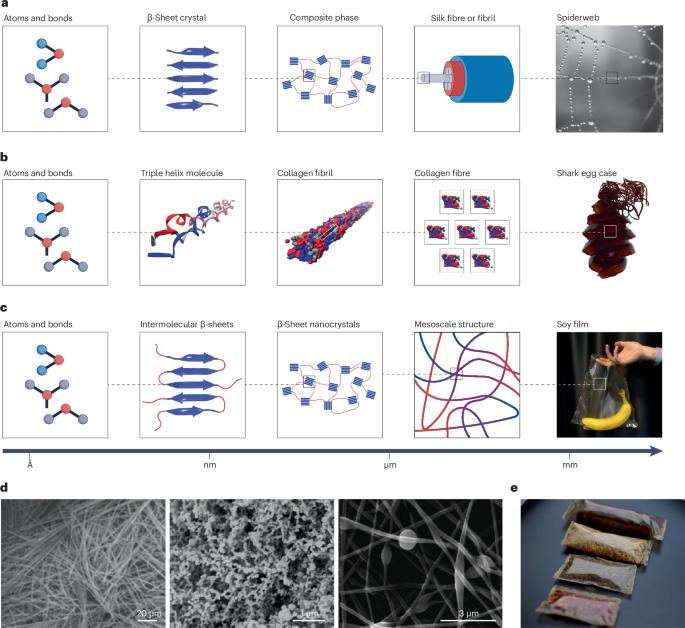
Some of the highest-performance materials in nature, including spider silk and collagen, are formed through protein self-assembly. These natural materials, which combine function, performance and assembly under mild aqueous conditions, have inspired a generation of technologically useful biomaterials that use natural proteins as the molecular building blocks. The shift from oil-based feedstocks towards renewable materials has accelerated the search for plastic replacements and has stimulated work in the two major classes of abundant natural polymers, proteins and polysaccharides. Whereas polysaccharides are already used in areas from packaging to structural applications, the unique properties of proteins have not yet been fully harnessed for renewable materials. Advances over the past 15 years have highlighted the promise of protein systems for high-performance applications, enabled by a fundamental understanding of polypeptide self-assembly, emerging computational methods such as artificial intelligence, feedstocks, and materials processing. In this Review, we highlight developments in this area and provide a perspective on the potential of this important class of molecules in both fundamental materials science and sustainability. Protein-based materials, formed through self-assembly, are gaining traction as technologically useful biomaterials. This Review surveys the design, assembly, mechanical properties, sourcing and processing of polypeptide materials, with a focus on their application as sustainable plastic alternatives.
期刊介绍:
Nature Reviews Materials is an online-only journal that is published weekly. It covers a wide range of scientific disciplines within materials science. The journal includes Reviews, Perspectives, and Comments.
Nature Reviews Materials focuses on various aspects of materials science, including the making, measuring, modelling, and manufacturing of materials. It examines the entire process of materials science, from laboratory discovery to the development of functional devices.






 京公网安备 11010802042870号
京ICP备2023020795号-1
京公网安备 11010802042870号
京ICP备2023020795号-1

 分享
分享
 求助内容:
求助内容: 应助结果提醒方式:
 扫码关注我们
