Basma A. Omran, M. O. Abdel-Salam, Hebatullah H. Farghal, Mayyada M. H. El-Sayed and Kwang-Hyun Baek
{"title":"Synthesis of TiO2–CuO@graphene oxide hybrid bionanocomposite with enhanced antibacterial and organic dye degradation activities†","authors":"Basma A. Omran, M. O. Abdel-Salam, Hebatullah H. Farghal, Mayyada M. H. El-Sayed and Kwang-Hyun Baek","doi":"10.1039/D5MA00031A","DOIUrl":null,"url":null,"abstract":"<p >The cumulative spread of infectious diseases and water pollution necessitates the development of innovative green materials. To address this challenge, titanium oxide (TiO<small><sub>2</sub></small>) and copper oxide (CuO) nanoparticles (NPs) were mycofabricated using <em>Trichoderma virens</em> filtrate, which was grafted with graphene oxide (GO) nanosheets prepared <em>via</em> the modified Tour's method, resulting in a TiO<small><sub>2</sub></small>–CuO@GO bionanocomposite. XRD revealed peaks corresponding to hexagonal carbon, rutile tetragonal TiO<small><sub>2</sub></small>, and tenorite monoclinic CuO in the TiO<small><sub>2</sub></small>–CuO@GO, having average crystallite sizes of 10.65 and 25.73 nm for GO and TiO<small><sub>2</sub></small>–CuO@GO, respectively. FTIR revealed distinct absorption bands corresponding to oxygen-containing functional groups such as –OH, C<img>O, C<img>C, and C–OH. EDX spectra confirmed homogenous elemental distributions of Ti 2p, Cu 2p, O 1s, and C 1s in the bionanocomposite. The zeta potential values and hydrodynamic sizes were −36.8 mV and 291.1 nm for GO and +25.6 mV and 603.2 nm for TiO<small><sub>2</sub></small>–CuO@GO, respectively. FE-SEM and HRTEM revealed that GO displayed a transparent, flaky structure with few wrinkles, whereas TiO<small><sub>2</sub></small>–CuO@GO displayed opaque, rounded TiO<small><sub>2</sub></small> NPs and elongated, rod-shaped CuO NPs loaded onto GO. The bionanocomposite exhibited potent antibacterial activity against various foodborne and phytobacterial pathogens. TiO<small><sub>2</sub></small>–CuO@GO was evaluated as a nanocatalyst for the degradation of Congo red at initial concentrations ranging from 10 to 50 mg L<small><sup>−1</sup></small>. Upon activation with peroxymonosulfate, the material demonstrated a degradation efficiency of 70% within 28 min. Enhanced dye removal under saline conditions indicated the improved efficiency of the nanocatalyst. This study highlights the multidisciplinary potential of TiO<small><sub>2</sub></small>–CuO@GO for applications in food packaging, agriculture, and wastewater treatment.</p>","PeriodicalId":18242,"journal":{"name":"Materials Advances","volume":" 8","pages":" 2654-2676"},"PeriodicalIF":4.7000,"publicationDate":"2025-03-31","publicationTypes":"Journal Article","fieldsOfStudy":null,"isOpenAccess":false,"openAccessPdf":"https://pubs.rsc.org/en/content/articlepdf/2025/ma/d5ma00031a?page=search","citationCount":"0","resultStr":null,"platform":"Semanticscholar","paperid":null,"PeriodicalName":"Materials Advances","FirstCategoryId":"1085","ListUrlMain":"https://pubs.rsc.org/en/content/articlelanding/2025/ma/d5ma00031a","RegionNum":0,"RegionCategory":null,"ArticlePicture":[],"TitleCN":null,"AbstractTextCN":null,"PMCID":null,"EPubDate":"","PubModel":"","JCR":"Q2","JCRName":"MATERIALS SCIENCE, MULTIDISCIPLINARY","Score":null,"Total":0}
引用次数: 0
Abstract
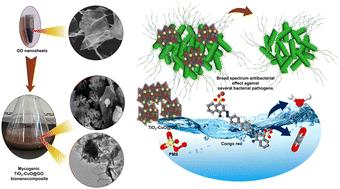
The cumulative spread of infectious diseases and water pollution necessitates the development of innovative green materials. To address this challenge, titanium oxide (TiO2) and copper oxide (CuO) nanoparticles (NPs) were mycofabricated using Trichoderma virens filtrate, which was grafted with graphene oxide (GO) nanosheets prepared via the modified Tour's method, resulting in a TiO2–CuO@GO bionanocomposite. XRD revealed peaks corresponding to hexagonal carbon, rutile tetragonal TiO2, and tenorite monoclinic CuO in the TiO2–CuO@GO, having average crystallite sizes of 10.65 and 25.73 nm for GO and TiO2–CuO@GO, respectively. FTIR revealed distinct absorption bands corresponding to oxygen-containing functional groups such as –OH, CO, CC, and C–OH. EDX spectra confirmed homogenous elemental distributions of Ti 2p, Cu 2p, O 1s, and C 1s in the bionanocomposite. The zeta potential values and hydrodynamic sizes were −36.8 mV and 291.1 nm for GO and +25.6 mV and 603.2 nm for TiO2–CuO@GO, respectively. FE-SEM and HRTEM revealed that GO displayed a transparent, flaky structure with few wrinkles, whereas TiO2–CuO@GO displayed opaque, rounded TiO2 NPs and elongated, rod-shaped CuO NPs loaded onto GO. The bionanocomposite exhibited potent antibacterial activity against various foodborne and phytobacterial pathogens. TiO2–CuO@GO was evaluated as a nanocatalyst for the degradation of Congo red at initial concentrations ranging from 10 to 50 mg L−1. Upon activation with peroxymonosulfate, the material demonstrated a degradation efficiency of 70% within 28 min. Enhanced dye removal under saline conditions indicated the improved efficiency of the nanocatalyst. This study highlights the multidisciplinary potential of TiO2–CuO@GO for applications in food packaging, agriculture, and wastewater treatment.





 京公网安备 11010802042870号
京ICP备2023020795号-1
京公网安备 11010802042870号
京ICP备2023020795号-1

 分享
分享
 求助内容:
求助内容: 应助结果提醒方式:
 扫码关注我们
