Yanbo Peng, Yuhong Zhao, Ying Yuan, Wei Meng, Wenhe Jiang and Xiluan Wang
{"title":"High-response humidity sensing with graphene oxide/lignosulfonate and laser-induced graphene for respiratory health†","authors":"Yanbo Peng, Yuhong Zhao, Ying Yuan, Wei Meng, Wenhe Jiang and Xiluan Wang","doi":"10.1039/D5RA01765C","DOIUrl":null,"url":null,"abstract":"<p >Most current commercial humidity sensors rely on precious metals and chemicals. In this study, alkali lignin produced in the paper industry was utilized to form a film with hydroxyethyl cellulose to generate laser-induced graphene (LIG) as an electrode material for a sensor by the laser-induction technique. LIG exhibits excellent conductivity, and the experimental results demonstrate that its resistivity can be adjusted by laser power without the necessity for additional conductive materials. A solution comprising a blend of graphene oxide and sodium lignosulfonate was introduced to the LIG surface in a dropwise manner, thereby establishing a sensing surface. This process resulted in the introduction of hydrophilic groups, including carboxyl, phenolic hydroxyl, and sulfonic acid. The integration of these hydrophilic groups enhanced the surface's sensitivity to humidity, thereby facilitating the precise capture of alterations in ambient air humidity. The humidity sensor, which employs alkali lignin and lignin laser-induced graphene as electrodes and graphene oxide (GO) as the humidity-sensitive layer, exhibits an exceptionally high degree of sensitivity to humidity. The response reached 42.74 (<em>R</em><small><sub>RH</sub></small>/<em>R</em><small><sub>0</sub></small>) at 80% relative humidity and 133.96 (<em>R</em><small><sub>RH</sub></small>/<em>R</em><small><sub>0</sub></small>) at 90% humidity with a sensitivity of 147.73%/% RH. Moreover, the sensor displays an impressively brief recovery period, which remains unaltered even after multiple cycles. Additionally, the humidity sensor exhibits excellent stability for a period of up to 30 days. This study has successfully developed a simple and efficient method for preparing graphene, and has produced a flexible resistive sensor with high sensitivity, repeatability, and stability, thereby opening up new avenues for the high-value utilisation of lignin.</p>","PeriodicalId":102,"journal":{"name":"RSC Advances","volume":" 15","pages":" 11739-11748"},"PeriodicalIF":4.6000,"publicationDate":"2025-04-15","publicationTypes":"Journal Article","fieldsOfStudy":null,"isOpenAccess":false,"openAccessPdf":"https://pubs.rsc.org/en/content/articlepdf/2025/ra/d5ra01765c?page=search","citationCount":"0","resultStr":null,"platform":"Semanticscholar","paperid":null,"PeriodicalName":"RSC Advances","FirstCategoryId":"92","ListUrlMain":"https://pubs.rsc.org/en/content/articlelanding/2025/ra/d5ra01765c","RegionNum":3,"RegionCategory":"化学","ArticlePicture":[],"TitleCN":null,"AbstractTextCN":null,"PMCID":null,"EPubDate":"","PubModel":"","JCR":"Q2","JCRName":"CHEMISTRY, MULTIDISCIPLINARY","Score":null,"Total":0}
引用次数: 0
Abstract
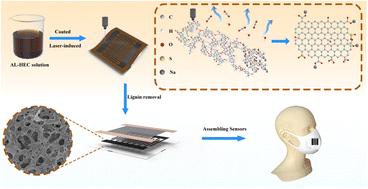
Most current commercial humidity sensors rely on precious metals and chemicals. In this study, alkali lignin produced in the paper industry was utilized to form a film with hydroxyethyl cellulose to generate laser-induced graphene (LIG) as an electrode material for a sensor by the laser-induction technique. LIG exhibits excellent conductivity, and the experimental results demonstrate that its resistivity can be adjusted by laser power without the necessity for additional conductive materials. A solution comprising a blend of graphene oxide and sodium lignosulfonate was introduced to the LIG surface in a dropwise manner, thereby establishing a sensing surface. This process resulted in the introduction of hydrophilic groups, including carboxyl, phenolic hydroxyl, and sulfonic acid. The integration of these hydrophilic groups enhanced the surface's sensitivity to humidity, thereby facilitating the precise capture of alterations in ambient air humidity. The humidity sensor, which employs alkali lignin and lignin laser-induced graphene as electrodes and graphene oxide (GO) as the humidity-sensitive layer, exhibits an exceptionally high degree of sensitivity to humidity. The response reached 42.74 (RRH/R0) at 80% relative humidity and 133.96 (RRH/R0) at 90% humidity with a sensitivity of 147.73%/% RH. Moreover, the sensor displays an impressively brief recovery period, which remains unaltered even after multiple cycles. Additionally, the humidity sensor exhibits excellent stability for a period of up to 30 days. This study has successfully developed a simple and efficient method for preparing graphene, and has produced a flexible resistive sensor with high sensitivity, repeatability, and stability, thereby opening up new avenues for the high-value utilisation of lignin.
期刊介绍:
An international, peer-reviewed journal covering all of the chemical sciences, including multidisciplinary and emerging areas. RSC Advances is a gold open access journal allowing researchers free access to research articles, and offering an affordable open access publishing option for authors around the world.




 京公网安备 11010802042870号
京ICP备2023020795号-1
京公网安备 11010802042870号
京ICP备2023020795号-1

 分享
分享
 求助内容:
求助内容: 应助结果提醒方式:
 扫码关注我们
