{"title":"Field-programmable photonic nonlinearity","authors":"Tianwei Wu, Yankun Li, Li Ge, Liang Feng","doi":"10.1038/s41566-025-01660-x","DOIUrl":null,"url":null,"abstract":"Propelled by advancements in artificial intelligence, the demand for field-programmable devices has grown rapidly in the last decade. Among various state-of-the-art platforms, programmable integrated photonics emerges as a promising candidate, offering a new strategy to drastically enhance computational power for data-intensive tasks. However, intrinsic weak nonlinear responses of dielectric materials have limited traditional photonic programmability to the linear domain, leaving out the most common and complex activation functions used in artificial intelligence. Here we push the capabilities of photonic field-programmability into the nonlinear realm by meticulous spatial control of distributed carrier excitations and their dynamics within an active semiconductor. Leveraging the architecture of photonic nonlinear computing through polynomial building blocks, our field-programmable photonic nonlinear microprocessor demonstrates in situ training of photonic polynomial networks with dynamically reconfigured nonlinear connections. Our results offer a new paradigm to revolutionize photonic reconfigurable computing, enabling the handling of intricate tasks using a polynomial network with unparalleled simplicity and efficiency. Field-programmable photonic nonlinearity is realized by controlling the spatial distribution of carrier excitations and their dynamic behaviour within an active semiconductor, advancing photonic computing and its integration with reconfigurable computing architectures.","PeriodicalId":18926,"journal":{"name":"Nature Photonics","volume":"19 7","pages":"725-732"},"PeriodicalIF":32.9000,"publicationDate":"2025-04-15","publicationTypes":"Journal Article","fieldsOfStudy":null,"isOpenAccess":false,"openAccessPdf":"","citationCount":"0","resultStr":null,"platform":"Semanticscholar","paperid":null,"PeriodicalName":"Nature Photonics","FirstCategoryId":"101","ListUrlMain":"https://www.nature.com/articles/s41566-025-01660-x","RegionNum":1,"RegionCategory":"物理与天体物理","ArticlePicture":[],"TitleCN":null,"AbstractTextCN":null,"PMCID":null,"EPubDate":"","PubModel":"","JCR":"Q1","JCRName":"OPTICS","Score":null,"Total":0}
引用次数: 0
Abstract
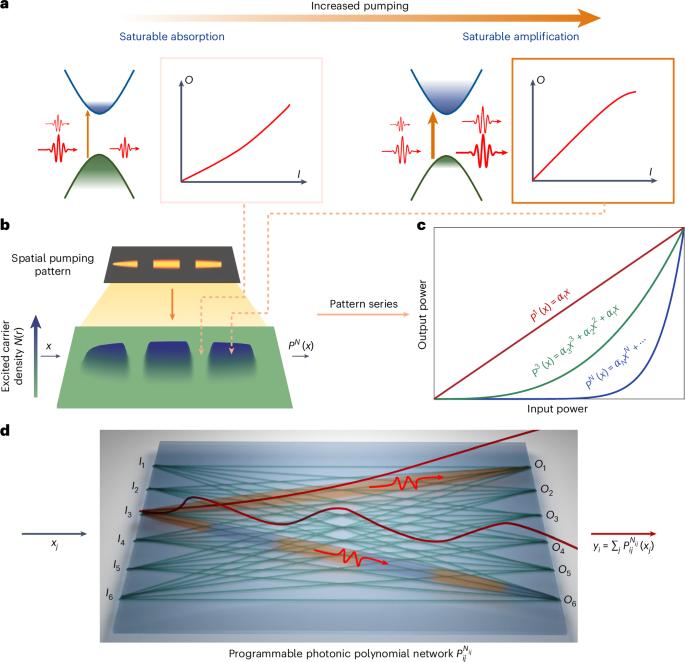
Propelled by advancements in artificial intelligence, the demand for field-programmable devices has grown rapidly in the last decade. Among various state-of-the-art platforms, programmable integrated photonics emerges as a promising candidate, offering a new strategy to drastically enhance computational power for data-intensive tasks. However, intrinsic weak nonlinear responses of dielectric materials have limited traditional photonic programmability to the linear domain, leaving out the most common and complex activation functions used in artificial intelligence. Here we push the capabilities of photonic field-programmability into the nonlinear realm by meticulous spatial control of distributed carrier excitations and their dynamics within an active semiconductor. Leveraging the architecture of photonic nonlinear computing through polynomial building blocks, our field-programmable photonic nonlinear microprocessor demonstrates in situ training of photonic polynomial networks with dynamically reconfigured nonlinear connections. Our results offer a new paradigm to revolutionize photonic reconfigurable computing, enabling the handling of intricate tasks using a polynomial network with unparalleled simplicity and efficiency. Field-programmable photonic nonlinearity is realized by controlling the spatial distribution of carrier excitations and their dynamic behaviour within an active semiconductor, advancing photonic computing and its integration with reconfigurable computing architectures.
期刊介绍:
Nature Photonics is a monthly journal dedicated to the scientific study and application of light, known as Photonics. It publishes top-quality, peer-reviewed research across all areas of light generation, manipulation, and detection.
The journal encompasses research into the fundamental properties of light and its interactions with matter, as well as the latest developments in optoelectronic devices and emerging photonics applications. Topics covered include lasers, LEDs, imaging, detectors, optoelectronic devices, quantum optics, biophotonics, optical data storage, spectroscopy, fiber optics, solar energy, displays, terahertz technology, nonlinear optics, plasmonics, nanophotonics, and X-rays.
In addition to research papers and review articles summarizing scientific findings in optoelectronics, Nature Photonics also features News and Views pieces and research highlights. It uniquely includes articles on the business aspects of the industry, such as technology commercialization and market analysis, offering a comprehensive perspective on the field.




 京公网安备 11010802042870号
京ICP备2023020795号-1
京公网安备 11010802042870号
京ICP备2023020795号-1

 分享
分享
 求助内容:
求助内容: 应助结果提醒方式:
 扫码关注我们
