Degradation and detoxification of neonicotinoid insecticides by a porous oxygen vacancy-rich BiOCl self-recovery system: Active site transfer enhances oxygen vacancies stability
Runren Jiang , Yuhao Ji , Min Wang , Yufang Chen , Xindi Wang , Guanghua Lu
{"title":"Degradation and detoxification of neonicotinoid insecticides by a porous oxygen vacancy-rich BiOCl self-recovery system: Active site transfer enhances oxygen vacancies stability","authors":"Runren Jiang , Yuhao Ji , Min Wang , Yufang Chen , Xindi Wang , Guanghua Lu","doi":"10.1016/j.watres.2025.123651","DOIUrl":null,"url":null,"abstract":"<div><div>The development of efficient photocatalytic methods for the degradation of neonicotinoid insecticide contamination and the reduction of its toxicity presents significant challenges. Although oxygen vacancies can enhance catalytic performance, they often destabilize the catalyst. In this study, we constructed a self-recovering porous BiOCl with oxygen vacancies (POv-BOCs), which forms an in-lattice electron donor-acceptor system under visible light. In this system, the donor lattice oxygen donates electrons to generate oxygen, while the acceptor lattice Bi accepts these electrons to produce metallic Bi<sup>0</sup>. The released oxygen is captured by Bi<sup>0</sup>, which replace the oxygen vacancies as active sites, thereby endowing POv-BOCs with enhanced stability. The electrophilic characteristics of POv-BOCs significantly improve the degradation performance of neonicotinoid insecticides, and the degradation rate exhibited a positive correlation with their electronic affinity value. Although some nitrated byproducts formed during the degradation process initially increased toxicity, the persistent action of POv-BOCs ultimately induced toxicity reduction. This work presents an effective approach to enhancing the stability and photocatalytic performance of oxygen vacancies, which are highly significant for developing of oxygen vacancy catalytic systems and the degradation of electron-deficient pollutants.</div></div>","PeriodicalId":443,"journal":{"name":"Water Research","volume":"282 ","pages":"Article 123651"},"PeriodicalIF":12.4000,"publicationDate":"2025-08-15","publicationTypes":"Journal Article","fieldsOfStudy":null,"isOpenAccess":false,"openAccessPdf":"","citationCount":"0","resultStr":null,"platform":"Semanticscholar","paperid":null,"PeriodicalName":"Water Research","FirstCategoryId":"93","ListUrlMain":"https://www.sciencedirect.com/science/article/pii/S0043135425005615","RegionNum":1,"RegionCategory":"环境科学与生态学","ArticlePicture":[],"TitleCN":null,"AbstractTextCN":null,"PMCID":null,"EPubDate":"2025/4/15 0:00:00","PubModel":"Epub","JCR":"Q1","JCRName":"ENGINEERING, ENVIRONMENTAL","Score":null,"Total":0}
引用次数: 0
Abstract
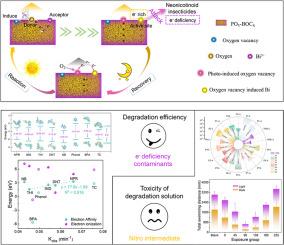
The development of efficient photocatalytic methods for the degradation of neonicotinoid insecticide contamination and the reduction of its toxicity presents significant challenges. Although oxygen vacancies can enhance catalytic performance, they often destabilize the catalyst. In this study, we constructed a self-recovering porous BiOCl with oxygen vacancies (POv-BOCs), which forms an in-lattice electron donor-acceptor system under visible light. In this system, the donor lattice oxygen donates electrons to generate oxygen, while the acceptor lattice Bi accepts these electrons to produce metallic Bi0. The released oxygen is captured by Bi0, which replace the oxygen vacancies as active sites, thereby endowing POv-BOCs with enhanced stability. The electrophilic characteristics of POv-BOCs significantly improve the degradation performance of neonicotinoid insecticides, and the degradation rate exhibited a positive correlation with their electronic affinity value. Although some nitrated byproducts formed during the degradation process initially increased toxicity, the persistent action of POv-BOCs ultimately induced toxicity reduction. This work presents an effective approach to enhancing the stability and photocatalytic performance of oxygen vacancies, which are highly significant for developing of oxygen vacancy catalytic systems and the degradation of electron-deficient pollutants.
期刊介绍:
Water Research, along with its open access companion journal Water Research X, serves as a platform for publishing original research papers covering various aspects of the science and technology related to the anthropogenic water cycle, water quality, and its management worldwide. The audience targeted by the journal comprises biologists, chemical engineers, chemists, civil engineers, environmental engineers, limnologists, and microbiologists. The scope of the journal include:
•Treatment processes for water and wastewaters (municipal, agricultural, industrial, and on-site treatment), including resource recovery and residuals management;
•Urban hydrology including sewer systems, stormwater management, and green infrastructure;
•Drinking water treatment and distribution;
•Potable and non-potable water reuse;
•Sanitation, public health, and risk assessment;
•Anaerobic digestion, solid and hazardous waste management, including source characterization and the effects and control of leachates and gaseous emissions;
•Contaminants (chemical, microbial, anthropogenic particles such as nanoparticles or microplastics) and related water quality sensing, monitoring, fate, and assessment;
•Anthropogenic impacts on inland, tidal, coastal and urban waters, focusing on surface and ground waters, and point and non-point sources of pollution;
•Environmental restoration, linked to surface water, groundwater and groundwater remediation;
•Analysis of the interfaces between sediments and water, and between water and atmosphere, focusing specifically on anthropogenic impacts;
•Mathematical modelling, systems analysis, machine learning, and beneficial use of big data related to the anthropogenic water cycle;
•Socio-economic, policy, and regulations studies.




 京公网安备 11010802042870号
京ICP备2023020795号-1
京公网安备 11010802042870号
京ICP备2023020795号-1

 分享
分享
 求助内容:
求助内容: 应助结果提醒方式:
 扫码关注我们
