Enhanced electrocatalytic properties of plasma-treated MoS2-NiO-PVA nanofibers for hydrogen evolution reaction: A study of surface modifications and charge transfer kinetics
{"title":"Enhanced electrocatalytic properties of plasma-treated MoS2-NiO-PVA nanofibers for hydrogen evolution reaction: A study of surface modifications and charge transfer kinetics","authors":"Hamed Fayaz Rouhi , Fatemeh Aghaei , Farhad Chaharganeh Kalangestani , Hossein Mahmoudi Chenari , Maryam Nilkar","doi":"10.1016/j.apsusc.2025.163274","DOIUrl":null,"url":null,"abstract":"<div><div>In this study, we report the synthesis and characterization of MoS<sub>2</sub>-PVA and MoS<sub>2</sub>-NiO-PVA composite nanofibers, focusing on their structural, chemical, and electrocatalytic properties before and after plasma treatment. X-ray diffraction (XRD) results verify that the incorporation of NiO nanoparticles into MoS<sub>2</sub>-PVA further enhances the crystallinity of the composite, as evidenced by the XRD patterns. Fourier-transform infrared (FTIR) spectroscopy reveals characteristic vibrations of hydroxyl, carbonyl, Mo-S, Mo-O, and Ni-O bonds, providing strong evidence of chemical interactions between MoS<sub>2</sub>, PVA, and NiO. X-ray photoelectron spectroscopy (XPS) analysis indicates the successful formation of MoS<sub>2</sub>-NiO-PVA nanofibers, with significant interactions between MoS<sub>2</sub> and NiO, enhancing electron transport properties. Scanning electron microscopy (FE-SEM) analysis shows that plasma treatment leads to significant morphological changes, including surface roughening and reduced fiber thickness. Water contact angle measurements demonstrate that plasma treatment improves the hydrophilicity of the nanofibers, facilitating better electrolyte interaction and increasing their electrocatalytic performance. The HER efficiency of MoS<sub>2</sub>-PVA and MoS<sub>2</sub>-NiO-PVA nanofibers was enhanced through plasma treatment, resulting in a lower overpotential (213 mV) and Tafel slope (135 mV/dec) for MoS<sub>2</sub>-NiO-PVA. The increase in capacitance (2.92 mF/cm<sup>2</sup>) and reduction in charge transfer resistance (<em>R<sub>ct</sub></em>) confirmed improved electrocatalytic activity. The electrocatalyst demonstrated excellent stability, maintaining 92 % of its initial performance after 12 h of continuous operation, as evidenced by cyclic voltammetry at 50 mV/s and a stable potential at 1.5 mA/cm<sup>2</sup>.These enhancements highlight plasma treatment as an effective strategy for optimizing HER kinetics in electrocatalysts. These improvements result from enhanced surface area, hydrophilicity, and accessibility of active sites, making plasma-treated nanofibers promising for energy applications.</div></div>","PeriodicalId":247,"journal":{"name":"Applied Surface Science","volume":"700 ","pages":"Article 163274"},"PeriodicalIF":6.9000,"publicationDate":"2025-08-15","publicationTypes":"Journal Article","fieldsOfStudy":null,"isOpenAccess":false,"openAccessPdf":"","citationCount":"0","resultStr":null,"platform":"Semanticscholar","paperid":null,"PeriodicalName":"Applied Surface Science","FirstCategoryId":"88","ListUrlMain":"https://www.sciencedirect.com/science/article/pii/S0169433225009882","RegionNum":2,"RegionCategory":"材料科学","ArticlePicture":[],"TitleCN":null,"AbstractTextCN":null,"PMCID":null,"EPubDate":"2025/4/14 0:00:00","PubModel":"Epub","JCR":"Q2","JCRName":"CHEMISTRY, PHYSICAL","Score":null,"Total":0}
引用次数: 0
Abstract
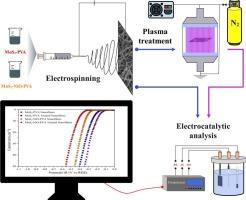
In this study, we report the synthesis and characterization of MoS2-PVA and MoS2-NiO-PVA composite nanofibers, focusing on their structural, chemical, and electrocatalytic properties before and after plasma treatment. X-ray diffraction (XRD) results verify that the incorporation of NiO nanoparticles into MoS2-PVA further enhances the crystallinity of the composite, as evidenced by the XRD patterns. Fourier-transform infrared (FTIR) spectroscopy reveals characteristic vibrations of hydroxyl, carbonyl, Mo-S, Mo-O, and Ni-O bonds, providing strong evidence of chemical interactions between MoS2, PVA, and NiO. X-ray photoelectron spectroscopy (XPS) analysis indicates the successful formation of MoS2-NiO-PVA nanofibers, with significant interactions between MoS2 and NiO, enhancing electron transport properties. Scanning electron microscopy (FE-SEM) analysis shows that plasma treatment leads to significant morphological changes, including surface roughening and reduced fiber thickness. Water contact angle measurements demonstrate that plasma treatment improves the hydrophilicity of the nanofibers, facilitating better electrolyte interaction and increasing their electrocatalytic performance. The HER efficiency of MoS2-PVA and MoS2-NiO-PVA nanofibers was enhanced through plasma treatment, resulting in a lower overpotential (213 mV) and Tafel slope (135 mV/dec) for MoS2-NiO-PVA. The increase in capacitance (2.92 mF/cm2) and reduction in charge transfer resistance (Rct) confirmed improved electrocatalytic activity. The electrocatalyst demonstrated excellent stability, maintaining 92 % of its initial performance after 12 h of continuous operation, as evidenced by cyclic voltammetry at 50 mV/s and a stable potential at 1.5 mA/cm2.These enhancements highlight plasma treatment as an effective strategy for optimizing HER kinetics in electrocatalysts. These improvements result from enhanced surface area, hydrophilicity, and accessibility of active sites, making plasma-treated nanofibers promising for energy applications.
期刊介绍:
Applied Surface Science covers topics contributing to a better understanding of surfaces, interfaces, nanostructures and their applications. The journal is concerned with scientific research on the atomic and molecular level of material properties determined with specific surface analytical techniques and/or computational methods, as well as the processing of such structures.




 京公网安备 11010802042870号
京ICP备2023020795号-1
京公网安备 11010802042870号
京ICP备2023020795号-1

 分享
分享
 求助内容:
求助内容: 应助结果提醒方式:
 扫码关注我们
