Xin Hu , Ahmed Tlili , Kristin Schirmer , Mutai Bao , Helmut Bürgmann
{"title":"Metal concentration in freshwater sediments is linked to microbial biodiversity and community composition","authors":"Xin Hu , Ahmed Tlili , Kristin Schirmer , Mutai Bao , Helmut Bürgmann","doi":"10.1016/j.envint.2025.109465","DOIUrl":null,"url":null,"abstract":"<div><div>The effect of metals on freshwater microbiomes is poorly understood compared to other factors, such as nutrients or climate. While deleterious effects of metals on plant and animal biodiversity are well documented, the role of metals in shaping the biodiversity, composition and functional potential of sediment microbial communities remains unknown. Therefore, we explored if metal concentrations can be linked to alterations in biodiversity and composition of freshwater sediment microbial communities. We collected sediments from 34 streams and lakes in Switzerland and grouped them based on their metal content. Microbial diversity and community composition were determined using 16S rRNA gene amplicon sequencing. Most of the sediments were not contaminated with metals according to Sediment Environmental Quality Criteria, although some stations exceeded the limits for Cu, Zn, and Pb. Nevertheless, correlational analysis indicated links of metal concentrations to various aspects of sediment microbial biodiversity. Al concentrations were significantly (<em>p</em> < 0.05) correlated with microbial richness. We further observed a predominantly negative correlation between some metals and abundances of dominant taxa. Predicted microbial functional potential analysis indicated that different types of metals have different effects on microbial functional potential. For example, Mn exhibited a significant positive correlation with nitrogen fixation potential, whereas Cu, Pb, and Zn displayed a significant negative correlation. Overall, our findings indicate that metal concentrations may alter microbial community diversity and functional potential in freshwater sediments even at ambient concentrations. Further research into the role of metals as drivers of microbial biodiversity and factors in biodiversity loss is warranted.</div></div>","PeriodicalId":308,"journal":{"name":"Environment International","volume":"199 ","pages":"Article 109465"},"PeriodicalIF":9.7000,"publicationDate":"2025-05-01","publicationTypes":"Journal Article","fieldsOfStudy":null,"isOpenAccess":false,"openAccessPdf":"","citationCount":"0","resultStr":null,"platform":"Semanticscholar","paperid":null,"PeriodicalName":"Environment International","FirstCategoryId":"93","ListUrlMain":"https://www.sciencedirect.com/science/article/pii/S0160412025002168","RegionNum":1,"RegionCategory":"环境科学与生态学","ArticlePicture":[],"TitleCN":null,"AbstractTextCN":null,"PMCID":null,"EPubDate":"2025/4/14 0:00:00","PubModel":"Epub","JCR":"Q1","JCRName":"ENVIRONMENTAL SCIENCES","Score":null,"Total":0}
引用次数: 0
Abstract
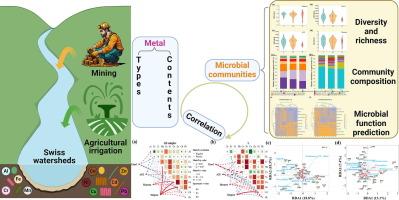
The effect of metals on freshwater microbiomes is poorly understood compared to other factors, such as nutrients or climate. While deleterious effects of metals on plant and animal biodiversity are well documented, the role of metals in shaping the biodiversity, composition and functional potential of sediment microbial communities remains unknown. Therefore, we explored if metal concentrations can be linked to alterations in biodiversity and composition of freshwater sediment microbial communities. We collected sediments from 34 streams and lakes in Switzerland and grouped them based on their metal content. Microbial diversity and community composition were determined using 16S rRNA gene amplicon sequencing. Most of the sediments were not contaminated with metals according to Sediment Environmental Quality Criteria, although some stations exceeded the limits for Cu, Zn, and Pb. Nevertheless, correlational analysis indicated links of metal concentrations to various aspects of sediment microbial biodiversity. Al concentrations were significantly (p < 0.05) correlated with microbial richness. We further observed a predominantly negative correlation between some metals and abundances of dominant taxa. Predicted microbial functional potential analysis indicated that different types of metals have different effects on microbial functional potential. For example, Mn exhibited a significant positive correlation with nitrogen fixation potential, whereas Cu, Pb, and Zn displayed a significant negative correlation. Overall, our findings indicate that metal concentrations may alter microbial community diversity and functional potential in freshwater sediments even at ambient concentrations. Further research into the role of metals as drivers of microbial biodiversity and factors in biodiversity loss is warranted.
期刊介绍:
Environmental Health publishes manuscripts focusing on critical aspects of environmental and occupational medicine, including studies in toxicology and epidemiology, to illuminate the human health implications of exposure to environmental hazards. The journal adopts an open-access model and practices open peer review.
It caters to scientists and practitioners across all environmental science domains, directly or indirectly impacting human health and well-being. With a commitment to enhancing the prevention of environmentally-related health risks, Environmental Health serves as a public health journal for the community and scientists engaged in matters of public health significance concerning the environment.




 京公网安备 11010802042870号
京ICP备2023020795号-1
京公网安备 11010802042870号
京ICP备2023020795号-1

 分享
分享
 求助内容:
求助内容: 应助结果提醒方式:
 扫码关注我们
