Xiaoli Ran , Yanlong Gong , Hao Zeng , Yang Bai , Sijie Li , Lei Zhang , Haitao Fu , Xizhong An , Dawei Su , Xiaohong Yang
{"title":"Carbon dots enhance photoelectrochemical water splitting activity of SrTiO3 nanoparticles: Band tuning and excellent charge separation","authors":"Xiaoli Ran , Yanlong Gong , Hao Zeng , Yang Bai , Sijie Li , Lei Zhang , Haitao Fu , Xizhong An , Dawei Su , Xiaohong Yang","doi":"10.1016/j.apsusc.2025.163262","DOIUrl":null,"url":null,"abstract":"<div><div>The photoelectrochemical (PEC) activity of Strontium titanate (SrTiO<sub>3</sub>) is constrained by its insufficient light absorption and significant carrier recombination. In this study, carbon dots (CDs) are integrated as co-catalysts onto the surface of oxygen-vacancy-doped mesoporous spherical SrTiO<sub>3</sub> nanoparticles to address these limitations and enhance PEC activity. Experimental characterizations and DFT calculations elucidate that the CDs demonstrated significant synergistic enhancements in PEC performance, particularly in band alignment, visible light absorption, and charge carrier transport, which collectively accelerated surface catalytic reactions. Most importantly, the electronic structure of SrTiO<sub>3</sub> was optimized by CDs, and their interfacial interaction plays an important role in enhancing its PEC performance. As a result, the optimal 0.005 %CDs/Sr<em><sub>X</sub></em>TiO<sub>3-</sub><em><sub>δ</sub></em> photoanode achieves a photocurrent density of 1.37 mA/cm<sup>2</sup> at 1.23 V vs. RHE, significantly surpassing that of Sr<em><sub>X</sub></em>TiO<sub>3</sub><em><sub>-δ</sub></em> (0.73 mA/cm<sup>2</sup>) and pristine SrTiO<sub>3</sub> (0.109 mA/cm<sup>2</sup>). Additionally, the incident photon-to-current conversion efficiency (IPCE) reaches 34 % for 0.005 %CDs/Sr<em><sub>X</sub></em>TiO<sub>3</sub><em><sub>-δ</sub></em>, compared to 18.2 % for Sr<em><sub>X</sub></em>TiO<sub>3</sub><em><sub>-δ</sub></em> and 2.6 % for SrTiO<sub>3</sub>. These findings present a straightforward and effective method for designing high-performance catalysts for PEC water splitting.</div></div>","PeriodicalId":247,"journal":{"name":"Applied Surface Science","volume":"701 ","pages":"Article 163262"},"PeriodicalIF":6.9000,"publicationDate":"2025-08-30","publicationTypes":"Journal Article","fieldsOfStudy":null,"isOpenAccess":false,"openAccessPdf":"","citationCount":"0","resultStr":null,"platform":"Semanticscholar","paperid":null,"PeriodicalName":"Applied Surface Science","FirstCategoryId":"88","ListUrlMain":"https://www.sciencedirect.com/science/article/pii/S0169433225009766","RegionNum":2,"RegionCategory":"材料科学","ArticlePicture":[],"TitleCN":null,"AbstractTextCN":null,"PMCID":null,"EPubDate":"2025/4/14 0:00:00","PubModel":"Epub","JCR":"Q2","JCRName":"CHEMISTRY, PHYSICAL","Score":null,"Total":0}
引用次数: 0
Abstract
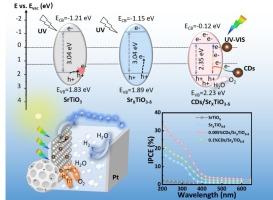
The photoelectrochemical (PEC) activity of Strontium titanate (SrTiO3) is constrained by its insufficient light absorption and significant carrier recombination. In this study, carbon dots (CDs) are integrated as co-catalysts onto the surface of oxygen-vacancy-doped mesoporous spherical SrTiO3 nanoparticles to address these limitations and enhance PEC activity. Experimental characterizations and DFT calculations elucidate that the CDs demonstrated significant synergistic enhancements in PEC performance, particularly in band alignment, visible light absorption, and charge carrier transport, which collectively accelerated surface catalytic reactions. Most importantly, the electronic structure of SrTiO3 was optimized by CDs, and their interfacial interaction plays an important role in enhancing its PEC performance. As a result, the optimal 0.005 %CDs/SrXTiO3-δ photoanode achieves a photocurrent density of 1.37 mA/cm2 at 1.23 V vs. RHE, significantly surpassing that of SrXTiO3-δ (0.73 mA/cm2) and pristine SrTiO3 (0.109 mA/cm2). Additionally, the incident photon-to-current conversion efficiency (IPCE) reaches 34 % for 0.005 %CDs/SrXTiO3-δ, compared to 18.2 % for SrXTiO3-δ and 2.6 % for SrTiO3. These findings present a straightforward and effective method for designing high-performance catalysts for PEC water splitting.
期刊介绍:
Applied Surface Science covers topics contributing to a better understanding of surfaces, interfaces, nanostructures and their applications. The journal is concerned with scientific research on the atomic and molecular level of material properties determined with specific surface analytical techniques and/or computational methods, as well as the processing of such structures.




 京公网安备 11010802042870号
京ICP备2023020795号-1
京公网安备 11010802042870号
京ICP备2023020795号-1

 分享
分享
 求助内容:
求助内容: 应助结果提醒方式:
 扫码关注我们
