{"title":"Integration Strategies and Formats in Field-Effect Transistor Chemo- and Biosensors: A Critical Review","authors":"Željko Janićijević, Larysa Baraban","doi":"10.1021/acssensors.4c03633","DOIUrl":null,"url":null,"abstract":"The continuous advances in micro- and nanofabrication technologies have inevitably led to major improvements in field-effect transistor (FET) design and architecture, significantly reducing the component footprint and enabling highly efficient integration into many electronic devices. Combined efforts in the areas of materials science, life sciences, and electronic engineering have unlocked opportunities to create ultrasensitive FET chemo- and biosensor devices that are coupled with more diverse and complex integration requirements in terms of hardware interfacing, reproducible functionality, and handling of analyte samples. Integration of FET chemo- and biosensors remains one of the major bottlenecks in bridging the gap between fundamental research concepts and commercial sensing devices. In this review, we critically discuss different strategies and formats of integration in the context of key requirements, fabrication scalability, and device complexity. The intentions of this review are 1) to provide a practical overview of successful FET sensor integration approaches, 2) to identify crucial challenges and factors limiting the extent of FET sensor integration, and 3) to highlight promising perspectives for future developments of FET sensor integration. We believe that our structured insights will be helpful for scientists and engineers of various profiles focusing on the design and development of FET-based chemo- and biosensor devices.","PeriodicalId":24,"journal":{"name":"ACS Sensors","volume":"74 5 Pt 1 1","pages":""},"PeriodicalIF":9.1000,"publicationDate":"2025-04-15","publicationTypes":"Journal Article","fieldsOfStudy":null,"isOpenAccess":false,"openAccessPdf":"","citationCount":"0","resultStr":null,"platform":"Semanticscholar","paperid":null,"PeriodicalName":"ACS Sensors","FirstCategoryId":"92","ListUrlMain":"https://doi.org/10.1021/acssensors.4c03633","RegionNum":1,"RegionCategory":"化学","ArticlePicture":[],"TitleCN":null,"AbstractTextCN":null,"PMCID":null,"EPubDate":"","PubModel":"","JCR":"Q1","JCRName":"CHEMISTRY, ANALYTICAL","Score":null,"Total":0}
引用次数: 0
Abstract
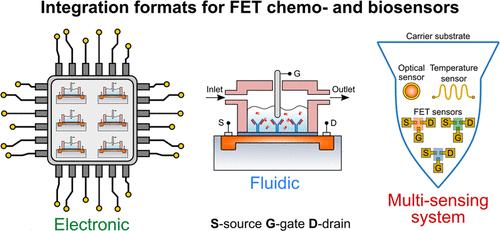
The continuous advances in micro- and nanofabrication technologies have inevitably led to major improvements in field-effect transistor (FET) design and architecture, significantly reducing the component footprint and enabling highly efficient integration into many electronic devices. Combined efforts in the areas of materials science, life sciences, and electronic engineering have unlocked opportunities to create ultrasensitive FET chemo- and biosensor devices that are coupled with more diverse and complex integration requirements in terms of hardware interfacing, reproducible functionality, and handling of analyte samples. Integration of FET chemo- and biosensors remains one of the major bottlenecks in bridging the gap between fundamental research concepts and commercial sensing devices. In this review, we critically discuss different strategies and formats of integration in the context of key requirements, fabrication scalability, and device complexity. The intentions of this review are 1) to provide a practical overview of successful FET sensor integration approaches, 2) to identify crucial challenges and factors limiting the extent of FET sensor integration, and 3) to highlight promising perspectives for future developments of FET sensor integration. We believe that our structured insights will be helpful for scientists and engineers of various profiles focusing on the design and development of FET-based chemo- and biosensor devices.
期刊介绍:
ACS Sensors is a peer-reviewed research journal that focuses on the dissemination of new and original knowledge in the field of sensor science, particularly those that selectively sense chemical or biological species or processes. The journal covers a broad range of topics, including but not limited to biosensors, chemical sensors, gas sensors, intracellular sensors, single molecule sensors, cell chips, and microfluidic devices. It aims to publish articles that address conceptual advances in sensing technology applicable to various types of analytes or application papers that report on the use of existing sensing concepts in new ways or for new analytes.



 京公网安备 11010802042870号
京ICP备2023020795号-1
京公网安备 11010802042870号
京ICP备2023020795号-1

 分享
分享
 求助内容:
求助内容: 应助结果提醒方式:
 扫码关注我们
