{"title":"Lithium-Ion Battery State Estimation Based on Anode Strain Field Reconstitution Utilizing Optical Frequency Domain Reflectometry","authors":"Kaijun Liu, Zhijuan Zou, Guolu Yin, Yingze Song, Zeheng Zhang, Yuyang Lou, Huafeng Lu, Duidui Li, Tao Zhu","doi":"10.1021/acssensors.5c00435","DOIUrl":null,"url":null,"abstract":"The state of charge (SOC) and state of health (SOH) in battery systems are crucial indicators for evaluating battery performance, playing a vital role in ensuring the normal operation of battery systems. In this study, a phase-sensitive optical frequency domain reflectometer was employed for real-time monitoring of strain fields in lithium battery anodes. Distributed strain and strain rate data were used as inputs to a feedforward neural network for predicting battery SOC. The results showed that the predictive accuracy of distributed strain data (98.3%) significantly outperformed single-point predictions (88.8%), demonstrating comparable accuracy (98.5%) to predictions based on electrical parameters (current, voltage). Additionally, features such as maximum strain in a single cycle and cumulative residual strain during cycling were utilized. A long short-term memory recurrent neural network was employed to predict battery SOH, achieving a prediction accuracy of 96.3%. The use of purely strain data enabled high-precision prediction of SOC and SOH without requiring any electrical information during battery operation. Moreover, the principle of distributed measurement allows simultaneous measurement of individual or multiple battery packs, thereby offering robust support for future battery system management.","PeriodicalId":24,"journal":{"name":"ACS Sensors","volume":"215 1","pages":""},"PeriodicalIF":9.1000,"publicationDate":"2025-04-15","publicationTypes":"Journal Article","fieldsOfStudy":null,"isOpenAccess":false,"openAccessPdf":"","citationCount":"0","resultStr":null,"platform":"Semanticscholar","paperid":null,"PeriodicalName":"ACS Sensors","FirstCategoryId":"92","ListUrlMain":"https://doi.org/10.1021/acssensors.5c00435","RegionNum":1,"RegionCategory":"化学","ArticlePicture":[],"TitleCN":null,"AbstractTextCN":null,"PMCID":null,"EPubDate":"","PubModel":"","JCR":"Q1","JCRName":"CHEMISTRY, ANALYTICAL","Score":null,"Total":0}
引用次数: 0
Abstract
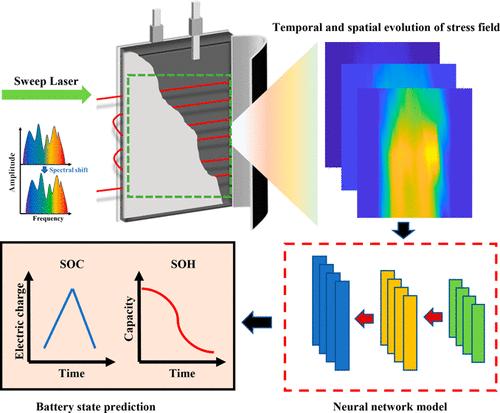
The state of charge (SOC) and state of health (SOH) in battery systems are crucial indicators for evaluating battery performance, playing a vital role in ensuring the normal operation of battery systems. In this study, a phase-sensitive optical frequency domain reflectometer was employed for real-time monitoring of strain fields in lithium battery anodes. Distributed strain and strain rate data were used as inputs to a feedforward neural network for predicting battery SOC. The results showed that the predictive accuracy of distributed strain data (98.3%) significantly outperformed single-point predictions (88.8%), demonstrating comparable accuracy (98.5%) to predictions based on electrical parameters (current, voltage). Additionally, features such as maximum strain in a single cycle and cumulative residual strain during cycling were utilized. A long short-term memory recurrent neural network was employed to predict battery SOH, achieving a prediction accuracy of 96.3%. The use of purely strain data enabled high-precision prediction of SOC and SOH without requiring any electrical information during battery operation. Moreover, the principle of distributed measurement allows simultaneous measurement of individual or multiple battery packs, thereby offering robust support for future battery system management.
电池系统的荷电状态(state of charge, SOC)和健康状态(state of health, SOH)是评价电池性能的重要指标,对保证电池系统的正常运行起着至关重要的作用。本研究采用相敏光学频域反射计对锂电池阳极的应变场进行实时监测。将分布应变和应变率数据作为前馈神经网络预测电池荷电状态的输入。结果表明,分布式应变数据的预测精度(98.3%)显著优于单点预测(88.8%),与基于电参数(电流、电压)的预测精度(98.5%)相当。此外,还利用了单次循环中的最大应变和循环过程中的累积残余应变等特征。采用长短期记忆递归神经网络对电池SOH进行预测,预测准确率达到96.3%。使用纯应变数据可以高精度地预测SOC和SOH,而无需在电池运行期间提供任何电气信息。此外,分布式测量原理允许同时测量单个或多个电池组,从而为未来的电池系统管理提供强大的支持。
期刊介绍:
ACS Sensors is a peer-reviewed research journal that focuses on the dissemination of new and original knowledge in the field of sensor science, particularly those that selectively sense chemical or biological species or processes. The journal covers a broad range of topics, including but not limited to biosensors, chemical sensors, gas sensors, intracellular sensors, single molecule sensors, cell chips, and microfluidic devices. It aims to publish articles that address conceptual advances in sensing technology applicable to various types of analytes or application papers that report on the use of existing sensing concepts in new ways or for new analytes.





 京公网安备 11010802042870号
京ICP备2023020795号-1
京公网安备 11010802042870号
京ICP备2023020795号-1

 分享
分享
 求助内容:
求助内容: 应助结果提醒方式:
 扫码关注我们
