{"title":"Influence of Bovine Liver Catalase on Self-Assembled Structures of a Surface-Active Ionic Liquid","authors":"Sudhanshu Sharma, Dineshbabu Takkella, Jyoti Vishwakarma, Krishna Gavvala","doi":"10.1021/acs.langmuir.4c05028","DOIUrl":null,"url":null,"abstract":"The modulation of self-assembled structures of a surface-active ionic liquid (SAIL), 1-butyl-3-methylimidazolium octyl sulfate [C<sub>4</sub>mim][C<sub>8</sub>OSO<sub>3</sub>], upon their interaction with bovine liver catalase (CAT) enzyme is investigated in this study. The intrinsic fluorescence of tryptophan (Trp) was investigated to monitor the conformational changes in CAT with [C<sub>4</sub>mim][C<sub>8</sub>OSO<sub>3</sub>]. Extrinsic fluorescence of the 8-anilino-1-naphthalenesulfonic acid (ANS) probe was further utilized to determine the structural and conformational changes along with the binding location of [C<sub>4</sub>mim][C<sub>8</sub>OSO<sub>3</sub>] in the enzyme. Fourier transform infrared (FTIR) measurements quantify the secondary structure changes, leading to modulation in the fluorescence characteristics. To elucidate modulation of the self-assembled structures, fluorescence lifetime imaging microscopy (FLIM) measurements were utilized. On adding CAT to an aqueous micellar solution of [C<sub>4</sub>mim][C<sub>8</sub>OSO<sub>3</sub>], there was the appearance of highly fluorescent ring-like structures. The internal structure of these was further investigated using transmission electron microscopy (TEM), where the ring sizes were found to be dependent upon the quantity of enzyme taken. These structures completely collapse and accumulate when the CAT concentration reaches near ∼5–7 μM. Further, the activity of the CAT enzyme was assessed in the presence of [C<sub>4</sub>mim][C<sub>8</sub>OSO<sub>3</sub>] depending upon the premicelle and micelle self-assemblies. Molecular dynamics (MD) simulation study was used to further analyze the binding location of the micelle-forming entity, [C<sub>8</sub>OSO<sub>3</sub>], and it was found that the [C<sub>8</sub>OSO<sub>3</sub>] species tends to remain at the enzyme active site. The results describe the unique transformation in self-assemblies of a SAIL by enzymatic action that has not been studied so far and opens up the interesting applications of SAIL in biomedical applications.","PeriodicalId":50,"journal":{"name":"Langmuir","volume":"183 1","pages":""},"PeriodicalIF":3.9000,"publicationDate":"2025-04-15","publicationTypes":"Journal Article","fieldsOfStudy":null,"isOpenAccess":false,"openAccessPdf":"","citationCount":"0","resultStr":null,"platform":"Semanticscholar","paperid":null,"PeriodicalName":"Langmuir","FirstCategoryId":"92","ListUrlMain":"https://doi.org/10.1021/acs.langmuir.4c05028","RegionNum":2,"RegionCategory":"化学","ArticlePicture":[],"TitleCN":null,"AbstractTextCN":null,"PMCID":null,"EPubDate":"","PubModel":"","JCR":"Q2","JCRName":"CHEMISTRY, MULTIDISCIPLINARY","Score":null,"Total":0}
引用次数: 0
Abstract
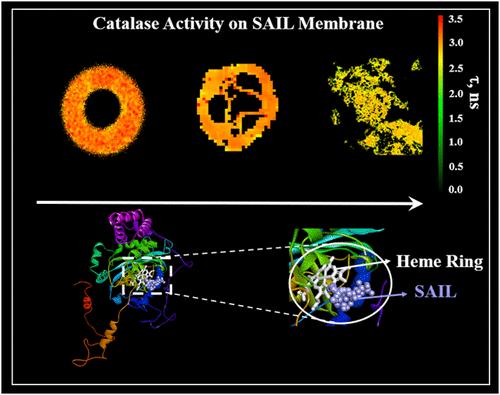
The modulation of self-assembled structures of a surface-active ionic liquid (SAIL), 1-butyl-3-methylimidazolium octyl sulfate [C4mim][C8OSO3], upon their interaction with bovine liver catalase (CAT) enzyme is investigated in this study. The intrinsic fluorescence of tryptophan (Trp) was investigated to monitor the conformational changes in CAT with [C4mim][C8OSO3]. Extrinsic fluorescence of the 8-anilino-1-naphthalenesulfonic acid (ANS) probe was further utilized to determine the structural and conformational changes along with the binding location of [C4mim][C8OSO3] in the enzyme. Fourier transform infrared (FTIR) measurements quantify the secondary structure changes, leading to modulation in the fluorescence characteristics. To elucidate modulation of the self-assembled structures, fluorescence lifetime imaging microscopy (FLIM) measurements were utilized. On adding CAT to an aqueous micellar solution of [C4mim][C8OSO3], there was the appearance of highly fluorescent ring-like structures. The internal structure of these was further investigated using transmission electron microscopy (TEM), where the ring sizes were found to be dependent upon the quantity of enzyme taken. These structures completely collapse and accumulate when the CAT concentration reaches near ∼5–7 μM. Further, the activity of the CAT enzyme was assessed in the presence of [C4mim][C8OSO3] depending upon the premicelle and micelle self-assemblies. Molecular dynamics (MD) simulation study was used to further analyze the binding location of the micelle-forming entity, [C8OSO3], and it was found that the [C8OSO3] species tends to remain at the enzyme active site. The results describe the unique transformation in self-assemblies of a SAIL by enzymatic action that has not been studied so far and opens up the interesting applications of SAIL in biomedical applications.
期刊介绍:
Langmuir is an interdisciplinary journal publishing articles in the following subject categories:
Colloids: surfactants and self-assembly, dispersions, emulsions, foams
Interfaces: adsorption, reactions, films, forces
Biological Interfaces: biocolloids, biomolecular and biomimetic materials
Materials: nano- and mesostructured materials, polymers, gels, liquid crystals
Electrochemistry: interfacial charge transfer, charge transport, electrocatalysis, electrokinetic phenomena, bioelectrochemistry
Devices and Applications: sensors, fluidics, patterning, catalysis, photonic crystals
However, when high-impact, original work is submitted that does not fit within the above categories, decisions to accept or decline such papers will be based on one criteria: What Would Irving Do?
Langmuir ranks #2 in citations out of 136 journals in the category of Physical Chemistry with 113,157 total citations. The journal received an Impact Factor of 4.384*.
This journal is also indexed in the categories of Materials Science (ranked #1) and Multidisciplinary Chemistry (ranked #5).



 京公网安备 11010802042870号
京ICP备2023020795号-1
京公网安备 11010802042870号
京ICP备2023020795号-1

 分享
分享
 求助内容:
求助内容: 应助结果提醒方式:
 扫码关注我们
