Xiaofan Jiang , Mingyuan Li , Yu Tao , Meng Zhang , Xinyu Li , Tianhao Zhang , Jiazhen Gu , Guangsheng Bai , Nanlong Zheng , Xuan Zhao , Huilong Hong , Leyang Jin , Xu Huang , Sanli Xu , Yan Guan , Chen Li , Wenkai Zhang , Yongping Fu
{"title":"One-dimensional lead halide perovskite quantum ribbons with controllable edge terminations and ribbon widths","authors":"Xiaofan Jiang , Mingyuan Li , Yu Tao , Meng Zhang , Xinyu Li , Tianhao Zhang , Jiazhen Gu , Guangsheng Bai , Nanlong Zheng , Xuan Zhao , Huilong Hong , Leyang Jin , Xu Huang , Sanli Xu , Yan Guan , Chen Li , Wenkai Zhang , Yongping Fu","doi":"10.1016/j.chempr.2025.102548","DOIUrl":null,"url":null,"abstract":"<div><div>One-dimensional (1D) halide<span><span> perovskite quantum ribbons, featuring 1D corner-sharing octahedral networks, are promising for optoelectronics<span> and photonics due to quantum confinement in two dimensions. However, the rational design of 1D perovskites remains challenging, and existing materials with narrow ribbon widths predominantly form self-trapped excitons, which limit their potential applications. Here, we synthesize 30 1D perovskites with controllable ribbon widths and edge octahedra terminations by </span></span>organic cation<span> engineering. We observe the absence of self-trapped excitons as the ribbon width increases up to four octahedra, alongside the ability to modulate their optoelectronic properties by tailoring the edge terminations. The 1D free excitons result in in-plane anisotropic photoluminescence (PL) emission with polarization degree reaching 60%. Moreover, we observe robust exciton-photon coupling with Rabi splitting energies up to 800 meV, which is significantly larger than those of three-dimensional (3D) and two-dimensional (2D) perovskites, demonstrating a class of 1D quantum materials for advanced optoelectronics and photonics.</span></span></div></div>","PeriodicalId":268,"journal":{"name":"Chem","volume":"11 9","pages":"Article 102548"},"PeriodicalIF":19.6000,"publicationDate":"2025-09-11","publicationTypes":"Journal Article","fieldsOfStudy":null,"isOpenAccess":false,"openAccessPdf":"","citationCount":"0","resultStr":null,"platform":"Semanticscholar","paperid":null,"PeriodicalName":"Chem","FirstCategoryId":"92","ListUrlMain":"https://www.sciencedirect.com/science/article/pii/S245192942500138X","RegionNum":1,"RegionCategory":"化学","ArticlePicture":[],"TitleCN":null,"AbstractTextCN":null,"PMCID":null,"EPubDate":"2025/4/15 0:00:00","PubModel":"Epub","JCR":"Q1","JCRName":"CHEMISTRY, MULTIDISCIPLINARY","Score":null,"Total":0}
引用次数: 0
Abstract
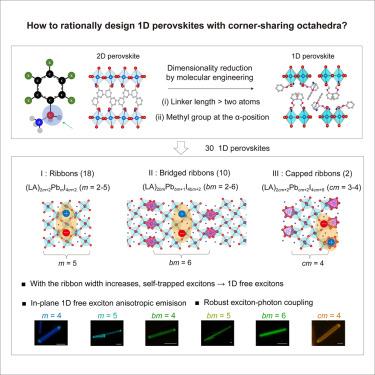
One-dimensional (1D) halide perovskite quantum ribbons, featuring 1D corner-sharing octahedral networks, are promising for optoelectronics and photonics due to quantum confinement in two dimensions. However, the rational design of 1D perovskites remains challenging, and existing materials with narrow ribbon widths predominantly form self-trapped excitons, which limit their potential applications. Here, we synthesize 30 1D perovskites with controllable ribbon widths and edge octahedra terminations by organic cation engineering. We observe the absence of self-trapped excitons as the ribbon width increases up to four octahedra, alongside the ability to modulate their optoelectronic properties by tailoring the edge terminations. The 1D free excitons result in in-plane anisotropic photoluminescence (PL) emission with polarization degree reaching 60%. Moreover, we observe robust exciton-photon coupling with Rabi splitting energies up to 800 meV, which is significantly larger than those of three-dimensional (3D) and two-dimensional (2D) perovskites, demonstrating a class of 1D quantum materials for advanced optoelectronics and photonics.
期刊介绍:
Chem, affiliated with Cell as its sister journal, serves as a platform for groundbreaking research and illustrates how fundamental inquiries in chemistry and its related fields can contribute to addressing future global challenges. It was established in 2016, and is currently edited by Robert Eagling.




 京公网安备 11010802042870号
京ICP备2023020795号-1
京公网安备 11010802042870号
京ICP备2023020795号-1

 分享
分享
 求助内容:
求助内容: 应助结果提醒方式:
 扫码关注我们
