{"title":"Unveiling Human Exposure to Plasticizers through Drinking Tea: A Nationwide Study","authors":"Yitong Pan, Shujun Dong, Qingqing Zhu, Le Tao, Xingyi Wu, Meichen Lu, Chunyang Liao, Guibin Jiang","doi":"10.1021/acs.est.5c02127","DOIUrl":null,"url":null,"abstract":"Dietary intake represents a significant exposure pathway for phthalates (PAEs) and nonphthalate plasticizers (NPPs). However, the associated exposure risk linked to tea consumption remains unclear. This study analyzed 10 PAEs and 10 NPPs in six types of tea collected from 18 provinces in China. Both PAEs and NPPs were detected in all samples, with concentrations ranging from 309 to 8150 ng/g for PAEs and 42.2 to 899 ng/g for NPPs, respectively. Source apportionment analysis indicates that packaging materials are important sources of plasticizer contamination in tea. The concentrations of di-isobutyl phthalate (DiBP), benzyl-butyl phthalate (BzBP), and trioctyl trimellitate (TOTM) in tea exhibited a significant correlation with those found in packaging materials (<i>r</i>: 0.414–0.465, <i>p</i> < 0.01). Five transformation products (TPs) of plasticizers were identified in brewed tea samples through suspect screening analysis, raising concerns about their potential health effects. Comparisons suggest that cold brewing may result in higher plasticizer exposure than hot brewing after a single brew. However, as the brewing times for hot brewed tea increased, the risk of human exposure rose, ultimately exceeded that of cold brewed tea. This study provides national-scale data on plasticizer contamination in Chinese tea and valuable insights into tea consumption practices.","PeriodicalId":36,"journal":{"name":"环境科学与技术","volume":"48 1","pages":""},"PeriodicalIF":11.3000,"publicationDate":"2025-04-15","publicationTypes":"Journal Article","fieldsOfStudy":null,"isOpenAccess":false,"openAccessPdf":"","citationCount":"0","resultStr":null,"platform":"Semanticscholar","paperid":null,"PeriodicalName":"环境科学与技术","FirstCategoryId":"1","ListUrlMain":"https://doi.org/10.1021/acs.est.5c02127","RegionNum":1,"RegionCategory":"环境科学与生态学","ArticlePicture":[],"TitleCN":null,"AbstractTextCN":null,"PMCID":null,"EPubDate":"","PubModel":"","JCR":"Q1","JCRName":"ENGINEERING, ENVIRONMENTAL","Score":null,"Total":0}
引用次数: 0
Abstract
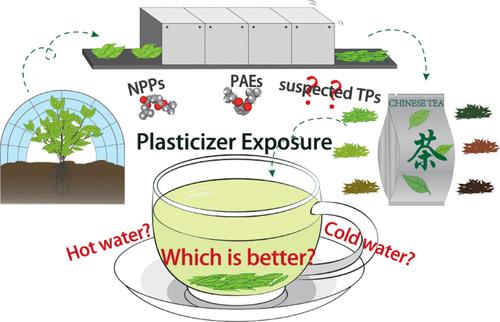
Dietary intake represents a significant exposure pathway for phthalates (PAEs) and nonphthalate plasticizers (NPPs). However, the associated exposure risk linked to tea consumption remains unclear. This study analyzed 10 PAEs and 10 NPPs in six types of tea collected from 18 provinces in China. Both PAEs and NPPs were detected in all samples, with concentrations ranging from 309 to 8150 ng/g for PAEs and 42.2 to 899 ng/g for NPPs, respectively. Source apportionment analysis indicates that packaging materials are important sources of plasticizer contamination in tea. The concentrations of di-isobutyl phthalate (DiBP), benzyl-butyl phthalate (BzBP), and trioctyl trimellitate (TOTM) in tea exhibited a significant correlation with those found in packaging materials (r: 0.414–0.465, p < 0.01). Five transformation products (TPs) of plasticizers were identified in brewed tea samples through suspect screening analysis, raising concerns about their potential health effects. Comparisons suggest that cold brewing may result in higher plasticizer exposure than hot brewing after a single brew. However, as the brewing times for hot brewed tea increased, the risk of human exposure rose, ultimately exceeded that of cold brewed tea. This study provides national-scale data on plasticizer contamination in Chinese tea and valuable insights into tea consumption practices.
期刊介绍:
Environmental Science & Technology (ES&T) is a co-sponsored academic and technical magazine by the Hubei Provincial Environmental Protection Bureau and the Hubei Provincial Academy of Environmental Sciences.
Environmental Science & Technology (ES&T) holds the status of Chinese core journals, scientific papers source journals of China, Chinese Science Citation Database source journals, and Chinese Academic Journal Comprehensive Evaluation Database source journals. This publication focuses on the academic field of environmental protection, featuring articles related to environmental protection and technical advancements.



 京公网安备 11010802042870号
京ICP备2023020795号-1
京公网安备 11010802042870号
京ICP备2023020795号-1

 分享
分享
 求助内容:
求助内容: 应助结果提醒方式:
 扫码关注我们
