Xiang Zhang, Bingjie Lu, Ling N. Jin, Shuo Yang, Chuan Wang, Jun Tai, Dan Li, Jianmin Chen
{"title":"Emission Dynamics and Public Health Implications of Airborne Pathogens and Antimicrobial Resistance from Urban Waste Collection Facilities","authors":"Xiang Zhang, Bingjie Lu, Ling N. Jin, Shuo Yang, Chuan Wang, Jun Tai, Dan Li, Jianmin Chen","doi":"10.1021/acs.est.4c12108","DOIUrl":null,"url":null,"abstract":"Airborne pathogens and antimicrobial resistance (AMR) present significant global health threats. Household waste collection facilities (WCFs), crucial initial nodes in urban waste management systems, have been understudied in regards to their role in emitting these hazards. This study investigated the abundance, composition, sources, driving mechanisms, and health risks associated with pathogens and AMR originating from WCFs in a major city, using culture-based analysis, high-throughput sequencing, and health risk modeling, respectively. The atmospheric escape rates of culturable bacteria (43.4%), fungi (71.7%), and antibiotic-resistant bacteria (ARB) (43.7%) were estimated based on the concentration differences between the interior and exterior of the WCFs by using SourceTracker2 analysis. Health risk assessments showed that annual infection risks for waste-handling workers ranged from 0.194 to 0.489, far exceeding the World Health Organization’s acceptable limit of 10<sup>–4</sup>. Community exposure risks were notable up to 220 m downwind from WCFs, marking the maximum extent of pathogen dispersion. Our analysis suggests that approximately 6.3% of the megacity’s area (equivalent to 400 km<sup>2</sup>) is within potential risk zones influenced by WCF emissions. These results underscore the critical need to evaluate and mitigate the public health risks posed by airborne pathogens and AMR emitted from WCFs in megacities globally.","PeriodicalId":36,"journal":{"name":"环境科学与技术","volume":"26 1","pages":""},"PeriodicalIF":11.3000,"publicationDate":"2025-04-14","publicationTypes":"Journal Article","fieldsOfStudy":null,"isOpenAccess":false,"openAccessPdf":"","citationCount":"0","resultStr":null,"platform":"Semanticscholar","paperid":null,"PeriodicalName":"环境科学与技术","FirstCategoryId":"1","ListUrlMain":"https://doi.org/10.1021/acs.est.4c12108","RegionNum":1,"RegionCategory":"环境科学与生态学","ArticlePicture":[],"TitleCN":null,"AbstractTextCN":null,"PMCID":null,"EPubDate":"","PubModel":"","JCR":"Q1","JCRName":"ENGINEERING, ENVIRONMENTAL","Score":null,"Total":0}
引用次数: 0
Abstract
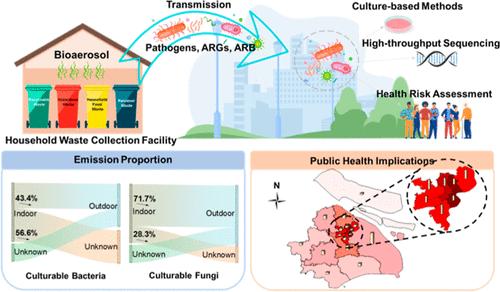
Airborne pathogens and antimicrobial resistance (AMR) present significant global health threats. Household waste collection facilities (WCFs), crucial initial nodes in urban waste management systems, have been understudied in regards to their role in emitting these hazards. This study investigated the abundance, composition, sources, driving mechanisms, and health risks associated with pathogens and AMR originating from WCFs in a major city, using culture-based analysis, high-throughput sequencing, and health risk modeling, respectively. The atmospheric escape rates of culturable bacteria (43.4%), fungi (71.7%), and antibiotic-resistant bacteria (ARB) (43.7%) were estimated based on the concentration differences between the interior and exterior of the WCFs by using SourceTracker2 analysis. Health risk assessments showed that annual infection risks for waste-handling workers ranged from 0.194 to 0.489, far exceeding the World Health Organization’s acceptable limit of 10–4. Community exposure risks were notable up to 220 m downwind from WCFs, marking the maximum extent of pathogen dispersion. Our analysis suggests that approximately 6.3% of the megacity’s area (equivalent to 400 km2) is within potential risk zones influenced by WCF emissions. These results underscore the critical need to evaluate and mitigate the public health risks posed by airborne pathogens and AMR emitted from WCFs in megacities globally.
期刊介绍:
Environmental Science & Technology (ES&T) is a co-sponsored academic and technical magazine by the Hubei Provincial Environmental Protection Bureau and the Hubei Provincial Academy of Environmental Sciences.
Environmental Science & Technology (ES&T) holds the status of Chinese core journals, scientific papers source journals of China, Chinese Science Citation Database source journals, and Chinese Academic Journal Comprehensive Evaluation Database source journals. This publication focuses on the academic field of environmental protection, featuring articles related to environmental protection and technical advancements.



 京公网安备 11010802042870号
京ICP备2023020795号-1
京公网安备 11010802042870号
京ICP备2023020795号-1

 分享
分享
 求助内容:
求助内容: 应助结果提醒方式:
 扫码关注我们
