Min Liu, Shenhong Wang, Xing Chen, Mengjing Wang, Haoduo Zhao, Fanrong Zhao, Shixuan Cui, Li Li, Mingliang Fang
{"title":"Separating the Role of Gut Enzymatic Transformation in Modulating Internal Exposure to Three Major Phthalates","authors":"Min Liu, Shenhong Wang, Xing Chen, Mengjing Wang, Haoduo Zhao, Fanrong Zhao, Shixuan Cui, Li Li, Mingliang Fang","doi":"10.1021/acs.est.4c12870","DOIUrl":null,"url":null,"abstract":"The gastrointestinal tract (GIT) is crucial in the absorption and metabolism of xenobiotics, including phthalates─widespread environmental contaminants associated with various health risks. Estimating human exposure to phthalates via biomonitoring is challenging due to their complex metabolic pathways, resulting in a mass-balance gap between internal and external exposure. The relative contributions of the GIT and liver to phthalate metabolism remain underexplored. This study investigated the metabolism of three representative phthalate diesters─dibutyl phthalate (DBP), di(2-ethylhexyl)phthalate (DEHP), and diethyl phthalate (DEP) in GIT. We first incubated these diesters in simulated stomach and small intestine fluids to identify the primary enzyme responsible for their hydrolysis. The kinetics were further investigated under varying pH conditions (4.0, 5.0, 6.0, 7.0 or 7.5) to mimic the small intestine environment. Next, using a refined human physiologically based toxicokinetic model, we quantified the relative contributions of preabsorption intestinal versus postabsorption hepatic biotransformation to the body burden of phthalates. Our results suggested that DBP and DEHP were extensively metabolized (>90%) in the GIT by lipase, with comparatively lower hepatic involvement, while DEP underwent minimal preadsorption metabolism (13%) in the GIT, highlighting the influence of structure-dependent differences on metabolic rates. This study emphasized the importance of incorporating both intestinal and hepatic metabolism into toxicokinetic analyses. The findings demonstrate the GIT’s critical role in limiting phthalate bioavailability, underscoring the need to account for the intestinal first-pass effect in toxicokinetic models to enhance predictions of phthalate pharmacokinetics and health impacts.","PeriodicalId":36,"journal":{"name":"环境科学与技术","volume":"25 1","pages":""},"PeriodicalIF":11.3000,"publicationDate":"2025-04-14","publicationTypes":"Journal Article","fieldsOfStudy":null,"isOpenAccess":false,"openAccessPdf":"","citationCount":"0","resultStr":null,"platform":"Semanticscholar","paperid":null,"PeriodicalName":"环境科学与技术","FirstCategoryId":"1","ListUrlMain":"https://doi.org/10.1021/acs.est.4c12870","RegionNum":1,"RegionCategory":"环境科学与生态学","ArticlePicture":[],"TitleCN":null,"AbstractTextCN":null,"PMCID":null,"EPubDate":"","PubModel":"","JCR":"Q1","JCRName":"ENGINEERING, ENVIRONMENTAL","Score":null,"Total":0}
引用次数: 0
Abstract
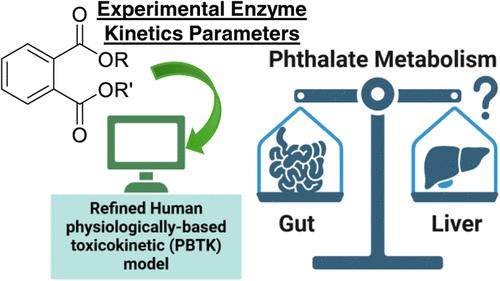
The gastrointestinal tract (GIT) is crucial in the absorption and metabolism of xenobiotics, including phthalates─widespread environmental contaminants associated with various health risks. Estimating human exposure to phthalates via biomonitoring is challenging due to their complex metabolic pathways, resulting in a mass-balance gap between internal and external exposure. The relative contributions of the GIT and liver to phthalate metabolism remain underexplored. This study investigated the metabolism of three representative phthalate diesters─dibutyl phthalate (DBP), di(2-ethylhexyl)phthalate (DEHP), and diethyl phthalate (DEP) in GIT. We first incubated these diesters in simulated stomach and small intestine fluids to identify the primary enzyme responsible for their hydrolysis. The kinetics were further investigated under varying pH conditions (4.0, 5.0, 6.0, 7.0 or 7.5) to mimic the small intestine environment. Next, using a refined human physiologically based toxicokinetic model, we quantified the relative contributions of preabsorption intestinal versus postabsorption hepatic biotransformation to the body burden of phthalates. Our results suggested that DBP and DEHP were extensively metabolized (>90%) in the GIT by lipase, with comparatively lower hepatic involvement, while DEP underwent minimal preadsorption metabolism (13%) in the GIT, highlighting the influence of structure-dependent differences on metabolic rates. This study emphasized the importance of incorporating both intestinal and hepatic metabolism into toxicokinetic analyses. The findings demonstrate the GIT’s critical role in limiting phthalate bioavailability, underscoring the need to account for the intestinal first-pass effect in toxicokinetic models to enhance predictions of phthalate pharmacokinetics and health impacts.
期刊介绍:
Environmental Science & Technology (ES&T) is a co-sponsored academic and technical magazine by the Hubei Provincial Environmental Protection Bureau and the Hubei Provincial Academy of Environmental Sciences.
Environmental Science & Technology (ES&T) holds the status of Chinese core journals, scientific papers source journals of China, Chinese Science Citation Database source journals, and Chinese Academic Journal Comprehensive Evaluation Database source journals. This publication focuses on the academic field of environmental protection, featuring articles related to environmental protection and technical advancements.



 京公网安备 11010802042870号
京ICP备2023020795号-1
京公网安备 11010802042870号
京ICP备2023020795号-1

 分享
分享
 求助内容:
求助内容: 应助结果提醒方式:
 扫码关注我们
