Organic fertilizer mitigated the oxidative stress of tomato induced by nanoplastics through affecting rhizosphere soil microorganisms and bacteriophage functions
{"title":"Organic fertilizer mitigated the oxidative stress of tomato induced by nanoplastics through affecting rhizosphere soil microorganisms and bacteriophage functions","authors":"Liang-Bin Zhao, Zi-Xuan Tang, Hui-Fang Zhai, Hong-Yu Lai, Hai-Yang Li, Shuo Liu, Xin-Di Liao, Si-Cheng Xing","doi":"10.1016/j.jhazmat.2025.138301","DOIUrl":null,"url":null,"abstract":"Nanoplastics (NPs), which are widely present in agricultural soils, are difficult to remove and are potentially harmful to plant growth and development. However, few studies have focused on how to mitigation the oxidative stress in plants induced by soil NPs exposure. Therefore, in this study, the effects of organic and chemical fertilizers on the oxidative stress of tomato under exposure to polystyrene nanoplastics (PS-NPs) in soil were investigated. Compared with chemical fertilizer under exposure to PS-NPs, the organic fertilizer reduced the reactive oxygen species (ROS) content by 25.63% and the H<sub>2</sub>O<sub>2</sub> content by 34.58% in tomato stems, whereas no significant effects were observed with respect to the amount of PS-NP internalized in tomato. Additionally, organic fertilizer increased the accumulation of the phytohormones salicylic acid (SA) and abscisic acid (ABA) by 76.53% and 22.54%, respectively, and these factors are key for reducing the ROS and H<sub>2</sub>O<sub>2</sub> contents in stems. In the rhizosphere microbiome of organic fertilizer group under exposure to PS-NPs, enrichment in Actinomycetes and an increased abundance of terpenoids and polyketides metabolism were the main factors affecting the accumulation of ABA and SA. Moreover, bacteriophage activity in the rhizosphere indirectly contributed to the increase in this function. These changes ultimately resulted in a reduction in oxidative stress in tomato stems and protected tomato growth. The results of this study will provide a better understanding of the interaction between plants and nanoplastics in soil and provide a new reference for alleviating the oxidative stress caused by nanoplastics in plants.","PeriodicalId":361,"journal":{"name":"Journal of Hazardous Materials","volume":"60 1","pages":""},"PeriodicalIF":11.3000,"publicationDate":"2025-04-15","publicationTypes":"Journal Article","fieldsOfStudy":null,"isOpenAccess":false,"openAccessPdf":"","citationCount":"0","resultStr":null,"platform":"Semanticscholar","paperid":null,"PeriodicalName":"Journal of Hazardous Materials","FirstCategoryId":"93","ListUrlMain":"https://doi.org/10.1016/j.jhazmat.2025.138301","RegionNum":1,"RegionCategory":"环境科学与生态学","ArticlePicture":[],"TitleCN":null,"AbstractTextCN":null,"PMCID":null,"EPubDate":"","PubModel":"","JCR":"Q1","JCRName":"ENGINEERING, ENVIRONMENTAL","Score":null,"Total":0}
引用次数: 0
Abstract
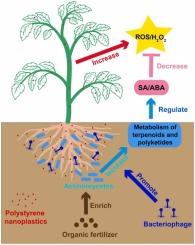
Nanoplastics (NPs), which are widely present in agricultural soils, are difficult to remove and are potentially harmful to plant growth and development. However, few studies have focused on how to mitigation the oxidative stress in plants induced by soil NPs exposure. Therefore, in this study, the effects of organic and chemical fertilizers on the oxidative stress of tomato under exposure to polystyrene nanoplastics (PS-NPs) in soil were investigated. Compared with chemical fertilizer under exposure to PS-NPs, the organic fertilizer reduced the reactive oxygen species (ROS) content by 25.63% and the H2O2 content by 34.58% in tomato stems, whereas no significant effects were observed with respect to the amount of PS-NP internalized in tomato. Additionally, organic fertilizer increased the accumulation of the phytohormones salicylic acid (SA) and abscisic acid (ABA) by 76.53% and 22.54%, respectively, and these factors are key for reducing the ROS and H2O2 contents in stems. In the rhizosphere microbiome of organic fertilizer group under exposure to PS-NPs, enrichment in Actinomycetes and an increased abundance of terpenoids and polyketides metabolism were the main factors affecting the accumulation of ABA and SA. Moreover, bacteriophage activity in the rhizosphere indirectly contributed to the increase in this function. These changes ultimately resulted in a reduction in oxidative stress in tomato stems and protected tomato growth. The results of this study will provide a better understanding of the interaction between plants and nanoplastics in soil and provide a new reference for alleviating the oxidative stress caused by nanoplastics in plants.
期刊介绍:
The Journal of Hazardous Materials serves as a global platform for promoting cutting-edge research in the field of Environmental Science and Engineering. Our publication features a wide range of articles, including full-length research papers, review articles, and perspectives, with the aim of enhancing our understanding of the dangers and risks associated with various materials concerning public health and the environment. It is important to note that the term "environmental contaminants" refers specifically to substances that pose hazardous effects through contamination, while excluding those that do not have such impacts on the environment or human health. Moreover, we emphasize the distinction between wastes and hazardous materials in order to provide further clarity on the scope of the journal. We have a keen interest in exploring specific compounds and microbial agents that have adverse effects on the environment.



 京公网安备 11010802042870号
京ICP备2023020795号-1
京公网安备 11010802042870号
京ICP备2023020795号-1

 分享
分享
 求助内容:
求助内容: 应助结果提醒方式:
 扫码关注我们
