Roman A. Khalaniya, Valeriy Yu. Verchenko, Andrei V. Mironov, Alexander N. Samarin, Alexey V. Bogach, Aleksandr N. Kulchu, Alexey O. Polevik, Zheng Wei, Evgeny V. Dikarev, Raivo Stern and Andrei V. Shevelkov
{"title":"Spin reorientation and magnetic frustration in Fe32+δGe35−xSix with a kagome lattice broken by crystallographic intergrowth†","authors":"Roman A. Khalaniya, Valeriy Yu. Verchenko, Andrei V. Mironov, Alexander N. Samarin, Alexey V. Bogach, Aleksandr N. Kulchu, Alexey O. Polevik, Zheng Wei, Evgeny V. Dikarev, Raivo Stern and Andrei V. Shevelkov","doi":"10.1039/D5DT00654F","DOIUrl":null,"url":null,"abstract":"<p >Fe<small><sub>32+<em>δ</em></sub></small>Ge<small><sub>35−<em>x</em></sub></small>Si<small><sub><em>x</em></sub></small> was synthesized using solid-state and chemical vapor transport reactions in both powder and single crystalline forms. Single crystal and high-resolution powder X-ray diffraction experiments revealed Fe<small><sub>32+<em>δ</em></sub></small>Ge<small><sub>35−<em>x</em></sub></small>Si<small><sub><em>x</em></sub></small> to be the third member of the Fe<small><sub>32+<em>δ</em></sub></small>Ge<small><sub>35−<em>x</em></sub></small>E<small><sub><em>x</em></sub></small> (E = p-element) family of ternary compounds alongside Fe<small><sub>32+<em>δ</em></sub></small>Ge<small><sub>33</sub></small>As<small><sub>2</sub></small> and Fe<small><sub>32+<em>δ</em></sub></small>Ge<small><sub>35−<em>x</em></sub></small>P<small><sub><em>x</em></sub></small>. Fe<small><sub>32+<em>δ</em></sub></small>Ge<small><sub>35−<em>x</em></sub></small>Si<small><sub><em>x</em></sub></small> features a two-dimensional intergrowth structure of two parent structure types: MgFe<small><sub>6</sub></small>Ge<small><sub>6</sub></small> and Co<small><sub>2</sub></small>Al<small><sub>5</sub></small>. Similar to the other members, the stabilisation of the intergrowth structure in Fe<small><sub>32+<em>δ</em></sub></small>Ge<small><sub>35−<em>x</em></sub></small>Si<small><sub><em>x</em></sub></small> occurs as a result of p-element substitution in the MgFe<small><sub>6</sub></small>Ge<small><sub>6</sub></small>-type block. The intergrowth breaks the kagome net of MgFe<small><sub>6</sub></small>Ge<small><sub>6</sub></small> into individual hexagrams while providing additional layers of geometrically frustrated atomic arrangements. Magnetic measurements showed antiferromagnetic ordering at <em>T</em><small><sub>N</sub></small> ∼ 150–160 K and spin reorientation below 80–90 K owing to the competition between magnetic interactions in the frustrated magnetic lattice of Fe<small><sub>32+<em>δ</em></sub></small>Ge<small><sub>35−<em>x</em></sub></small>Si<small><sub><em>x</em></sub></small>.</p>","PeriodicalId":71,"journal":{"name":"Dalton Transactions","volume":" 20","pages":" 8317-8330"},"PeriodicalIF":3.3000,"publicationDate":"2025-04-15","publicationTypes":"Journal Article","fieldsOfStudy":null,"isOpenAccess":false,"openAccessPdf":"","citationCount":"0","resultStr":null,"platform":"Semanticscholar","paperid":null,"PeriodicalName":"Dalton Transactions","FirstCategoryId":"92","ListUrlMain":"https://pubs.rsc.org/en/content/articlelanding/2025/dt/d5dt00654f","RegionNum":3,"RegionCategory":"化学","ArticlePicture":[],"TitleCN":null,"AbstractTextCN":null,"PMCID":null,"EPubDate":"","PubModel":"","JCR":"Q2","JCRName":"CHEMISTRY, INORGANIC & NUCLEAR","Score":null,"Total":0}
引用次数: 0
Abstract
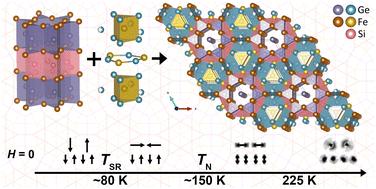
Fe32+δGe35−xSix was synthesized using solid-state and chemical vapor transport reactions in both powder and single crystalline forms. Single crystal and high-resolution powder X-ray diffraction experiments revealed Fe32+δGe35−xSix to be the third member of the Fe32+δGe35−xEx (E = p-element) family of ternary compounds alongside Fe32+δGe33As2 and Fe32+δGe35−xPx. Fe32+δGe35−xSix features a two-dimensional intergrowth structure of two parent structure types: MgFe6Ge6 and Co2Al5. Similar to the other members, the stabilisation of the intergrowth structure in Fe32+δGe35−xSix occurs as a result of p-element substitution in the MgFe6Ge6-type block. The intergrowth breaks the kagome net of MgFe6Ge6 into individual hexagrams while providing additional layers of geometrically frustrated atomic arrangements. Magnetic measurements showed antiferromagnetic ordering at TN ∼ 150–160 K and spin reorientation below 80–90 K owing to the competition between magnetic interactions in the frustrated magnetic lattice of Fe32+δGe35−xSix.
期刊介绍:
Dalton Transactions is a journal for all areas of inorganic chemistry, which encompasses the organometallic, bioinorganic and materials chemistry of the elements, with applications including synthesis, catalysis, energy conversion/storage, electrical devices and medicine. Dalton Transactions welcomes high-quality, original submissions in all of these areas and more, where the advancement of knowledge in inorganic chemistry is significant.



 京公网安备 11010802042870号
京ICP备2023020795号-1
京公网安备 11010802042870号
京ICP备2023020795号-1

 分享
分享
 求助内容:
求助内容: 应助结果提醒方式:
 扫码关注我们
