{"title":"Synthesis of highly dispersible TiO2 nanoparticles and their application in quantum dot light emitting diodes†","authors":"Botao Hu, Mengxin Liu, Xinan Shi and Daocheng Pan","doi":"10.1039/D5DT00410A","DOIUrl":null,"url":null,"abstract":"<p >Metal oxide nanoparticles are commonly used as electron transport layers (ETLs) in quantum dot light emitting diodes (QLEDs) because of their wide band gap, high electron mobility, and appropriate conduction and valence band positions. Currently, nanoparticulate ZnO is the most successful electron transportation material in high-performance QLEDs. However, the positive aging effect is widely observed for ZnO-based QLEDs, as the instability of amphiprotic ZnO nanoparticles under acidic, basic, and moist conditions limits their applications. In this study, highly dispersible and alcohol-soluble TiO<small><sub>2</sub></small> nanoparticles are synthesized by using a non-hydrolytic sol–gel method, followed by a dimethyl sulfoxide post-treatment. The use of colloidal TiO<small><sub>2</sub></small> nanoparticles as an ETL yields optimal QLEDs, with a maximum external quantum efficiency of 12.03%, a highest luminance value of 103 420 cd m<small><sup>−2</sup></small>, and a current efficiency of 18.06 cd A<small><sup>−1</sup></small>. These results reveal that TiO<small><sub>2</sub></small> nanoparticles hold great potential as ETLs in future QLEDs.</p>","PeriodicalId":71,"journal":{"name":"Dalton Transactions","volume":" 20","pages":" 8174-8182"},"PeriodicalIF":3.3000,"publicationDate":"2025-04-15","publicationTypes":"Journal Article","fieldsOfStudy":null,"isOpenAccess":false,"openAccessPdf":"","citationCount":"0","resultStr":null,"platform":"Semanticscholar","paperid":null,"PeriodicalName":"Dalton Transactions","FirstCategoryId":"92","ListUrlMain":"https://pubs.rsc.org/en/content/articlelanding/2025/dt/d5dt00410a","RegionNum":3,"RegionCategory":"化学","ArticlePicture":[],"TitleCN":null,"AbstractTextCN":null,"PMCID":null,"EPubDate":"","PubModel":"","JCR":"Q2","JCRName":"CHEMISTRY, INORGANIC & NUCLEAR","Score":null,"Total":0}
引用次数: 0
Abstract
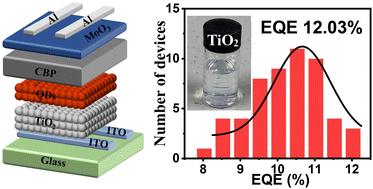
Metal oxide nanoparticles are commonly used as electron transport layers (ETLs) in quantum dot light emitting diodes (QLEDs) because of their wide band gap, high electron mobility, and appropriate conduction and valence band positions. Currently, nanoparticulate ZnO is the most successful electron transportation material in high-performance QLEDs. However, the positive aging effect is widely observed for ZnO-based QLEDs, as the instability of amphiprotic ZnO nanoparticles under acidic, basic, and moist conditions limits their applications. In this study, highly dispersible and alcohol-soluble TiO2 nanoparticles are synthesized by using a non-hydrolytic sol–gel method, followed by a dimethyl sulfoxide post-treatment. The use of colloidal TiO2 nanoparticles as an ETL yields optimal QLEDs, with a maximum external quantum efficiency of 12.03%, a highest luminance value of 103 420 cd m−2, and a current efficiency of 18.06 cd A−1. These results reveal that TiO2 nanoparticles hold great potential as ETLs in future QLEDs.
期刊介绍:
Dalton Transactions is a journal for all areas of inorganic chemistry, which encompasses the organometallic, bioinorganic and materials chemistry of the elements, with applications including synthesis, catalysis, energy conversion/storage, electrical devices and medicine. Dalton Transactions welcomes high-quality, original submissions in all of these areas and more, where the advancement of knowledge in inorganic chemistry is significant.



 京公网安备 11010802042870号
京ICP备2023020795号-1
京公网安备 11010802042870号
京ICP备2023020795号-1

 分享
分享
 求助内容:
求助内容: 应助结果提醒方式:
 扫码关注我们
