Bibek Kumar, Sanghamitro Chatterjee, Amit Agrawal, Rajneesh Bhardwaj
{"title":"Asymmetric Deposits and Crack Formation during Desiccation of a Blood Droplet on an Inclined Surface","authors":"Bibek Kumar, Sanghamitro Chatterjee, Amit Agrawal, Rajneesh Bhardwaj","doi":"10.1021/acs.langmuir.4c03767","DOIUrl":null,"url":null,"abstract":"We study the combined effect of varying droplet volume and inclination angles on the desiccation patterns left behind evaporating sessile droplets of human blood. We systematically varied the droplet volume in a range of [1–10 μL] and inclination angles between [0–70°]. Microstructural characterization of the deposits was performed using optical microscopy and surface profilometry. On a horizontal surface, typical deposits of toroidal shape with cracks oriented in radial and azimuthal directions were observed. With an increase in the droplet volume and inclination, the interplay between the gravitational and surface tension effects leads to an asymmetric liquid–vapor interface shape, resulting in a differential evaporative mass flux pattern across the interface. Subsequently, we observe elongation of the overall desiccation patterns along with asymmetric mass deposits between the advancing and receding fronts. As a consequence, the crack morphology on the two fronts exhibits pronounced differences. The distinct regimes of asymmetric mass deposits and crack morphology were quantitatively examined as a characteristic of varying droplet volume and inclinations, parametrized in terms of the mean radial crack spacing and width. These findings are qualitatively analyzed by a first-order theoretical model that is based on the energy conservation principle incorporating the release of mechanical stress energy by contraction of the deposit at the last stage of the desiccation process and the consumed surface energy upon formation of the new surfaces during crack evolution.","PeriodicalId":50,"journal":{"name":"Langmuir","volume":"40 1","pages":""},"PeriodicalIF":3.9000,"publicationDate":"2025-04-14","publicationTypes":"Journal Article","fieldsOfStudy":null,"isOpenAccess":false,"openAccessPdf":"","citationCount":"0","resultStr":null,"platform":"Semanticscholar","paperid":null,"PeriodicalName":"Langmuir","FirstCategoryId":"92","ListUrlMain":"https://doi.org/10.1021/acs.langmuir.4c03767","RegionNum":2,"RegionCategory":"化学","ArticlePicture":[],"TitleCN":null,"AbstractTextCN":null,"PMCID":null,"EPubDate":"","PubModel":"","JCR":"Q2","JCRName":"CHEMISTRY, MULTIDISCIPLINARY","Score":null,"Total":0}
引用次数: 0
Abstract
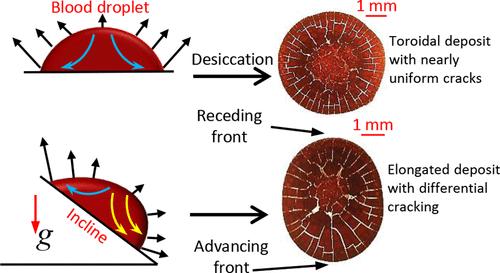
We study the combined effect of varying droplet volume and inclination angles on the desiccation patterns left behind evaporating sessile droplets of human blood. We systematically varied the droplet volume in a range of [1–10 μL] and inclination angles between [0–70°]. Microstructural characterization of the deposits was performed using optical microscopy and surface profilometry. On a horizontal surface, typical deposits of toroidal shape with cracks oriented in radial and azimuthal directions were observed. With an increase in the droplet volume and inclination, the interplay between the gravitational and surface tension effects leads to an asymmetric liquid–vapor interface shape, resulting in a differential evaporative mass flux pattern across the interface. Subsequently, we observe elongation of the overall desiccation patterns along with asymmetric mass deposits between the advancing and receding fronts. As a consequence, the crack morphology on the two fronts exhibits pronounced differences. The distinct regimes of asymmetric mass deposits and crack morphology were quantitatively examined as a characteristic of varying droplet volume and inclinations, parametrized in terms of the mean radial crack spacing and width. These findings are qualitatively analyzed by a first-order theoretical model that is based on the energy conservation principle incorporating the release of mechanical stress energy by contraction of the deposit at the last stage of the desiccation process and the consumed surface energy upon formation of the new surfaces during crack evolution.
期刊介绍:
Langmuir is an interdisciplinary journal publishing articles in the following subject categories:
Colloids: surfactants and self-assembly, dispersions, emulsions, foams
Interfaces: adsorption, reactions, films, forces
Biological Interfaces: biocolloids, biomolecular and biomimetic materials
Materials: nano- and mesostructured materials, polymers, gels, liquid crystals
Electrochemistry: interfacial charge transfer, charge transport, electrocatalysis, electrokinetic phenomena, bioelectrochemistry
Devices and Applications: sensors, fluidics, patterning, catalysis, photonic crystals
However, when high-impact, original work is submitted that does not fit within the above categories, decisions to accept or decline such papers will be based on one criteria: What Would Irving Do?
Langmuir ranks #2 in citations out of 136 journals in the category of Physical Chemistry with 113,157 total citations. The journal received an Impact Factor of 4.384*.
This journal is also indexed in the categories of Materials Science (ranked #1) and Multidisciplinary Chemistry (ranked #5).



 京公网安备 11010802042870号
京ICP备2023020795号-1
京公网安备 11010802042870号
京ICP备2023020795号-1

 分享
分享
 求助内容:
求助内容: 应助结果提醒方式:
 扫码关注我们
