Coalescence-Driven Local Crowding Promotes Liquid-to-Solid-Like Phase Transition in a Homogeneous and Heterogeneous Droplet Assembly: Regulatory Role of Ligands
Chinmaya Kumar Patel, Abhradip Mallik, Deb Kumar Rath, Rajesh Kumar, Tushar Kanti Mukherjee
{"title":"Coalescence-Driven Local Crowding Promotes Liquid-to-Solid-Like Phase Transition in a Homogeneous and Heterogeneous Droplet Assembly: Regulatory Role of Ligands","authors":"Chinmaya Kumar Patel, Abhradip Mallik, Deb Kumar Rath, Rajesh Kumar, Tushar Kanti Mukherjee","doi":"10.1021/acs.langmuir.5c00633","DOIUrl":null,"url":null,"abstract":"Liquid-to-solid-like phase transition (LSPT) of disordered proteins via metastable liquid-like droplets is a well-documented phenomenon in biology and is linked to many pathological conditions including neurodegenerative diseases. However, very less is known about the early microscopic events and transient intermediates involved in the irreversible protein aggregation of functional globular proteins. Herein, using a range of microscopic and spectroscopic techniques, we show that the LSPT of a functional globular protein, human serum albumin (HSA), is exclusively driven by spontaneous coalescence of liquid-like droplets involving various transient intermediates in a temporal manner. We show that interdroplet communication via coalescence is essential for both initial aggregation and growth of amorphous aggregates within individual droplets, which subsequently transform to amyloid-like fibrils. Immobilized droplets neither show any nucleation nor any growth upon aging. Moreover, we found that the exchange of materials with the dilute dispersed phase has negligible influence on the LSPT of HSA. Our findings reveal that interfacial properties effectively modulate the feasibility and kinetics of LSPT of HSA via ligand binding, suggesting a possible regulatory mechanism that cells utilize to control the dynamics of LSPT. Furthermore, using a dynamic heterogeneous droplet assembly of two functional proteins, HSA and human serum transferrin (Tf), we show an intriguing phenomenon within the fused droplets where both liquid-like and solid-like phases coexist within the same droplet, which eventually transform to a mixed fibrillar assembly. These microscopic insights not only highlight the importance of interdroplet interactions behind the LSPT of biomolecules but also showcase its adverse effect on the structure and function of other functional proteins in a crowded and heterogeneous protein assembly.","PeriodicalId":50,"journal":{"name":"Langmuir","volume":"60 1","pages":""},"PeriodicalIF":3.9000,"publicationDate":"2025-04-14","publicationTypes":"Journal Article","fieldsOfStudy":null,"isOpenAccess":false,"openAccessPdf":"","citationCount":"0","resultStr":null,"platform":"Semanticscholar","paperid":null,"PeriodicalName":"Langmuir","FirstCategoryId":"92","ListUrlMain":"https://doi.org/10.1021/acs.langmuir.5c00633","RegionNum":2,"RegionCategory":"化学","ArticlePicture":[],"TitleCN":null,"AbstractTextCN":null,"PMCID":null,"EPubDate":"","PubModel":"","JCR":"Q2","JCRName":"CHEMISTRY, MULTIDISCIPLINARY","Score":null,"Total":0}
引用次数: 0
Abstract
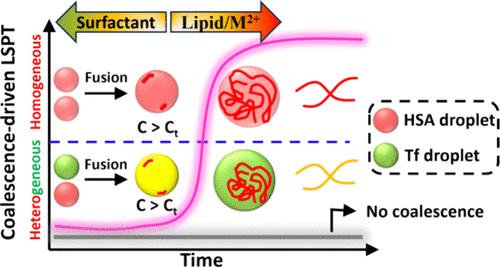
Liquid-to-solid-like phase transition (LSPT) of disordered proteins via metastable liquid-like droplets is a well-documented phenomenon in biology and is linked to many pathological conditions including neurodegenerative diseases. However, very less is known about the early microscopic events and transient intermediates involved in the irreversible protein aggregation of functional globular proteins. Herein, using a range of microscopic and spectroscopic techniques, we show that the LSPT of a functional globular protein, human serum albumin (HSA), is exclusively driven by spontaneous coalescence of liquid-like droplets involving various transient intermediates in a temporal manner. We show that interdroplet communication via coalescence is essential for both initial aggregation and growth of amorphous aggregates within individual droplets, which subsequently transform to amyloid-like fibrils. Immobilized droplets neither show any nucleation nor any growth upon aging. Moreover, we found that the exchange of materials with the dilute dispersed phase has negligible influence on the LSPT of HSA. Our findings reveal that interfacial properties effectively modulate the feasibility and kinetics of LSPT of HSA via ligand binding, suggesting a possible regulatory mechanism that cells utilize to control the dynamics of LSPT. Furthermore, using a dynamic heterogeneous droplet assembly of two functional proteins, HSA and human serum transferrin (Tf), we show an intriguing phenomenon within the fused droplets where both liquid-like and solid-like phases coexist within the same droplet, which eventually transform to a mixed fibrillar assembly. These microscopic insights not only highlight the importance of interdroplet interactions behind the LSPT of biomolecules but also showcase its adverse effect on the structure and function of other functional proteins in a crowded and heterogeneous protein assembly.
期刊介绍:
Langmuir is an interdisciplinary journal publishing articles in the following subject categories:
Colloids: surfactants and self-assembly, dispersions, emulsions, foams
Interfaces: adsorption, reactions, films, forces
Biological Interfaces: biocolloids, biomolecular and biomimetic materials
Materials: nano- and mesostructured materials, polymers, gels, liquid crystals
Electrochemistry: interfacial charge transfer, charge transport, electrocatalysis, electrokinetic phenomena, bioelectrochemistry
Devices and Applications: sensors, fluidics, patterning, catalysis, photonic crystals
However, when high-impact, original work is submitted that does not fit within the above categories, decisions to accept or decline such papers will be based on one criteria: What Would Irving Do?
Langmuir ranks #2 in citations out of 136 journals in the category of Physical Chemistry with 113,157 total citations. The journal received an Impact Factor of 4.384*.
This journal is also indexed in the categories of Materials Science (ranked #1) and Multidisciplinary Chemistry (ranked #5).



 京公网安备 11010802042870号
京ICP备2023020795号-1
京公网安备 11010802042870号
京ICP备2023020795号-1

 分享
分享
 求助内容:
求助内容: 应助结果提醒方式:
 扫码关注我们
