Lili Shi, Cassidy S. Anderson, Arthur Y. Baranovskiy, Jian Qin, Yaobin Xu, Rajankumar L. Patel, Chaojiang Niu, Dianying Liu, Rengarajan Pelapur, Eveline G. Booy, Adam Stokes, Zhao Liu, Jie Bao, Jie Xiao, Jun Liu, Dongping Lu
{"title":"Enhancing Volumetric Energy Density in Lithium–Sulfur Batteries through Highly Dense, Low Tortuosity Sulfur Electrodes","authors":"Lili Shi, Cassidy S. Anderson, Arthur Y. Baranovskiy, Jian Qin, Yaobin Xu, Rajankumar L. Patel, Chaojiang Niu, Dianying Liu, Rengarajan Pelapur, Eveline G. Booy, Adam Stokes, Zhao Liu, Jie Bao, Jie Xiao, Jun Liu, Dongping Lu","doi":"10.1002/aenm.202405890","DOIUrl":null,"url":null,"abstract":"<p>Recent advancements in Lithium–sulfur (Li─S) batteries have significantly improved cell-specific energy, while challenges persist in improving volumetric energy and cell cycle life. In this study, a design principle is elucidated to enhance sulfur utilization in high-density and high-sulfur-content electrodes using a liquid-templated shear-rolling method. The findings indicate that a vascular-like hierarchical electrode structure and compatible liquid electrolytes are critical for improving electrolyte permeability in dense electrodes, achieving high sulfur utilization (>1200 mAh g<sup>−1</sup>) under practical conditions (47% cathode porosity, S loading 4.5 mg cm<sup>−2</sup>, S content 70%, E/S 4 mL g<sup>−1</sup>). Li─S pouch cells are demonstrated with an exceptionally high volumetric energy density (668 Wh L<sup>−1</sup>) and extended cycle life by integrating the optimized electrode structures and electrolytes. This study advances understanding and design of high volumetric energy Li─S cells. Additionally, the proposed templated shear-rolling technique shows potential for application in the fabrication of other high-energy electrodes.</p>","PeriodicalId":111,"journal":{"name":"Advanced Energy Materials","volume":"15 23","pages":""},"PeriodicalIF":26.0000,"publicationDate":"2025-04-15","publicationTypes":"Journal Article","fieldsOfStudy":null,"isOpenAccess":false,"openAccessPdf":"https://onlinelibrary.wiley.com/doi/epdf/10.1002/aenm.202405890","citationCount":"0","resultStr":null,"platform":"Semanticscholar","paperid":null,"PeriodicalName":"Advanced Energy Materials","FirstCategoryId":"88","ListUrlMain":"https://advanced.onlinelibrary.wiley.com/doi/10.1002/aenm.202405890","RegionNum":1,"RegionCategory":"材料科学","ArticlePicture":[],"TitleCN":null,"AbstractTextCN":null,"PMCID":null,"EPubDate":"","PubModel":"","JCR":"Q1","JCRName":"CHEMISTRY, PHYSICAL","Score":null,"Total":0}
引用次数: 0
Abstract
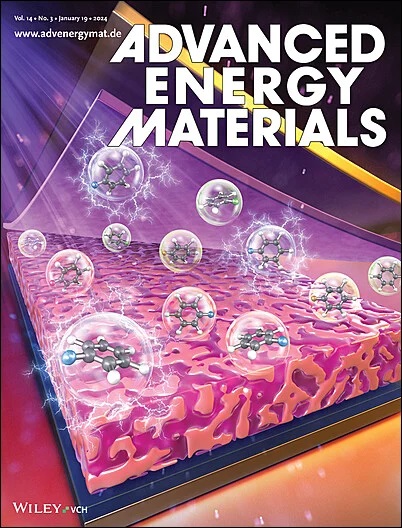
Recent advancements in Lithium–sulfur (Li─S) batteries have significantly improved cell-specific energy, while challenges persist in improving volumetric energy and cell cycle life. In this study, a design principle is elucidated to enhance sulfur utilization in high-density and high-sulfur-content electrodes using a liquid-templated shear-rolling method. The findings indicate that a vascular-like hierarchical electrode structure and compatible liquid electrolytes are critical for improving electrolyte permeability in dense electrodes, achieving high sulfur utilization (>1200 mAh g−1) under practical conditions (47% cathode porosity, S loading 4.5 mg cm−2, S content 70%, E/S 4 mL g−1). Li─S pouch cells are demonstrated with an exceptionally high volumetric energy density (668 Wh L−1) and extended cycle life by integrating the optimized electrode structures and electrolytes. This study advances understanding and design of high volumetric energy Li─S cells. Additionally, the proposed templated shear-rolling technique shows potential for application in the fabrication of other high-energy electrodes.
锂硫(Li─S)电池的最新进展显著提高了电池的比能量,但在提高体积能量和电池循环寿命方面仍然存在挑战。在本研究中,阐明了一种利用液体模板剪切轧制法提高高密度高硫电极硫利用率的设计原则。研究结果表明,血管状分层电极结构和兼容的液体电解质是提高致密电极中电解质渗透率的关键,在实际条件下(阴极孔隙率47%,S负载4.5 mg cm−2,S含量70%,E/S为4 mL g−1)实现高硫利用率(>1200 mAh g−1)。通过集成优化的电极结构和电解质,Li─S袋电池具有极高的体积能量密度(668 Wh L−1)和延长的循环寿命。这项研究促进了对高体积能量锂离子电池的理解和设计。此外,所提出的模板剪切轧制技术在制造其他高能电极方面具有应用潜力。
期刊介绍:
Established in 2011, Advanced Energy Materials is an international, interdisciplinary, English-language journal that focuses on materials used in energy harvesting, conversion, and storage. It is regarded as a top-quality journal alongside Advanced Materials, Advanced Functional Materials, and Small.
With a 2022 Impact Factor of 27.8, Advanced Energy Materials is considered a prime source for the best energy-related research. The journal covers a wide range of topics in energy-related research, including organic and inorganic photovoltaics, batteries and supercapacitors, fuel cells, hydrogen generation and storage, thermoelectrics, water splitting and photocatalysis, solar fuels and thermosolar power, magnetocalorics, and piezoelectronics.
The readership of Advanced Energy Materials includes materials scientists, chemists, physicists, and engineers in both academia and industry. The journal is indexed in various databases and collections, such as Advanced Technologies & Aerospace Database, FIZ Karlsruhe, INSPEC (IET), Science Citation Index Expanded, Technology Collection, and Web of Science, among others.





 京公网安备 11010802042870号
京ICP备2023020795号-1
京公网安备 11010802042870号
京ICP备2023020795号-1

 分享
分享
 求助内容:
求助内容: 应助结果提醒方式:
 扫码关注我们
