{"title":"SnS2(001)-Reinforced Ion/Molecular Sieving Separator Enables High-Performance Aqueous Zinc-Organic Batteries","authors":"Lijuan Hai, Ying Sun, Miaomiao Wu, Zhibo Liu, Yong Guo, Xingchao Wang, Jixi Guo, Dianzeng Jia","doi":"10.1002/adfm.202501468","DOIUrl":null,"url":null,"abstract":"<p>Challenges including dendrite growth on Zn anodes and organic cathode dissolution severely hinder the practical application of aqueous zinc-organic batteries (AZOBs). Herein, a Janus separator engineered by anchoring SnS<sub>2</sub>(001) nanosheets onto glass fiber (SnS<sub>2</sub>(001)@GF) to tackle these issues is prsented. The (001) plane orientation of SnS<sub>2</sub>, compared to the (100) crystal plane, features reduced binding energy with Zn<sup>2+</sup> and lower work function, enhancing Zn<sup>2+</sup> ion diffusion, creating uniform electric field and ion concentration, and enabling preferential deposition of Zn<sup>2+</sup> along the (002) direction with rapid kinetics, while concurrently repelling SO<sub>4</sub><sup>2−</sup> ions through electrostatic repulsion. Additionally, the hierarchical stacking properties of SnS<sub>2</sub>(001) mitigate the shuttling of organic cathodes. With this Janus separator, a robust SEI layer of ZnS, Zn<sub>5</sub>Sn<sub>4</sub>, and Zn<sub>7</sub>Sn<sub>4</sub> forms on the Zn surface, further inhibiting Zn dendrites and byproduct formation. The Zn//Zn cell exhibits stable cyclability exceeding 2100 h at 1 mA cm<sup>−2</sup> and 1 mAh cm<sup>−2</sup>. The Zn//bipolar organic molecular cathinone (IDT) full battery achieves stable electrochemical behavior over 2250 cycles at 10 A g<sup>−1</sup>, with 100% capacity retention after 850 cycles at a mass loading of 17 mg cm<sup>−1</sup>. Other full batteries utilizing dibenzo[b,i]thianthrene-5,7,12,14–tetraone (DTT) and 5,7,12,14–pentacenetetrone (PT) respectively demonstrate significantly enhanced electrochemical performance.</p>","PeriodicalId":112,"journal":{"name":"Advanced Functional Materials","volume":"35 38","pages":""},"PeriodicalIF":19.0000,"publicationDate":"2025-04-15","publicationTypes":"Journal Article","fieldsOfStudy":null,"isOpenAccess":false,"openAccessPdf":"","citationCount":"0","resultStr":null,"platform":"Semanticscholar","paperid":null,"PeriodicalName":"Advanced Functional Materials","FirstCategoryId":"88","ListUrlMain":"https://advanced.onlinelibrary.wiley.com/doi/10.1002/adfm.202501468","RegionNum":1,"RegionCategory":"材料科学","ArticlePicture":[],"TitleCN":null,"AbstractTextCN":null,"PMCID":null,"EPubDate":"","PubModel":"","JCR":"Q1","JCRName":"CHEMISTRY, MULTIDISCIPLINARY","Score":null,"Total":0}
引用次数: 0
Abstract
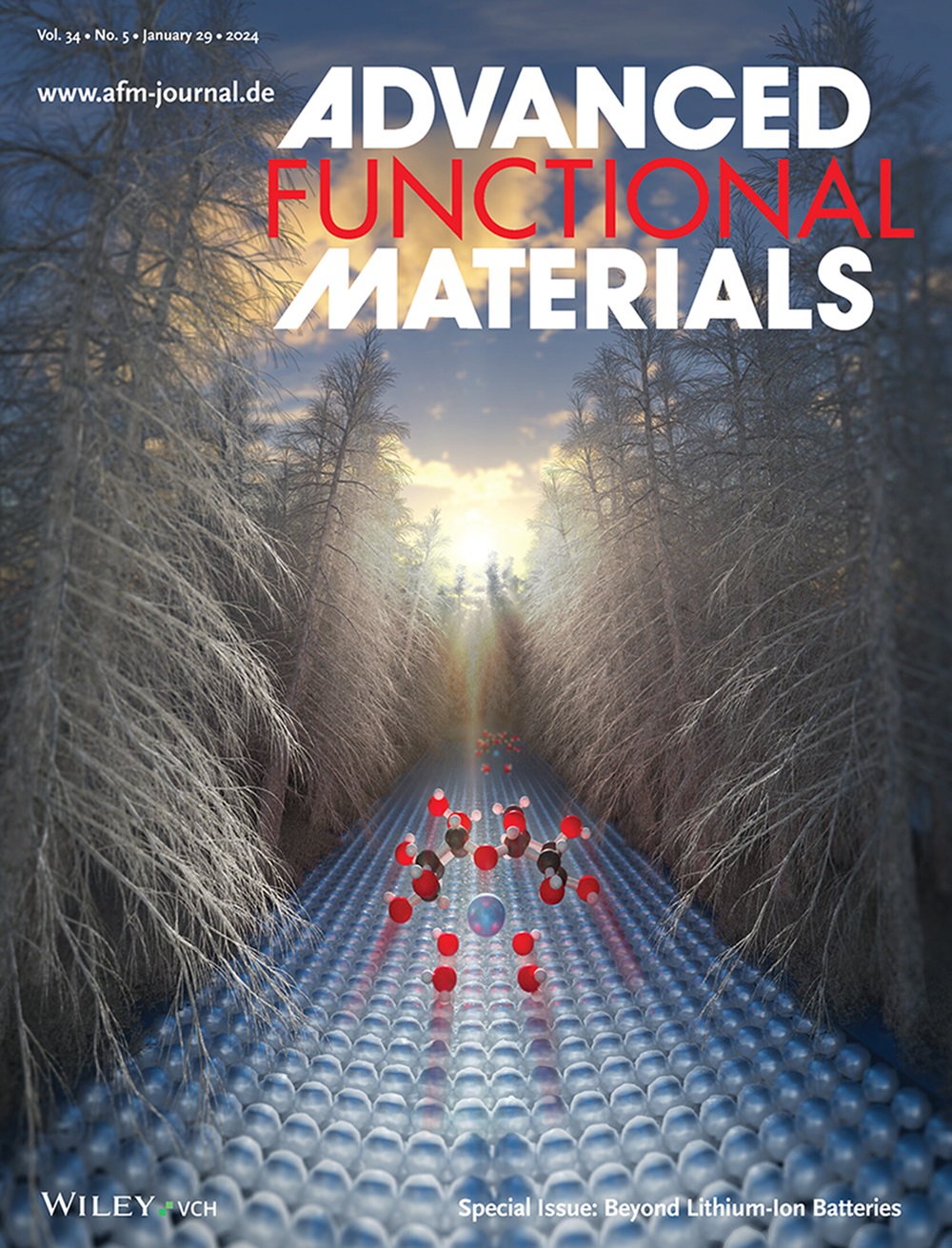
Challenges including dendrite growth on Zn anodes and organic cathode dissolution severely hinder the practical application of aqueous zinc-organic batteries (AZOBs). Herein, a Janus separator engineered by anchoring SnS2(001) nanosheets onto glass fiber (SnS2(001)@GF) to tackle these issues is prsented. The (001) plane orientation of SnS2, compared to the (100) crystal plane, features reduced binding energy with Zn2+ and lower work function, enhancing Zn2+ ion diffusion, creating uniform electric field and ion concentration, and enabling preferential deposition of Zn2+ along the (002) direction with rapid kinetics, while concurrently repelling SO42− ions through electrostatic repulsion. Additionally, the hierarchical stacking properties of SnS2(001) mitigate the shuttling of organic cathodes. With this Janus separator, a robust SEI layer of ZnS, Zn5Sn4, and Zn7Sn4 forms on the Zn surface, further inhibiting Zn dendrites and byproduct formation. The Zn//Zn cell exhibits stable cyclability exceeding 2100 h at 1 mA cm−2 and 1 mAh cm−2. The Zn//bipolar organic molecular cathinone (IDT) full battery achieves stable electrochemical behavior over 2250 cycles at 10 A g−1, with 100% capacity retention after 850 cycles at a mass loading of 17 mg cm−1. Other full batteries utilizing dibenzo[b,i]thianthrene-5,7,12,14–tetraone (DTT) and 5,7,12,14–pentacenetetrone (PT) respectively demonstrate significantly enhanced electrochemical performance.
锌阳极枝晶生长和有机阴极溶解等问题严重阻碍了水基锌有机电池的实际应用。本文提出了一种将SnS2(001)纳米片锚定在玻璃纤维(SnS2(001)@GF)上的Janus分离器来解决这些问题。与(100)晶面相比,SnS2的(001)面取向降低了与Zn2+的束缚能,降低了功函数,增强了Zn2+离子的扩散,形成了均匀的电场和离子浓度,使Zn2+沿(002)方向以快速动力学的方式优先沉积,同时通过静电斥力排斥SO42−离子。此外,SnS2(001)的层叠特性减轻了有机阴极的穿梭。使用这种Janus分离器,在Zn表面形成了一层坚固的由ZnS、Zn5Sn4和Zn7Sn4组成的SEI层,进一步抑制了Zn枝晶和副产物的形成。锌/锌电池在1ma cm - 2和1mah cm - 2下具有超过2100小时的稳定可循环性。锌//双极有机分子卡西酮(IDT)全电池在10 A g−1下可在2250次循环中获得稳定的电化学行为,在17 mg cm−1的质量负载下可在850次循环后保持100%的容量。其他使用二苯并[b,i]噻吩-5,7,12,14 -四酮(DTT)和5,7,12,14 -五碳四酮(PT)的全电池分别表现出显著提高的电化学性能。
期刊介绍:
Firmly established as a top-tier materials science journal, Advanced Functional Materials reports breakthrough research in all aspects of materials science, including nanotechnology, chemistry, physics, and biology every week.
Advanced Functional Materials is known for its rapid and fair peer review, quality content, and high impact, making it the first choice of the international materials science community.



 京公网安备 11010802042870号
京ICP备2023020795号-1
京公网安备 11010802042870号
京ICP备2023020795号-1

 分享
分享
 求助内容:
求助内容: 应助结果提醒方式:
 扫码关注我们
