Soil fertility matters! A new conceptual model for carbon stewardship in neotropical croplands taking climate-smart agricultural practices into account
Laudelino Vieira da Mota Neto , João Paulo Ribeiro-Oliveira , Marcelo Valadares Galdos , José Victor Silva Barros , Karina Mendes Bertolino , Juliano Carlos Calonego , Ciro Antonio Rosolem
{"title":"Soil fertility matters! A new conceptual model for carbon stewardship in neotropical croplands taking climate-smart agricultural practices into account","authors":"Laudelino Vieira da Mota Neto , João Paulo Ribeiro-Oliveira , Marcelo Valadares Galdos , José Victor Silva Barros , Karina Mendes Bertolino , Juliano Carlos Calonego , Ciro Antonio Rosolem","doi":"10.1016/j.scitotenv.2025.179407","DOIUrl":null,"url":null,"abstract":"<div><div>Mismanagement of agroecosystems in Neotropical regions threatens global security, accelerating the transgression of planetary boundaries. Therefore, understanding carbon (C) stewardship and how climate-smart agriculture (CSA) practices change nutrient availability plays a central role. Here, we analyzed nutrient availability, nitrogen (N) inputs, climate, and soil texture influence C flow into particulate (POC) and mineral-associated organic carbon (MAOC) pools to support sustainable C management in neotropical agroecosystems. To test our hypothesis data were collected from three field experimental agroecosystem sites and a literature overview. Our machine learning models estimated that nutrient availability, notably zinc (Zn), and soil texture, regulate C flow into POC and MAOC pools in agroecosystems. The climate variables exhibited minimal effects. There was no MAOC C saturation in neotropical agroecosystems, with an upper boundary of 36 g C kg<sup>-1</sup>. This demonstrates the potential of nature-based solutions for C storage in tropical soils. Synthetic N fertilization was not a key driver of C flow into POC and MAOC pools in these agroecosystems; however, organic N inputs, such as those from legumes, showed significant potential in increasing soil C and reducing carbon-to‑nitrogen ratio. Our main finding reveals soil fertility as a key regulator of C flow into POC and MAOC pools in Neotropical agroecosystems. Additionally, nature-based solutions from CSA are viable for atmospheric carbon removal strategies in Neotropical areas. Thus, by integrating experimental and simulated insights, we propose a new conceptual model linking nutrient availability to C stewardship in neotropical agroecosystems, outlining existing knowledge gaps and suggesting directions for future research toward climate-smart agriculture.</div></div>","PeriodicalId":422,"journal":{"name":"Science of the Total Environment","volume":"978 ","pages":"Article 179407"},"PeriodicalIF":8.0000,"publicationDate":"2025-05-25","publicationTypes":"Journal Article","fieldsOfStudy":null,"isOpenAccess":false,"openAccessPdf":"","citationCount":"0","resultStr":null,"platform":"Semanticscholar","paperid":null,"PeriodicalName":"Science of the Total Environment","FirstCategoryId":"93","ListUrlMain":"https://www.sciencedirect.com/science/article/pii/S0048969725010447","RegionNum":1,"RegionCategory":"环境科学与生态学","ArticlePicture":[],"TitleCN":null,"AbstractTextCN":null,"PMCID":null,"EPubDate":"2025/4/16 0:00:00","PubModel":"Epub","JCR":"Q1","JCRName":"ENVIRONMENTAL SCIENCES","Score":null,"Total":0}
引用次数: 0
Abstract
Mismanagement of agroecosystems in Neotropical regions threatens global security, accelerating the transgression of planetary boundaries. Therefore, understanding carbon (C) stewardship and how climate-smart agriculture (CSA) practices change nutrient availability plays a central role. Here, we analyzed nutrient availability, nitrogen (N) inputs, climate, and soil texture influence C flow into particulate (POC) and mineral-associated organic carbon (MAOC) pools to support sustainable C management in neotropical agroecosystems. To test our hypothesis data were collected from three field experimental agroecosystem sites and a literature overview. Our machine learning models estimated that nutrient availability, notably zinc (Zn), and soil texture, regulate C flow into POC and MAOC pools in agroecosystems. The climate variables exhibited minimal effects. There was no MAOC C saturation in neotropical agroecosystems, with an upper boundary of 36 g C kg-1. This demonstrates the potential of nature-based solutions for C storage in tropical soils. Synthetic N fertilization was not a key driver of C flow into POC and MAOC pools in these agroecosystems; however, organic N inputs, such as those from legumes, showed significant potential in increasing soil C and reducing carbon-to‑nitrogen ratio. Our main finding reveals soil fertility as a key regulator of C flow into POC and MAOC pools in Neotropical agroecosystems. Additionally, nature-based solutions from CSA are viable for atmospheric carbon removal strategies in Neotropical areas. Thus, by integrating experimental and simulated insights, we propose a new conceptual model linking nutrient availability to C stewardship in neotropical agroecosystems, outlining existing knowledge gaps and suggesting directions for future research toward climate-smart agriculture.
新热带地区农业生态系统管理不善威胁着全球安全,加速了地球边界的越界。因此,了解碳(C)管理以及气候智慧型农业(CSA)实践如何改变养分可用性至关重要。在这里,我们分析了养分有效性、氮(N)输入、气候和土壤质地对碳流入颗粒(POC)和矿物相关有机碳(MAOC)库的影响,以支持新热带农业生态系统的可持续碳管理。为了验证我们的假设,我们收集了三个田间试验农业生态系统站点的数据并进行了文献综述。我们的机器学习模型估计养分有效性,特别是锌(Zn)和土壤质地,调节农业生态系统中碳流入POC和MAOC库。气候变量的影响最小。新热带农业生态系统未出现MAOC C饱和,上限为36 g C kg-1。这显示了热带土壤中基于自然的碳储存解决方案的潜力。在这些农业生态系统中,合成氮肥不是碳流入POC和MAOC库的关键驱动因素;然而,有机氮的输入,如豆科植物的输入,在增加土壤C和降低碳氮比方面显示出显著的潜力。我们的主要发现揭示了土壤肥力是新热带农业生态系统中碳流入POC和MAOC库的关键调节因子。此外,基于CSA的自然解决方案对于新热带地区的大气碳去除策略是可行的。因此,通过整合实验和模拟的见解,我们提出了一个新的概念模型,将新热带农业生态系统中的养分可用性与碳管理联系起来,概述了现有的知识空白,并为未来的气候智慧型农业研究提出了方向。
期刊介绍:
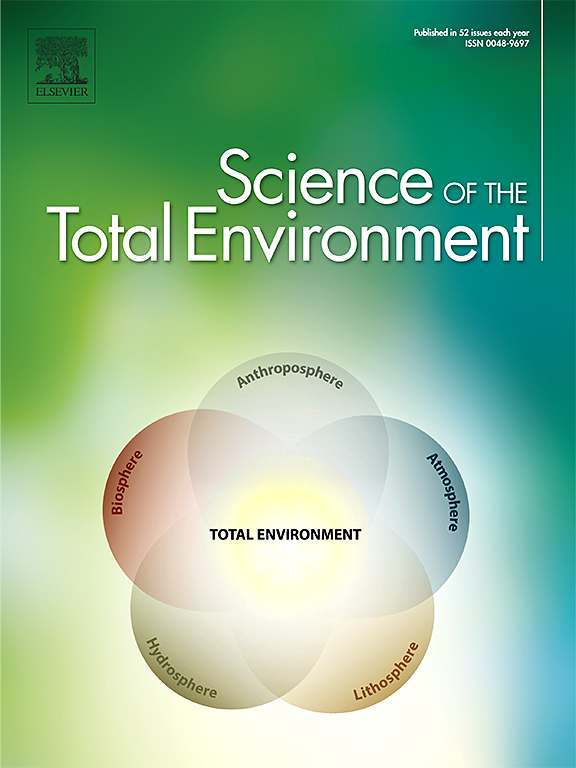
The Science of the Total Environment is an international journal dedicated to scientific research on the environment and its interaction with humanity. It covers a wide range of disciplines and seeks to publish innovative, hypothesis-driven, and impactful research that explores the entire environment, including the atmosphere, lithosphere, hydrosphere, biosphere, and anthroposphere.
The journal's updated Aims & Scope emphasizes the importance of interdisciplinary environmental research with broad impact. Priority is given to studies that advance fundamental understanding and explore the interconnectedness of multiple environmental spheres. Field studies are preferred, while laboratory experiments must demonstrate significant methodological advancements or mechanistic insights with direct relevance to the environment.




 京公网安备 11010802042870号
京ICP备2023020795号-1
京公网安备 11010802042870号
京ICP备2023020795号-1

 分享
分享
 求助内容:
求助内容: 应助结果提醒方式:
 扫码关注我们
