Shitang Song , Xu Ma , Xingfan Li , Bingbing Xu , Weishuo Li , Ronghui Deng , Jing Ye , Zongran Liu , Haoqi Yu , Luzheng Xu , Shuhui Zhang , Donghui Yang , Mali Zu , Tianjiao Ji , Guangjun Nie , Jia-Kuo Yu
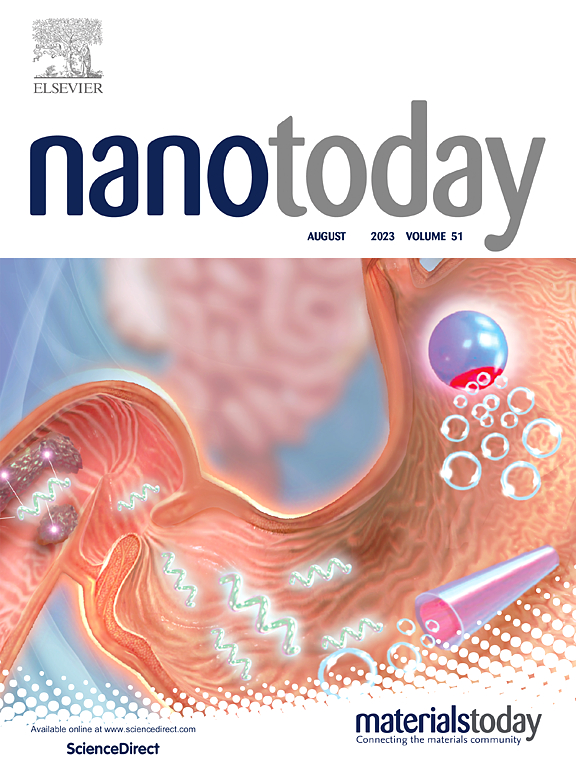
{"title":"Targeting a key pro-fibrotic factor S100A4 in cartilage to alleviate osteoarthritis progression and pain","authors":"Shitang Song , Xu Ma , Xingfan Li , Bingbing Xu , Weishuo Li , Ronghui Deng , Jing Ye , Zongran Liu , Haoqi Yu , Luzheng Xu , Shuhui Zhang , Donghui Yang , Mali Zu , Tianjiao Ji , Guangjun Nie , Jia-Kuo Yu","doi":"10.1016/j.nantod.2025.102755","DOIUrl":null,"url":null,"abstract":"<div><div>Osteoarthritis (OA) is the most prevalent degenerative joint disease marked by cartilage degeneration, synovial inflammation and pain, which seriously affects life quality of patients. However, due to unclear pathological mechanisms, there is still lack of specific targets at the molecular level for OA treatment. Since OA-related cartilage displays pathological features of fibrosis, such as increased secretion of collagen I (COL I) but decreased secretion of collagen II (COL II), and cartilage fibrosis is usually defined as a final-stage of OA, we hypothesized that fibrosis related factors could promote OA progression. By combining public databases with pathological analysis of clinical OA immunohistochemistry samples, we found that a key pro-fibrotic factor, S100A4, also named fibroblast specific protein-1 (FSP-1), was overexpressed by OA chondrocytes and positively related with OA progression. To investigate if S100A4 can be a therapeutic target of OA, we designed <u>c</u>artilage-<u>t</u>argeting <u>l</u>ipid <u>n</u>ano<u>p</u>articles (CT-LNP) loading S100A4 siRNA (CT-LNP-siA4) to silence the S100A4 gene in OA chondrocytes. In both mouse and rat OA models, CT-LNP-siA4 could significantly downregulate the expression of S100A4 and OA phenotype-related molecules, such as COL I, MMP-13, and IL-6, inhibiting OA progression and chronic pain. This study validated S100A4 as a potential molecular target and proved that the corresponding LNP drug formulation was effective for the OA treatment at various animal models.</div></div>","PeriodicalId":395,"journal":{"name":"Nano Today","volume":"63 ","pages":"Article 102755"},"PeriodicalIF":10.9000,"publicationDate":"2025-08-01","publicationTypes":"Journal Article","fieldsOfStudy":null,"isOpenAccess":false,"openAccessPdf":"","citationCount":"0","resultStr":null,"platform":"Semanticscholar","paperid":null,"PeriodicalName":"Nano Today","FirstCategoryId":"88","ListUrlMain":"https://www.sciencedirect.com/science/article/pii/S1748013225001276","RegionNum":1,"RegionCategory":"材料科学","ArticlePicture":[],"TitleCN":null,"AbstractTextCN":null,"PMCID":null,"EPubDate":"2025/4/15 0:00:00","PubModel":"Epub","JCR":"Q1","JCRName":"CHEMISTRY, MULTIDISCIPLINARY","Score":null,"Total":0}
引用次数: 0
Abstract
Osteoarthritis (OA) is the most prevalent degenerative joint disease marked by cartilage degeneration, synovial inflammation and pain, which seriously affects life quality of patients. However, due to unclear pathological mechanisms, there is still lack of specific targets at the molecular level for OA treatment. Since OA-related cartilage displays pathological features of fibrosis, such as increased secretion of collagen I (COL I) but decreased secretion of collagen II (COL II), and cartilage fibrosis is usually defined as a final-stage of OA, we hypothesized that fibrosis related factors could promote OA progression. By combining public databases with pathological analysis of clinical OA immunohistochemistry samples, we found that a key pro-fibrotic factor, S100A4, also named fibroblast specific protein-1 (FSP-1), was overexpressed by OA chondrocytes and positively related with OA progression. To investigate if S100A4 can be a therapeutic target of OA, we designed cartilage-targeting lipid nanoparticles (CT-LNP) loading S100A4 siRNA (CT-LNP-siA4) to silence the S100A4 gene in OA chondrocytes. In both mouse and rat OA models, CT-LNP-siA4 could significantly downregulate the expression of S100A4 and OA phenotype-related molecules, such as COL I, MMP-13, and IL-6, inhibiting OA progression and chronic pain. This study validated S100A4 as a potential molecular target and proved that the corresponding LNP drug formulation was effective for the OA treatment at various animal models.
期刊介绍:
Nano Today is a journal dedicated to publishing influential and innovative work in the field of nanoscience and technology. It covers a wide range of subject areas including biomaterials, materials chemistry, materials science, chemistry, bioengineering, biochemistry, genetics and molecular biology, engineering, and nanotechnology. The journal considers articles that inform readers about the latest research, breakthroughs, and topical issues in these fields. It provides comprehensive coverage through a mixture of peer-reviewed articles, research news, and information on key developments. Nano Today is abstracted and indexed in Science Citation Index, Ei Compendex, Embase, Scopus, and INSPEC.



 京公网安备 11010802042870号
京ICP备2023020795号-1
京公网安备 11010802042870号
京ICP备2023020795号-1

 分享
分享
 求助内容:
求助内容: 应助结果提醒方式:
 扫码关注我们
