Recent advances in gold nanoparticle-graphene hybrid nanoplatforms with visible to near-infrared response for photodynamic and photothermal therapy and bioimaging
Alexandru Holca, Vlad Cucuiet, Simion Astilean, Marc Lamy de la Chapelle and Monica Focsan
{"title":"Recent advances in gold nanoparticle-graphene hybrid nanoplatforms with visible to near-infrared response for photodynamic and photothermal therapy and bioimaging","authors":"Alexandru Holca, Vlad Cucuiet, Simion Astilean, Marc Lamy de la Chapelle and Monica Focsan","doi":"10.1039/D4RA09100K","DOIUrl":null,"url":null,"abstract":"<p >Photodynamic therapy (PDT) and photothermal therapy (PTT) are light-activated cancer treatments. PDT involves the administration of a photosensitizing agent, which is activated by light of a specific wavelength to generate reactive oxygen species. Alternatively, PTT involves the use of photothermal agents, which are materials that absorb light and convert it into heat. Gold nanoparticles are often used as photothermal agents owing to their localized surface plasmon resonance (LSPR), a key optical property, which allows them to efficiently absorb light and convert it into heat. Graphene, which is a 2D material with extraordinary optical and physical properties and a large surface area, shows great promise both in PDT and PTT as an intrinsic nanoheater or a versatile platform for the immobilization of gold nanoparticles and other functional molecules, including photosensitizers. Moreover, graphene-based derivatives, <em>i.e.</em> graphene oxide (GO) and reduced graphene oxide (rGO), exhibit intrinsic optical/spectroscopic signals, which can be used in fluorescence, Raman and thermal imaging. By combining gold nanoparticles with graphene derivatives, a higher increase in temperature can be achieved under light irradiation owing to the synergistic effect of these two materials and the drug delivery efficiency and multimodal imaging techniques can be enhanced. This review provides insights into graphene-based nanoplatforms, focusing on multimodal therapy and imaging techniques. Furthermore, future perspectives in the field of graphene-based- and hybrid-nanoplatforms are suggested.</p>","PeriodicalId":102,"journal":{"name":"RSC Advances","volume":" 15","pages":" 11902-11922"},"PeriodicalIF":4.6000,"publicationDate":"2025-04-15","publicationTypes":"Journal Article","fieldsOfStudy":null,"isOpenAccess":false,"openAccessPdf":"https://pubs.rsc.org/en/content/articlepdf/2025/ra/d4ra09100k?page=search","citationCount":"0","resultStr":null,"platform":"Semanticscholar","paperid":null,"PeriodicalName":"RSC Advances","FirstCategoryId":"92","ListUrlMain":"https://pubs.rsc.org/en/content/articlelanding/2025/ra/d4ra09100k","RegionNum":3,"RegionCategory":"化学","ArticlePicture":[],"TitleCN":null,"AbstractTextCN":null,"PMCID":null,"EPubDate":"","PubModel":"","JCR":"Q2","JCRName":"CHEMISTRY, MULTIDISCIPLINARY","Score":null,"Total":0}
引用次数: 0
Abstract
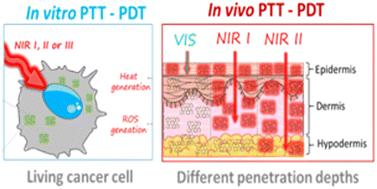
Photodynamic therapy (PDT) and photothermal therapy (PTT) are light-activated cancer treatments. PDT involves the administration of a photosensitizing agent, which is activated by light of a specific wavelength to generate reactive oxygen species. Alternatively, PTT involves the use of photothermal agents, which are materials that absorb light and convert it into heat. Gold nanoparticles are often used as photothermal agents owing to their localized surface plasmon resonance (LSPR), a key optical property, which allows them to efficiently absorb light and convert it into heat. Graphene, which is a 2D material with extraordinary optical and physical properties and a large surface area, shows great promise both in PDT and PTT as an intrinsic nanoheater or a versatile platform for the immobilization of gold nanoparticles and other functional molecules, including photosensitizers. Moreover, graphene-based derivatives, i.e. graphene oxide (GO) and reduced graphene oxide (rGO), exhibit intrinsic optical/spectroscopic signals, which can be used in fluorescence, Raman and thermal imaging. By combining gold nanoparticles with graphene derivatives, a higher increase in temperature can be achieved under light irradiation owing to the synergistic effect of these two materials and the drug delivery efficiency and multimodal imaging techniques can be enhanced. This review provides insights into graphene-based nanoplatforms, focusing on multimodal therapy and imaging techniques. Furthermore, future perspectives in the field of graphene-based- and hybrid-nanoplatforms are suggested.
期刊介绍:
An international, peer-reviewed journal covering all of the chemical sciences, including multidisciplinary and emerging areas. RSC Advances is a gold open access journal allowing researchers free access to research articles, and offering an affordable open access publishing option for authors around the world.



 京公网安备 11010802042870号
京ICP备2023020795号-1
京公网安备 11010802042870号
京ICP备2023020795号-1

 分享
分享
 求助内容:
求助内容: 应助结果提醒方式:
 扫码关注我们
