{"title":"Research progress on structural regulation of nitrogen-fixing photocatalysts","authors":"Zhao Zhanfeng, Zhang Yue and Gao Ningning","doi":"10.1039/D5RA00953G","DOIUrl":null,"url":null,"abstract":"<p >Photocatalytic nitrogen fixation is a forward-looking technology for zero-carbon nitrogen fixation, which is crucial for alleviating the energy crisis and achieving carbon neutrality. Based on research into the structural regulation of nitrogen-fixing photocatalysts, this review summarizes the latest progress and challenges in photocatalytic ammonia synthesis from three dimensions: active sites, crystal structures, and composite structures. In terms of active site construction, common types of active sites, including metal sites, non-metal sites, vacancies, and single atoms, are discussed. Their characteristics and methods for improving photocatalytic nitrogen fixation performance are analyzed. Furthermore, starting from the mechanism of nitrogen activation, a general strategy for active sites to promote the electron exchange process and thereby enhance nitrogen activation efficiency is explored. In terms of crystal structure construction, the design of nitrogen-fixing photocatalysts is described from three perspectives: crystal form, crystal facet, and morphology control. In terms of composite structure construction, this review discusses the key role of structures such as semiconductor–metal composites and semiconductor–semiconductor composites in promoting carrier separation. It is hoped that this review can provide new insights for the design and preparation of efficient nitrogen-fixing photocatalysts and inspire practical applications of photocatalytic nitrogen fixation.</p>","PeriodicalId":102,"journal":{"name":"RSC Advances","volume":" 15","pages":" 12047-12056"},"PeriodicalIF":4.6000,"publicationDate":"2025-04-16","publicationTypes":"Journal Article","fieldsOfStudy":null,"isOpenAccess":false,"openAccessPdf":"https://pubs.rsc.org/en/content/articlepdf/2025/ra/d5ra00953g?page=search","citationCount":"0","resultStr":null,"platform":"Semanticscholar","paperid":null,"PeriodicalName":"RSC Advances","FirstCategoryId":"92","ListUrlMain":"https://pubs.rsc.org/en/content/articlelanding/2025/ra/d5ra00953g","RegionNum":3,"RegionCategory":"化学","ArticlePicture":[],"TitleCN":null,"AbstractTextCN":null,"PMCID":null,"EPubDate":"","PubModel":"","JCR":"Q2","JCRName":"CHEMISTRY, MULTIDISCIPLINARY","Score":null,"Total":0}
引用次数: 0
Abstract
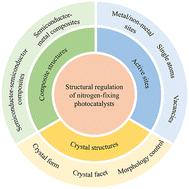
Photocatalytic nitrogen fixation is a forward-looking technology for zero-carbon nitrogen fixation, which is crucial for alleviating the energy crisis and achieving carbon neutrality. Based on research into the structural regulation of nitrogen-fixing photocatalysts, this review summarizes the latest progress and challenges in photocatalytic ammonia synthesis from three dimensions: active sites, crystal structures, and composite structures. In terms of active site construction, common types of active sites, including metal sites, non-metal sites, vacancies, and single atoms, are discussed. Their characteristics and methods for improving photocatalytic nitrogen fixation performance are analyzed. Furthermore, starting from the mechanism of nitrogen activation, a general strategy for active sites to promote the electron exchange process and thereby enhance nitrogen activation efficiency is explored. In terms of crystal structure construction, the design of nitrogen-fixing photocatalysts is described from three perspectives: crystal form, crystal facet, and morphology control. In terms of composite structure construction, this review discusses the key role of structures such as semiconductor–metal composites and semiconductor–semiconductor composites in promoting carrier separation. It is hoped that this review can provide new insights for the design and preparation of efficient nitrogen-fixing photocatalysts and inspire practical applications of photocatalytic nitrogen fixation.
期刊介绍:
An international, peer-reviewed journal covering all of the chemical sciences, including multidisciplinary and emerging areas. RSC Advances is a gold open access journal allowing researchers free access to research articles, and offering an affordable open access publishing option for authors around the world.



 京公网安备 11010802042870号
京ICP备2023020795号-1
京公网安备 11010802042870号
京ICP备2023020795号-1

 分享
分享
 求助内容:
求助内容: 应助结果提醒方式:
 扫码关注我们
