Exploring Forest Soils Variability Based on Physicochemical Properties Using Correspondence Analysis and Classification and Regression Tree for Forensic Provenance Analysis
Nadirah Abd Hamid, Muhamad Hilmi Baba, Hukil Sino, Azhar Abdul Halim, Loong Chuen Lee
{"title":"Exploring Forest Soils Variability Based on Physicochemical Properties Using Correspondence Analysis and Classification and Regression Tree for Forensic Provenance Analysis","authors":"Nadirah Abd Hamid, Muhamad Hilmi Baba, Hukil Sino, Azhar Abdul Halim, Loong Chuen Lee","doi":"10.1134/S1061934824701661","DOIUrl":null,"url":null,"abstract":"<p>Soils on forest lands are likely characterized by high organic matter content and a diversity of nutrients. Thus, differentiating forest soils from different sites of origin is a challenging task. This study aims to assess the variability of 163 forest soils based on two easily measured physiochemical properties: soil color and pH. The soil samples were collected from 11 different sites across six states in Malaysia. Soil color was recorded under both air-dry and moistened conditions based on the Munsell Soil Color Chart. Meanwhile, soil pH was determined using a soil-to-water ratio of 1 : 20 (w/v). The association between the source origins and the physiochemical properties of the soils was assessed using simple correspondence analysis. Classification of the soils by the type of anthropogenic activities, according to pH, was further modeled using the classification and regression tree algorithm. The results showed that soils from ecotourism sites tended to be less acidic than those from reserved forest sites. Meanwhile, soils from forest lands used for hiking showed acidity levels between the two types of sites. On the other hand, variability in soil color by the source origin was found to be insignificant. In conclusion, forest soils could be further classified according to the type of anthropogenic activities, which are partly governed by the type and magnitude of human activities.</p>","PeriodicalId":606,"journal":{"name":"Journal of Analytical Chemistry","volume":"80 1","pages":"182 - 194"},"PeriodicalIF":1.1000,"publicationDate":"2025-04-15","publicationTypes":"Journal Article","fieldsOfStudy":null,"isOpenAccess":false,"openAccessPdf":"","citationCount":"0","resultStr":null,"platform":"Semanticscholar","paperid":null,"PeriodicalName":"Journal of Analytical Chemistry","FirstCategoryId":"92","ListUrlMain":"https://link.springer.com/article/10.1134/S1061934824701661","RegionNum":4,"RegionCategory":"化学","ArticlePicture":[],"TitleCN":null,"AbstractTextCN":null,"PMCID":null,"EPubDate":"","PubModel":"","JCR":"Q4","JCRName":"CHEMISTRY, ANALYTICAL","Score":null,"Total":0}
引用次数: 0
Abstract
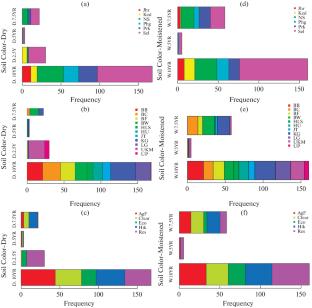
Soils on forest lands are likely characterized by high organic matter content and a diversity of nutrients. Thus, differentiating forest soils from different sites of origin is a challenging task. This study aims to assess the variability of 163 forest soils based on two easily measured physiochemical properties: soil color and pH. The soil samples were collected from 11 different sites across six states in Malaysia. Soil color was recorded under both air-dry and moistened conditions based on the Munsell Soil Color Chart. Meanwhile, soil pH was determined using a soil-to-water ratio of 1 : 20 (w/v). The association between the source origins and the physiochemical properties of the soils was assessed using simple correspondence analysis. Classification of the soils by the type of anthropogenic activities, according to pH, was further modeled using the classification and regression tree algorithm. The results showed that soils from ecotourism sites tended to be less acidic than those from reserved forest sites. Meanwhile, soils from forest lands used for hiking showed acidity levels between the two types of sites. On the other hand, variability in soil color by the source origin was found to be insignificant. In conclusion, forest soils could be further classified according to the type of anthropogenic activities, which are partly governed by the type and magnitude of human activities.
期刊介绍:
The Journal of Analytical Chemistry is an international peer reviewed journal that covers theoretical and applied aspects of analytical chemistry; it informs the reader about new achievements in analytical methods, instruments and reagents. Ample space is devoted to problems arising in the analysis of vital media such as water and air. Consideration is given to the detection and determination of metal ions, anions, and various organic substances. The journal welcomes manuscripts from all countries in the English or Russian language.



 京公网安备 11010802042870号
京ICP备2023020795号-1
京公网安备 11010802042870号
京ICP备2023020795号-1

 分享
分享
 求助内容:
求助内容: 应助结果提醒方式:
 扫码关注我们
