{"title":"Electrostatic waves and nonlinear structures in Titan’s ionosphere","authors":"Usman Saeed, Shaukat Ali Shan, Hamid Saleem","doi":"10.1140/epjp/s13360-025-06204-4","DOIUrl":null,"url":null,"abstract":"<div><p>The temporal and spatial scales associated with linear and nonlinear ion acoustic waves (IAWs) in Titan’s ionosphere have been estimated in the presence of an extremely small ambient magnetic field of the order of <span>\\(B_0 \\simeq 2 \\times 10^{-4}\\)</span> G. Titan’s ionosphere has many kinds of positive and negative ions but for analytical calculations, the dominant ions HCNH<sup>+</sup> and CN<sup>−</sup> are taken into account along with free electrons keeping in view the observations of the Cassini spacecraft. The frequencies of IAW turn out to be of the order of (0.001) rad/s, and parallel wavelengths of the order of several kilometers, which are very different from Earth’s ionosphere. Shear flow-driven purely growing instability is also investigated. It is found that the IAWs become unstable in the presence of field-aligned shear flow of positive and negative ions. It is pointed out that the nonlinear IAWs can give rise to large solitary electrostatic structures with widths of the order of several hundred kilometers. The values of plasma beta corresponding to positive and negative ions are <span>\\(\\beta _{a}\\simeq (0.046)\\ll 1\\)</span> and <span>\\(\\beta _{b}\\simeq (0.006)\\ll 1\\)</span>, which are suitable for the propagation of electrostatic waves.</p></div>","PeriodicalId":792,"journal":{"name":"The European Physical Journal Plus","volume":"140 4","pages":""},"PeriodicalIF":2.9000,"publicationDate":"2025-04-16","publicationTypes":"Journal Article","fieldsOfStudy":null,"isOpenAccess":false,"openAccessPdf":"","citationCount":"0","resultStr":null,"platform":"Semanticscholar","paperid":null,"PeriodicalName":"The European Physical Journal Plus","FirstCategoryId":"4","ListUrlMain":"https://link.springer.com/article/10.1140/epjp/s13360-025-06204-4","RegionNum":3,"RegionCategory":"物理与天体物理","ArticlePicture":[],"TitleCN":null,"AbstractTextCN":null,"PMCID":null,"EPubDate":"","PubModel":"","JCR":"Q2","JCRName":"PHYSICS, MULTIDISCIPLINARY","Score":null,"Total":0}
引用次数: 0
Abstract
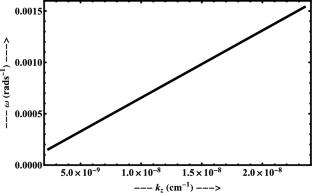
The temporal and spatial scales associated with linear and nonlinear ion acoustic waves (IAWs) in Titan’s ionosphere have been estimated in the presence of an extremely small ambient magnetic field of the order of \(B_0 \simeq 2 \times 10^{-4}\) G. Titan’s ionosphere has many kinds of positive and negative ions but for analytical calculations, the dominant ions HCNH+ and CN− are taken into account along with free electrons keeping in view the observations of the Cassini spacecraft. The frequencies of IAW turn out to be of the order of (0.001) rad/s, and parallel wavelengths of the order of several kilometers, which are very different from Earth’s ionosphere. Shear flow-driven purely growing instability is also investigated. It is found that the IAWs become unstable in the presence of field-aligned shear flow of positive and negative ions. It is pointed out that the nonlinear IAWs can give rise to large solitary electrostatic structures with widths of the order of several hundred kilometers. The values of plasma beta corresponding to positive and negative ions are \(\beta _{a}\simeq (0.046)\ll 1\) and \(\beta _{b}\simeq (0.006)\ll 1\), which are suitable for the propagation of electrostatic waves.
期刊介绍:
The aims of this peer-reviewed online journal are to distribute and archive all relevant material required to document, assess, validate and reconstruct in detail the body of knowledge in the physical and related sciences.
The scope of EPJ Plus encompasses a broad landscape of fields and disciplines in the physical and related sciences - such as covered by the topical EPJ journals and with the explicit addition of geophysics, astrophysics, general relativity and cosmology, mathematical and quantum physics, classical and fluid mechanics, accelerator and medical physics, as well as physics techniques applied to any other topics, including energy, environment and cultural heritage.