Study of the Evaporation Mechanism of Impurity Elements in the Analysis of High-Purity Graphite Powder with Fluorine Additives by Arc Atomic Emission Spectrometry
{"title":"Study of the Evaporation Mechanism of Impurity Elements in the Analysis of High-Purity Graphite Powder with Fluorine Additives by Arc Atomic Emission Spectrometry","authors":"N. I. Zolotareva, S. S. Grazhulene","doi":"10.1134/S1061934824701569","DOIUrl":null,"url":null,"abstract":"<p>The study examines the impact of chemically active fluorine-containing additives, namely AlF<sub>3</sub>, ZnF<sub>2</sub>, and SrF<sub>2</sub>, on the evaporation behavior of low- and medium-volatile impurity elements from a crater in a direct current arc electrode in the analysis of graphite powder. The results demonstrate that the use of AlF<sub>3</sub> and ZnF<sub>2</sub> significantly increases the intensity of spectral lines for the analyzed elements and shortens the time required for their complete evaporation from the electrode crater. Among the additives tested, zinc fluoride in a concentration of 5 wt % proved to be the most effective. The greatest increase in intensity was observed for low-volatile elements prone to carbide formation. The use of ZnF<sub>2</sub> lowered the limits of detection for low- and medium-volatile elements in the graphite powder by direct arc atomic emission spectrometry by 2–3 orders of magnitude, reaching concentrations of <i>n</i> × 10<sup>–7</sup> to <i>n</i> × 10<sup>–5</sup> wt %. This approach improved the reproducibility of the results by a factor of 2 compared to the analysis of graphite powder without additives.</p>","PeriodicalId":606,"journal":{"name":"Journal of Analytical Chemistry","volume":"80 1","pages":"85 - 95"},"PeriodicalIF":1.1000,"publicationDate":"2025-04-15","publicationTypes":"Journal Article","fieldsOfStudy":null,"isOpenAccess":false,"openAccessPdf":"","citationCount":"0","resultStr":null,"platform":"Semanticscholar","paperid":null,"PeriodicalName":"Journal of Analytical Chemistry","FirstCategoryId":"92","ListUrlMain":"https://link.springer.com/article/10.1134/S1061934824701569","RegionNum":4,"RegionCategory":"化学","ArticlePicture":[],"TitleCN":null,"AbstractTextCN":null,"PMCID":null,"EPubDate":"","PubModel":"","JCR":"Q4","JCRName":"CHEMISTRY, ANALYTICAL","Score":null,"Total":0}
引用次数: 0
Abstract
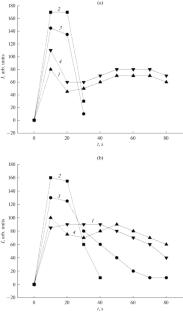
The study examines the impact of chemically active fluorine-containing additives, namely AlF3, ZnF2, and SrF2, on the evaporation behavior of low- and medium-volatile impurity elements from a crater in a direct current arc electrode in the analysis of graphite powder. The results demonstrate that the use of AlF3 and ZnF2 significantly increases the intensity of spectral lines for the analyzed elements and shortens the time required for their complete evaporation from the electrode crater. Among the additives tested, zinc fluoride in a concentration of 5 wt % proved to be the most effective. The greatest increase in intensity was observed for low-volatile elements prone to carbide formation. The use of ZnF2 lowered the limits of detection for low- and medium-volatile elements in the graphite powder by direct arc atomic emission spectrometry by 2–3 orders of magnitude, reaching concentrations of n × 10–7 to n × 10–5 wt %. This approach improved the reproducibility of the results by a factor of 2 compared to the analysis of graphite powder without additives.
期刊介绍:
The Journal of Analytical Chemistry is an international peer reviewed journal that covers theoretical and applied aspects of analytical chemistry; it informs the reader about new achievements in analytical methods, instruments and reagents. Ample space is devoted to problems arising in the analysis of vital media such as water and air. Consideration is given to the detection and determination of metal ions, anions, and various organic substances. The journal welcomes manuscripts from all countries in the English or Russian language.



 京公网安备 11010802042870号
京ICP备2023020795号-1
京公网安备 11010802042870号
京ICP备2023020795号-1

 分享
分享
 求助内容:
求助内容: 应助结果提醒方式:
 扫码关注我们
