S. A. Gromova, M. V. Matiash, V. V. Apyari, S. G. Dmitrienko, Yu. A. Zolotov
{"title":"Luminescence Determination of Dopamine Using a Photocamera","authors":"S. A. Gromova, M. V. Matiash, V. V. Apyari, S. G. Dmitrienko, Yu. A. Zolotov","doi":"10.1134/S1061934824701557","DOIUrl":null,"url":null,"abstract":"<p>The study demonstrates that the interaction of dopamine with fluorescamine can serve as a basis for a fluorescence assay for dopamine using a camera, as the product formed in this interaction exhibits a fluorescence peak in the visible spectral region (485 nm). Fluorescence can be excited with a light-emitting diode emitting in the near-ultraviolet spectral region (395 nm). The reaction should be carried out at pH 8–8.5 in a phosphate buffer solution for 5 min, with fluorescamine being added to the reaction mixture last. The performance characteristics of the camera-based assay were evaluated and compared with those of a similar dopamine assay using a professional spectrofluorometer and a spectrophotometer. The limits of detection for dopamine using a camera, a spectrophotometer, and a spectrofluorometer were 1.8, 1.6, and 0.5 µM, respectively, while the analytical ranges were 5.4–50, 4.8–100, and 1.5–100 µM. The presence of common inorganic ions in concentrations 10 times higher than that of dopamine does not interfere with the assay. The proposed method for dopamine determination can be used for the quality control of pharmaceutical products.</p>","PeriodicalId":606,"journal":{"name":"Journal of Analytical Chemistry","volume":"80 1","pages":"76 - 84"},"PeriodicalIF":1.1000,"publicationDate":"2025-04-15","publicationTypes":"Journal Article","fieldsOfStudy":null,"isOpenAccess":false,"openAccessPdf":"","citationCount":"0","resultStr":null,"platform":"Semanticscholar","paperid":null,"PeriodicalName":"Journal of Analytical Chemistry","FirstCategoryId":"92","ListUrlMain":"https://link.springer.com/article/10.1134/S1061934824701557","RegionNum":4,"RegionCategory":"化学","ArticlePicture":[],"TitleCN":null,"AbstractTextCN":null,"PMCID":null,"EPubDate":"","PubModel":"","JCR":"Q4","JCRName":"CHEMISTRY, ANALYTICAL","Score":null,"Total":0}
引用次数: 0
Abstract
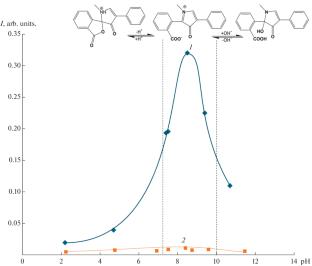
The study demonstrates that the interaction of dopamine with fluorescamine can serve as a basis for a fluorescence assay for dopamine using a camera, as the product formed in this interaction exhibits a fluorescence peak in the visible spectral region (485 nm). Fluorescence can be excited with a light-emitting diode emitting in the near-ultraviolet spectral region (395 nm). The reaction should be carried out at pH 8–8.5 in a phosphate buffer solution for 5 min, with fluorescamine being added to the reaction mixture last. The performance characteristics of the camera-based assay were evaluated and compared with those of a similar dopamine assay using a professional spectrofluorometer and a spectrophotometer. The limits of detection for dopamine using a camera, a spectrophotometer, and a spectrofluorometer were 1.8, 1.6, and 0.5 µM, respectively, while the analytical ranges were 5.4–50, 4.8–100, and 1.5–100 µM. The presence of common inorganic ions in concentrations 10 times higher than that of dopamine does not interfere with the assay. The proposed method for dopamine determination can be used for the quality control of pharmaceutical products.
期刊介绍:
The Journal of Analytical Chemistry is an international peer reviewed journal that covers theoretical and applied aspects of analytical chemistry; it informs the reader about new achievements in analytical methods, instruments and reagents. Ample space is devoted to problems arising in the analysis of vital media such as water and air. Consideration is given to the detection and determination of metal ions, anions, and various organic substances. The journal welcomes manuscripts from all countries in the English or Russian language.



 京公网安备 11010802042870号
京ICP备2023020795号-1
京公网安备 11010802042870号
京ICP备2023020795号-1

 分享
分享
 求助内容:
求助内容: 应助结果提醒方式:
 扫码关注我们
