Jinshan Wei , Hexing Lin , Yi Li , Ying Guo , Shaoqing Liu , Meng Sun , Ya-yun Li
{"title":"Cobalt-copper dual-atom catalyst boosts electrocatalytic nitrate reduction from water","authors":"Jinshan Wei , Hexing Lin , Yi Li , Ying Guo , Shaoqing Liu , Meng Sun , Ya-yun Li","doi":"10.1016/j.jhazmat.2025.138264","DOIUrl":null,"url":null,"abstract":"<div><div>Electrochemical nitrate reduction reaction (NO<sub>3</sub>RR) presents a promising approach for sustainable water denitrification. Yet its practical implementation is hindered by sluggish reaction kinetics. Herein, we develop a nitrogen-doped carbon supported cobalt-copper dual-atom catalyst (CoCu-NC DAC) to significantly enhance the electro-catalytic NO<sub>3</sub>RR performance. The optimized CoCu-NC DAC demonstrates exceptional activity, achieving a faraday efficiency of 95.3 % and a high NH<sub>4</sub><sup>+</sup> yield rate of 2.41 mg h<sup>−1</sup> cm<sup>−2</sup> at −0.6 V<sub>RHE</sub>, surpassing the performance of conventional Cu/Co single-atom catalysts. In-situ analysis and density functional theory calculations confirm that the synergistic effects arising from (1) optimized electronic structure for balanced intermediate adsorption, and (2) enhanced surface H concentration facilitating NO<sub>x</sub> hydrogenation. This work not only provides fundamental insights into the DACs, but also offers a practical solution for groundwater nitrate remediation, opening new avenues for the application of atomically dispersed catalysts.</div></div>","PeriodicalId":361,"journal":{"name":"Journal of Hazardous Materials","volume":"493 ","pages":"Article 138264"},"PeriodicalIF":11.3000,"publicationDate":"2025-08-05","publicationTypes":"Journal Article","fieldsOfStudy":null,"isOpenAccess":false,"openAccessPdf":"","citationCount":"0","resultStr":null,"platform":"Semanticscholar","paperid":null,"PeriodicalName":"Journal of Hazardous Materials","FirstCategoryId":"93","ListUrlMain":"https://www.sciencedirect.com/science/article/pii/S0304389425011793","RegionNum":1,"RegionCategory":"环境科学与生态学","ArticlePicture":[],"TitleCN":null,"AbstractTextCN":null,"PMCID":null,"EPubDate":"2025/4/16 0:00:00","PubModel":"Epub","JCR":"Q1","JCRName":"ENGINEERING, ENVIRONMENTAL","Score":null,"Total":0}
引用次数: 0
Abstract
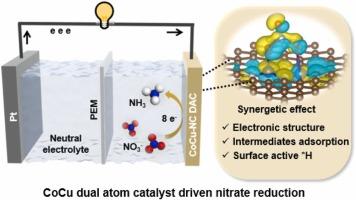
Electrochemical nitrate reduction reaction (NO3RR) presents a promising approach for sustainable water denitrification. Yet its practical implementation is hindered by sluggish reaction kinetics. Herein, we develop a nitrogen-doped carbon supported cobalt-copper dual-atom catalyst (CoCu-NC DAC) to significantly enhance the electro-catalytic NO3RR performance. The optimized CoCu-NC DAC demonstrates exceptional activity, achieving a faraday efficiency of 95.3 % and a high NH4+ yield rate of 2.41 mg h−1 cm−2 at −0.6 VRHE, surpassing the performance of conventional Cu/Co single-atom catalysts. In-situ analysis and density functional theory calculations confirm that the synergistic effects arising from (1) optimized electronic structure for balanced intermediate adsorption, and (2) enhanced surface H concentration facilitating NOx hydrogenation. This work not only provides fundamental insights into the DACs, but also offers a practical solution for groundwater nitrate remediation, opening new avenues for the application of atomically dispersed catalysts.
期刊介绍:
The Journal of Hazardous Materials serves as a global platform for promoting cutting-edge research in the field of Environmental Science and Engineering. Our publication features a wide range of articles, including full-length research papers, review articles, and perspectives, with the aim of enhancing our understanding of the dangers and risks associated with various materials concerning public health and the environment. It is important to note that the term "environmental contaminants" refers specifically to substances that pose hazardous effects through contamination, while excluding those that do not have such impacts on the environment or human health. Moreover, we emphasize the distinction between wastes and hazardous materials in order to provide further clarity on the scope of the journal. We have a keen interest in exploring specific compounds and microbial agents that have adverse effects on the environment.



 京公网安备 11010802042870号
京ICP备2023020795号-1
京公网安备 11010802042870号
京ICP备2023020795号-1

 分享
分享
 求助内容:
求助内容: 应助结果提醒方式:
 扫码关注我们
