Environmental high-risk efflux pumps mediate concurrent enhancement of resistance and virulence in reclaimed water from urban wastewater treatment plants
Shanqi Shen , Zhong He , Siya Zhao , Zezhang Zhu , Xinyi Wang , Yechao Tian , Yuze Han , Min Hu , Chang Lu , Aimin Li
{"title":"Environmental high-risk efflux pumps mediate concurrent enhancement of resistance and virulence in reclaimed water from urban wastewater treatment plants","authors":"Shanqi Shen , Zhong He , Siya Zhao , Zezhang Zhu , Xinyi Wang , Yechao Tian , Yuze Han , Min Hu , Chang Lu , Aimin Li","doi":"10.1016/j.jhazmat.2025.138236","DOIUrl":null,"url":null,"abstract":"<div><div>With the growing demand for urban water, reclaimed water is a key solution for mitigating shortages. However, wastewater treatment plants (WWTPs) can act as reservoirs for antibiotic resistance genes (ARGs) and virulence factors (VFs), posing environmental and public health risks. This study systematically investigated the distribution and co-selection mechanisms of ARGs and VFs across four treatment stages in five WWTPs in Nanjing over two years, with a focus on high-risk efflux pump-related ARGs. A total of 902 persistent ARGs and 1086 persistent VFs were identified, including 12 characteristic ARGs, 12 characteristic VFs, and 20 high-risk priority ARGs. Network analysis and linear regression revealed a significant correlation between efflux pump ARGs and VFs, particularly those linked to outer membrane proteins, pili, and iron ion transport. Their coexistence suggests potential selective advantages during wastewater treatment. Laboratory-simulated aquatic environment experiments, RT-qPCR, and virulence protein assays further confirmed the co-selection between resistance and virulence. Results demonstrated that environmental stress, including antibiotics, heavy metals, and disinfection, induces efflux pump overexpression, enhancing bacterial pathogenicity. These findings highlight the importance of monitoring high-risk efflux pump ARGs in reclaimed water safety. Targeted surveillance and advanced treatment strategies are crucial for controlling antibiotic resistance and ensuring safe water reuse.</div></div>","PeriodicalId":361,"journal":{"name":"Journal of Hazardous Materials","volume":"493 ","pages":"Article 138236"},"PeriodicalIF":11.3000,"publicationDate":"2025-08-05","publicationTypes":"Journal Article","fieldsOfStudy":null,"isOpenAccess":false,"openAccessPdf":"","citationCount":"0","resultStr":null,"platform":"Semanticscholar","paperid":null,"PeriodicalName":"Journal of Hazardous Materials","FirstCategoryId":"93","ListUrlMain":"https://www.sciencedirect.com/science/article/pii/S0304389425011513","RegionNum":1,"RegionCategory":"环境科学与生态学","ArticlePicture":[],"TitleCN":null,"AbstractTextCN":null,"PMCID":null,"EPubDate":"2025/4/16 0:00:00","PubModel":"Epub","JCR":"Q1","JCRName":"ENGINEERING, ENVIRONMENTAL","Score":null,"Total":0}
引用次数: 0
Abstract
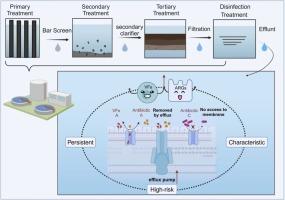
With the growing demand for urban water, reclaimed water is a key solution for mitigating shortages. However, wastewater treatment plants (WWTPs) can act as reservoirs for antibiotic resistance genes (ARGs) and virulence factors (VFs), posing environmental and public health risks. This study systematically investigated the distribution and co-selection mechanisms of ARGs and VFs across four treatment stages in five WWTPs in Nanjing over two years, with a focus on high-risk efflux pump-related ARGs. A total of 902 persistent ARGs and 1086 persistent VFs were identified, including 12 characteristic ARGs, 12 characteristic VFs, and 20 high-risk priority ARGs. Network analysis and linear regression revealed a significant correlation between efflux pump ARGs and VFs, particularly those linked to outer membrane proteins, pili, and iron ion transport. Their coexistence suggests potential selective advantages during wastewater treatment. Laboratory-simulated aquatic environment experiments, RT-qPCR, and virulence protein assays further confirmed the co-selection between resistance and virulence. Results demonstrated that environmental stress, including antibiotics, heavy metals, and disinfection, induces efflux pump overexpression, enhancing bacterial pathogenicity. These findings highlight the importance of monitoring high-risk efflux pump ARGs in reclaimed water safety. Targeted surveillance and advanced treatment strategies are crucial for controlling antibiotic resistance and ensuring safe water reuse.
期刊介绍:
The Journal of Hazardous Materials serves as a global platform for promoting cutting-edge research in the field of Environmental Science and Engineering. Our publication features a wide range of articles, including full-length research papers, review articles, and perspectives, with the aim of enhancing our understanding of the dangers and risks associated with various materials concerning public health and the environment. It is important to note that the term "environmental contaminants" refers specifically to substances that pose hazardous effects through contamination, while excluding those that do not have such impacts on the environment or human health. Moreover, we emphasize the distinction between wastes and hazardous materials in order to provide further clarity on the scope of the journal. We have a keen interest in exploring specific compounds and microbial agents that have adverse effects on the environment.



 京公网安备 11010802042870号
京ICP备2023020795号-1
京公网安备 11010802042870号
京ICP备2023020795号-1

 分享
分享
 求助内容:
求助内容: 应助结果提醒方式:
 扫码关注我们
