{"title":"Mechanism and Kinetics for Copper Leaching by Complexing with Lysine Bearing Two Amino Groups","authors":"Mengying Li, Qingliang Wang, Weiduo Guo, Shaobo Zhou, Jinlong Fan, Liping Zhao, Zhen He, Zhiwu Lei, Yahui Zhang","doi":"10.1021/acs.langmuir.4c05274","DOIUrl":null,"url":null,"abstract":"In order to overcome the environmental problems associated with ammonia volatilization during the ammonia leaching process, the leaching effects of copper by amino acids with various numbers and substitution positions of amino functional groups were systematically studied. The results showed that lysine had the best leaching efficiency for copper. When the concentration of lysine was 0.2 mol/L, the leaching temperature was 20 °C, the molar ratio of lysine to copper was 3.88, the stirring speed was 250 rpm, the pH was 10, and the leaching time was 14 h, the leaching rate of copper reached 99%. The leaching results of copper containing smelting slag showed that lysine has an excellent effect on selective leaching of copper. The leaching kinetic results indicated that the rate-limiting step of the leaching process is controlled by the interfacial chemical reaction, with an apparent activation energy of 64.8 kJ/mol. Fourier transform infrared spectroscopy (FT-IR) and X-ray photoelectron spectroscopy (XPS) analyses confirmed that COO<sup>–</sup> and –NH groups in lysine can form complexes with copper ions. Compared to conventional methods, this approach not only achieves environmentally benign disposal of heavy metal pollutants but also provides a novel strategy for the green recovery of valuable metals from secondary resources.","PeriodicalId":50,"journal":{"name":"Langmuir","volume":"108 1","pages":""},"PeriodicalIF":3.9000,"publicationDate":"2025-04-15","publicationTypes":"Journal Article","fieldsOfStudy":null,"isOpenAccess":false,"openAccessPdf":"","citationCount":"0","resultStr":null,"platform":"Semanticscholar","paperid":null,"PeriodicalName":"Langmuir","FirstCategoryId":"92","ListUrlMain":"https://doi.org/10.1021/acs.langmuir.4c05274","RegionNum":2,"RegionCategory":"化学","ArticlePicture":[],"TitleCN":null,"AbstractTextCN":null,"PMCID":null,"EPubDate":"","PubModel":"","JCR":"Q2","JCRName":"CHEMISTRY, MULTIDISCIPLINARY","Score":null,"Total":0}
引用次数: 0
Abstract
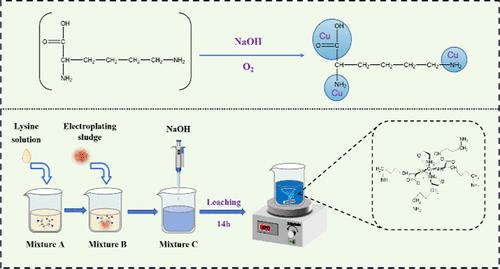
In order to overcome the environmental problems associated with ammonia volatilization during the ammonia leaching process, the leaching effects of copper by amino acids with various numbers and substitution positions of amino functional groups were systematically studied. The results showed that lysine had the best leaching efficiency for copper. When the concentration of lysine was 0.2 mol/L, the leaching temperature was 20 °C, the molar ratio of lysine to copper was 3.88, the stirring speed was 250 rpm, the pH was 10, and the leaching time was 14 h, the leaching rate of copper reached 99%. The leaching results of copper containing smelting slag showed that lysine has an excellent effect on selective leaching of copper. The leaching kinetic results indicated that the rate-limiting step of the leaching process is controlled by the interfacial chemical reaction, with an apparent activation energy of 64.8 kJ/mol. Fourier transform infrared spectroscopy (FT-IR) and X-ray photoelectron spectroscopy (XPS) analyses confirmed that COO– and –NH groups in lysine can form complexes with copper ions. Compared to conventional methods, this approach not only achieves environmentally benign disposal of heavy metal pollutants but also provides a novel strategy for the green recovery of valuable metals from secondary resources.
期刊介绍:
Langmuir is an interdisciplinary journal publishing articles in the following subject categories:
Colloids: surfactants and self-assembly, dispersions, emulsions, foams
Interfaces: adsorption, reactions, films, forces
Biological Interfaces: biocolloids, biomolecular and biomimetic materials
Materials: nano- and mesostructured materials, polymers, gels, liquid crystals
Electrochemistry: interfacial charge transfer, charge transport, electrocatalysis, electrokinetic phenomena, bioelectrochemistry
Devices and Applications: sensors, fluidics, patterning, catalysis, photonic crystals
However, when high-impact, original work is submitted that does not fit within the above categories, decisions to accept or decline such papers will be based on one criteria: What Would Irving Do?
Langmuir ranks #2 in citations out of 136 journals in the category of Physical Chemistry with 113,157 total citations. The journal received an Impact Factor of 4.384*.
This journal is also indexed in the categories of Materials Science (ranked #1) and Multidisciplinary Chemistry (ranked #5).



 京公网安备 11010802042870号
京ICP备2023020795号-1
京公网安备 11010802042870号
京ICP备2023020795号-1

 分享
分享
 求助内容:
求助内容: 应助结果提醒方式:
 扫码关注我们
