Geng Cheng , Wenpei Li , Chengyan Liu , Jie Gao , Jun-Liang Chen , Jianhua Zhou , Xiaoyang Wang , Lei Miao
{"title":"A new catalytic merit for prediction catalytic potential of 2D materials in LiO2 batteries: Theoretical investigation and experimental identification","authors":"Geng Cheng , Wenpei Li , Chengyan Liu , Jie Gao , Jun-Liang Chen , Jianhua Zhou , Xiaoyang Wang , Lei Miao","doi":"10.1016/j.jmat.2025.101060","DOIUrl":null,"url":null,"abstract":"<div><div>Two-dimensional (2D) materials such as metal chalcogenides have great potential as cathode catalyst materials for lithium oxygen batteries (LOBs) due to their large specific surface area and stable chemical properties. However, thus far, due to the lack of theoretical prediction methods, huge load on catalytic synthesis and performance evaluation is concerned. Herein, we reported a theoretical method for 2D metal chalcogenides as catalysts for LOBs using first principles density functional theory (DFT) calculations. We extracted key parameters that affect the overpotential, including Li–X bond energy (X represents chalcogen elements) and catalyst lattice constant, and theoretically predicted the catalytic performance. The DFT calculation results indicate that MoS<sub>2</sub> with appropriate Li–X bond energy and lattice constant has the lowest theoretical overpotential, and its cyclic stability should be higher than other materials under the same conditions. Significantly, we experimentally validated the theoretical predictions presented above. The experimental results shows that pure MoS<sub>2</sub> with 2H phase can stably work for more than 220 cycles at a current density of 500 mA/g, and the actual overpotential is lower than other metal chalcogenides. This work provides a swift pathway to accelerate searching high performance catalytic in LOBs.</div></div>","PeriodicalId":16173,"journal":{"name":"Journal of Materiomics","volume":"11 6","pages":"Article 101060"},"PeriodicalIF":9.6000,"publicationDate":"2025-11-01","publicationTypes":"Journal Article","fieldsOfStudy":null,"isOpenAccess":false,"openAccessPdf":"","citationCount":"0","resultStr":null,"platform":"Semanticscholar","paperid":null,"PeriodicalName":"Journal of Materiomics","FirstCategoryId":"88","ListUrlMain":"https://www.sciencedirect.com/science/article/pii/S2352847825000504","RegionNum":1,"RegionCategory":"材料科学","ArticlePicture":[],"TitleCN":null,"AbstractTextCN":null,"PMCID":null,"EPubDate":"2025/4/16 0:00:00","PubModel":"Epub","JCR":"Q1","JCRName":"CHEMISTRY, PHYSICAL","Score":null,"Total":0}
引用次数: 0
Abstract
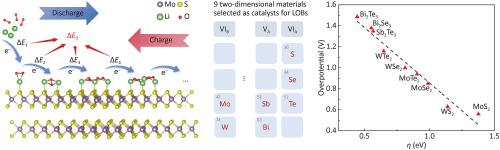
Two-dimensional (2D) materials such as metal chalcogenides have great potential as cathode catalyst materials for lithium oxygen batteries (LOBs) due to their large specific surface area and stable chemical properties. However, thus far, due to the lack of theoretical prediction methods, huge load on catalytic synthesis and performance evaluation is concerned. Herein, we reported a theoretical method for 2D metal chalcogenides as catalysts for LOBs using first principles density functional theory (DFT) calculations. We extracted key parameters that affect the overpotential, including Li–X bond energy (X represents chalcogen elements) and catalyst lattice constant, and theoretically predicted the catalytic performance. The DFT calculation results indicate that MoS2 with appropriate Li–X bond energy and lattice constant has the lowest theoretical overpotential, and its cyclic stability should be higher than other materials under the same conditions. Significantly, we experimentally validated the theoretical predictions presented above. The experimental results shows that pure MoS2 with 2H phase can stably work for more than 220 cycles at a current density of 500 mA/g, and the actual overpotential is lower than other metal chalcogenides. This work provides a swift pathway to accelerate searching high performance catalytic in LOBs.
期刊介绍:
The Journal of Materiomics is a peer-reviewed open-access journal that aims to serve as a forum for the continuous dissemination of research within the field of materials science. It particularly emphasizes systematic studies on the relationships between composition, processing, structure, property, and performance of advanced materials. The journal is supported by the Chinese Ceramic Society and is indexed in SCIE and Scopus. It is commonly referred to as J Materiomics.




 京公网安备 11010802042870号
京ICP备2023020795号-1
京公网安备 11010802042870号
京ICP备2023020795号-1

 分享
分享
 求助内容:
求助内容: 应助结果提醒方式:
 扫码关注我们
