Lung-associated lymph nodes and spleen are major secondary accumulating organs in mice following inhaled black carbon as a surrogate of ultrafine ambient particles
Gyuri Kim , Soyeon Jeon , Bumjun Park , Seo-Gyeong Jo , Hi-Gyu Moon , Seok-Ho Kim , Yun Suk Huh , Kyuhong Lee , Rodger Duffin , Wan-Seob Cho
{"title":"Lung-associated lymph nodes and spleen are major secondary accumulating organs in mice following inhaled black carbon as a surrogate of ultrafine ambient particles","authors":"Gyuri Kim , Soyeon Jeon , Bumjun Park , Seo-Gyeong Jo , Hi-Gyu Moon , Seok-Ho Kim , Yun Suk Huh , Kyuhong Lee , Rodger Duffin , Wan-Seob Cho","doi":"10.1016/j.envint.2025.109475","DOIUrl":null,"url":null,"abstract":"<div><div>Despite increasing public concern about the health impact of air pollution, little is known about the biokinetics of ultrafine particles. Herein, we investigate their biokinetics and associated mechanisms underlying organ distribution and extrapulmonary translocation of ambient ultrafine particulate matter in mice. The test materials used in this study were black carbon (BC) generated by a spark discharge soot generator and two reference materials (SRM 2975 and carbon black). The test particles were intratracheally instilled into the lungs of mice at 25 μg/mouse, and the organ burden was evaluated up to 3 months post-instillation. The data showed significant BC accumulation in lung-associated lymph nodes (LALN) and spleen from 1–3 months post-exposure, with no detectable levels in other organs. The reference materials showed a similar distribution pattern, indicating a common extrapulmonary translocation pathway for ultrafine carbon particles deposited in alveoli. This pathway is unique to particles deposited in the alveoli, as direct injection into lymphatic and systemic circulation showed typical organ accumulation (e.g., liver, lung, spleen, and LALN). The results highlight that the unique extrapulmonary translocation of test particles to the LALN and spleen may be due to the particles that escape from the lung being the smallest particles, evading hepatic surveillance but physically entrapped in the spleen’s open circulation.</div></div>","PeriodicalId":308,"journal":{"name":"Environment International","volume":"199 ","pages":"Article 109475"},"PeriodicalIF":9.7000,"publicationDate":"2025-04-15","publicationTypes":"Journal Article","fieldsOfStudy":null,"isOpenAccess":false,"openAccessPdf":"","citationCount":"0","resultStr":null,"platform":"Semanticscholar","paperid":null,"PeriodicalName":"Environment International","FirstCategoryId":"93","ListUrlMain":"https://www.sciencedirect.com/science/article/pii/S0160412025002260","RegionNum":1,"RegionCategory":"环境科学与生态学","ArticlePicture":[],"TitleCN":null,"AbstractTextCN":null,"PMCID":null,"EPubDate":"","PubModel":"","JCR":"Q1","JCRName":"ENVIRONMENTAL SCIENCES","Score":null,"Total":0}
引用次数: 0
Abstract
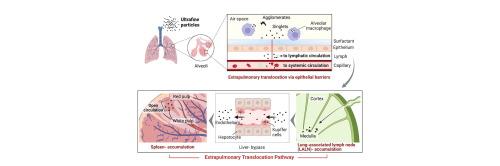
Despite increasing public concern about the health impact of air pollution, little is known about the biokinetics of ultrafine particles. Herein, we investigate their biokinetics and associated mechanisms underlying organ distribution and extrapulmonary translocation of ambient ultrafine particulate matter in mice. The test materials used in this study were black carbon (BC) generated by a spark discharge soot generator and two reference materials (SRM 2975 and carbon black). The test particles were intratracheally instilled into the lungs of mice at 25 μg/mouse, and the organ burden was evaluated up to 3 months post-instillation. The data showed significant BC accumulation in lung-associated lymph nodes (LALN) and spleen from 1–3 months post-exposure, with no detectable levels in other organs. The reference materials showed a similar distribution pattern, indicating a common extrapulmonary translocation pathway for ultrafine carbon particles deposited in alveoli. This pathway is unique to particles deposited in the alveoli, as direct injection into lymphatic and systemic circulation showed typical organ accumulation (e.g., liver, lung, spleen, and LALN). The results highlight that the unique extrapulmonary translocation of test particles to the LALN and spleen may be due to the particles that escape from the lung being the smallest particles, evading hepatic surveillance but physically entrapped in the spleen’s open circulation.
期刊介绍:
Environmental Health publishes manuscripts focusing on critical aspects of environmental and occupational medicine, including studies in toxicology and epidemiology, to illuminate the human health implications of exposure to environmental hazards. The journal adopts an open-access model and practices open peer review.
It caters to scientists and practitioners across all environmental science domains, directly or indirectly impacting human health and well-being. With a commitment to enhancing the prevention of environmentally-related health risks, Environmental Health serves as a public health journal for the community and scientists engaged in matters of public health significance concerning the environment.




 京公网安备 11010802042870号
京ICP备2023020795号-1
京公网安备 11010802042870号
京ICP备2023020795号-1

 分享
分享
 求助内容:
求助内容: 应助结果提醒方式:
 扫码关注我们
