{"title":"Lone pair electron-induced attrition of lanthanide ions from a sillenite-structured bismuth gallate host†","authors":"Nistha Singh, Sandeep Nigam, Chiranjib Majumder, Nidhi Gupta and Vasanthakumaran Sudarsan","doi":"10.1039/D4DT03483J","DOIUrl":null,"url":null,"abstract":"<p >The crucial role of lone pair of electrons in the functionality of materials has been unprecedented. The present study reports a prolific correlation between the local structure and the stereochemical activity of the lone pairs of Bi<small><sup>3+</sup></small> ions in the sillenite structure. The structural changes induced by variations in annealing temperatures greatly influenced the stereochemical activity of Bi<small><sup>3+</sup></small> ion lone pairs, which, in turn, dictated the capacity for the incorporation of probing lanthanide ions in its proximity. Increased annealing temperature induces a transformation of Bi<small><sub>12</sub></small>GaO<small><sub>20±<em>δ</em></sub></small> samples from a nanoscale to a bulk length scale. During the nano-to-bulk conversion of sillenite-structured Bi<small><sub>12</sub></small>GaO<small><sub>20±<em>δ</em></sub></small>, the emergence of long-range ordering synchronized with the enhanced stereochemical activity of the lone pair, and this amelioration in activity led to the attrition of luminescent lanthanide ions (Eu<small><sup>3+</sup></small>, Tb<small><sup>3+</sup></small>, Er<small><sup>3+</sup></small>, and Yb<small><sup>3+</sup></small>) from the sillenite phase. Based on detailed experimental and theoretical investigations, it was envisioned that while finite size impeded the long-range translational repeatability of lone pairs in the nano-crystalline Bi<small><sub>12</sub></small>GaO<small><sub>20±<em>δ</em></sub></small> sample, the concurrent existence of random geometrical distortion induces averaging of interactions at the focal Bi-site, suppressing the stereochemical activity. In high-temperature annealed bulk Bi<small><sub>12</sub></small>GaO<small><sub>20±<em>δ</em></sub></small> sillenite samples, the long-range symmetrical arrangement of Bi<small><sup>3+</sup></small> lone pairs balances the repulsive interactions. To maintain this balance, guest (doped) lanthanide ions were eliminated from the host lattice, resulting in phase separation. It is believed that the observations and rationalizations established between the local structure and the stereochemical activity of Bi<small><sup>3+</sup></small> ion lone pair will aid in designing future bismuth-based functional materials.</p>","PeriodicalId":71,"journal":{"name":"Dalton Transactions","volume":" 19","pages":" 7690-7699"},"PeriodicalIF":3.3000,"publicationDate":"2025-04-16","publicationTypes":"Journal Article","fieldsOfStudy":null,"isOpenAccess":false,"openAccessPdf":"","citationCount":"0","resultStr":null,"platform":"Semanticscholar","paperid":null,"PeriodicalName":"Dalton Transactions","FirstCategoryId":"92","ListUrlMain":"https://pubs.rsc.org/en/content/articlelanding/2025/dt/d4dt03483j","RegionNum":3,"RegionCategory":"化学","ArticlePicture":[],"TitleCN":null,"AbstractTextCN":null,"PMCID":null,"EPubDate":"","PubModel":"","JCR":"Q2","JCRName":"CHEMISTRY, INORGANIC & NUCLEAR","Score":null,"Total":0}
引用次数: 0
Abstract
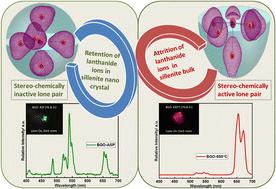
The crucial role of lone pair of electrons in the functionality of materials has been unprecedented. The present study reports a prolific correlation between the local structure and the stereochemical activity of the lone pairs of Bi3+ ions in the sillenite structure. The structural changes induced by variations in annealing temperatures greatly influenced the stereochemical activity of Bi3+ ion lone pairs, which, in turn, dictated the capacity for the incorporation of probing lanthanide ions in its proximity. Increased annealing temperature induces a transformation of Bi12GaO20±δ samples from a nanoscale to a bulk length scale. During the nano-to-bulk conversion of sillenite-structured Bi12GaO20±δ, the emergence of long-range ordering synchronized with the enhanced stereochemical activity of the lone pair, and this amelioration in activity led to the attrition of luminescent lanthanide ions (Eu3+, Tb3+, Er3+, and Yb3+) from the sillenite phase. Based on detailed experimental and theoretical investigations, it was envisioned that while finite size impeded the long-range translational repeatability of lone pairs in the nano-crystalline Bi12GaO20±δ sample, the concurrent existence of random geometrical distortion induces averaging of interactions at the focal Bi-site, suppressing the stereochemical activity. In high-temperature annealed bulk Bi12GaO20±δ sillenite samples, the long-range symmetrical arrangement of Bi3+ lone pairs balances the repulsive interactions. To maintain this balance, guest (doped) lanthanide ions were eliminated from the host lattice, resulting in phase separation. It is believed that the observations and rationalizations established between the local structure and the stereochemical activity of Bi3+ ion lone pair will aid in designing future bismuth-based functional materials.
期刊介绍:
Dalton Transactions is a journal for all areas of inorganic chemistry, which encompasses the organometallic, bioinorganic and materials chemistry of the elements, with applications including synthesis, catalysis, energy conversion/storage, electrical devices and medicine. Dalton Transactions welcomes high-quality, original submissions in all of these areas and more, where the advancement of knowledge in inorganic chemistry is significant.




 京公网安备 11010802042870号
京ICP备2023020795号-1
京公网安备 11010802042870号
京ICP备2023020795号-1

 分享
分享
 求助内容:
求助内容: 应助结果提醒方式:
 扫码关注我们
