Preliminary Observations of a Substrate-Based Radiotracer Biosensor for In Vivo Positron Emission Tomography Imaging of Tumor Transmembrane Protease ST14
{"title":"Preliminary Observations of a Substrate-Based Radiotracer Biosensor for In Vivo Positron Emission Tomography Imaging of Tumor Transmembrane Protease ST14","authors":"Tukang Peng, Jianjun Liu, Haitao Zhao","doi":"10.1021/acssensors.4c03476","DOIUrl":null,"url":null,"abstract":"Imaging protease proteolysis with positron emission tomography (PET) has not been well documented in the literature, primarily due to the absence of suitable radiotracers. This study aims to develop a substrate-based radiotracer biosensor for ST14 protease to facilitate direct <i>in vivo</i> PET imaging of proteolysis. The design of the substrate-based radiotracer RQARK-DOTA-<sup>68</sup>Ga is characterized by the inclusion of an ST14 substrate RQAR moiety and a Lys-DOTA-<sup>68</sup>Ga moiety, linked via an ST14 cleavage site. The enzymatic cleavage of this radiotracer by ST14 protease was characterized <i>in vitro</i>, and the proteolysis of ST14 was further confirmed through <i>in vivo</i> PET imaging in tumors expressing ST14. RQARK-DOTA-<sup>68</sup>Ga was specifically cleaved by ST14 protease to yield Lys-DOTA-<sup>68</sup>Ga and RQAR moieties, whereas the <span>d</span>-isomer, rqark-DOTA-68Ga, was not susceptible to cleavage by ST14 protease. <i>In vivo</i> PET imaging demonstrated high tumor uptake of radioactive signal postinjection RQARK-DOTA-<sup>68</sup>Ga in ST14-expressing AsPC-1 xenografts, with optimal accumulation observed 1 h postinjection. In contrast, the <span>d</span>-isomer radiotracer, rqark-DOTA-<sup>68</sup>Ga, exhibited negligible tumor uptake, indicating a distinct preference for the substrate-based radiotracer in regions of ST14-mediated proteolysis. Radio-HPLC analysis following extraction from AsPC-1 tumors injected with RQARK-DOTA-<sup>68</sup>Ga identified a radioactive peak corresponding to Lys-DOTA-<sup>68</sup>Ga, confirming enzymatic cleavage and the generation of the anticipated radioactive product in the tumor tissue. Preliminary results indicate that a novel strategy for noninvasive in vivo positron emission tomography imaging of the transmembrane protease ST14 in tumors has been introduced through the development and application of a substrate-based radiotracer biosensor. The radiotracer RQARK-DOTA-<sup>68</sup>Ga, capable of producing imaging signals through structural changes triggered by substrate cleavage, has proven its ST14-targeting potency in both in vitro enzymatic assays and in vivo PET imaging.","PeriodicalId":24,"journal":{"name":"ACS Sensors","volume":"74 1","pages":""},"PeriodicalIF":9.1000,"publicationDate":"2025-04-15","publicationTypes":"Journal Article","fieldsOfStudy":null,"isOpenAccess":false,"openAccessPdf":"","citationCount":"0","resultStr":null,"platform":"Semanticscholar","paperid":null,"PeriodicalName":"ACS Sensors","FirstCategoryId":"92","ListUrlMain":"https://doi.org/10.1021/acssensors.4c03476","RegionNum":1,"RegionCategory":"化学","ArticlePicture":[],"TitleCN":null,"AbstractTextCN":null,"PMCID":null,"EPubDate":"","PubModel":"","JCR":"Q1","JCRName":"CHEMISTRY, ANALYTICAL","Score":null,"Total":0}
引用次数: 0
Abstract
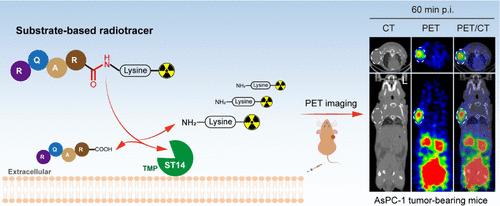
Imaging protease proteolysis with positron emission tomography (PET) has not been well documented in the literature, primarily due to the absence of suitable radiotracers. This study aims to develop a substrate-based radiotracer biosensor for ST14 protease to facilitate direct in vivo PET imaging of proteolysis. The design of the substrate-based radiotracer RQARK-DOTA-68Ga is characterized by the inclusion of an ST14 substrate RQAR moiety and a Lys-DOTA-68Ga moiety, linked via an ST14 cleavage site. The enzymatic cleavage of this radiotracer by ST14 protease was characterized in vitro, and the proteolysis of ST14 was further confirmed through in vivo PET imaging in tumors expressing ST14. RQARK-DOTA-68Ga was specifically cleaved by ST14 protease to yield Lys-DOTA-68Ga and RQAR moieties, whereas the d-isomer, rqark-DOTA-68Ga, was not susceptible to cleavage by ST14 protease. In vivo PET imaging demonstrated high tumor uptake of radioactive signal postinjection RQARK-DOTA-68Ga in ST14-expressing AsPC-1 xenografts, with optimal accumulation observed 1 h postinjection. In contrast, the d-isomer radiotracer, rqark-DOTA-68Ga, exhibited negligible tumor uptake, indicating a distinct preference for the substrate-based radiotracer in regions of ST14-mediated proteolysis. Radio-HPLC analysis following extraction from AsPC-1 tumors injected with RQARK-DOTA-68Ga identified a radioactive peak corresponding to Lys-DOTA-68Ga, confirming enzymatic cleavage and the generation of the anticipated radioactive product in the tumor tissue. Preliminary results indicate that a novel strategy for noninvasive in vivo positron emission tomography imaging of the transmembrane protease ST14 in tumors has been introduced through the development and application of a substrate-based radiotracer biosensor. The radiotracer RQARK-DOTA-68Ga, capable of producing imaging signals through structural changes triggered by substrate cleavage, has proven its ST14-targeting potency in both in vitro enzymatic assays and in vivo PET imaging.
期刊介绍:
ACS Sensors is a peer-reviewed research journal that focuses on the dissemination of new and original knowledge in the field of sensor science, particularly those that selectively sense chemical or biological species or processes. The journal covers a broad range of topics, including but not limited to biosensors, chemical sensors, gas sensors, intracellular sensors, single molecule sensors, cell chips, and microfluidic devices. It aims to publish articles that address conceptual advances in sensing technology applicable to various types of analytes or application papers that report on the use of existing sensing concepts in new ways or for new analytes.



 京公网安备 11010802042870号
京ICP备2023020795号-1
京公网安备 11010802042870号
京ICP备2023020795号-1

 分享
分享
 求助内容:
求助内容: 应助结果提醒方式:
 扫码关注我们
