Veronika Tibljas, Simona Francese, Marjory Da Costa Abreu and Robert Bradshaw
{"title":"A multimodal mass spectrometry imaging workflow for ballpoint pen ink analysis and “forgery” detection†","authors":"Veronika Tibljas, Simona Francese, Marjory Da Costa Abreu and Robert Bradshaw","doi":"10.1039/D5AN00217F","DOIUrl":null,"url":null,"abstract":"<p >Inks, including ballpoint, gel, fountain pen, laser toner, inkjet, and security inks, have unique chemical formulations and require specific examination methods based on their properties and the surfaces they are deposited on. Despite the increasing use of digital signatures, ballpoint pens are still used for signing legal documents. Common forensic approaches involving visual examination are crucial in forensic analysis due to their non-destructive nature. However, often their effectiveness can rely on the expertise of the forensic analyst. Other common approaches, such as thin layer chromatography (TLC), require sample extraction which is destructive. This work shows a multimodal imaging workflow, including the application (in order of increasing destructiveness) of Desorption Electrospray Ionisation Mass Spectrometry Imaging (DESI MSI) followed by Matrix Assisted Laser Desorption Ionisation Mass Spectrometry Imaging (MALDI MSI) enabling comprehensive ink and substrate analysis <em>in situ</em>. It is important to note that this work was performed in preparation for a real casework study submitted to our group for analysis. The application of DESI MSI in negative ion mode and MALDI MSI in positive ion mode in principle allows for detection and mapping of diverse chemical species (<em>e.g.</em> dyes, polymers, <em>etc.</em>), providing a comprehensive understanding of the chemical composition of the sample. Indeed, it is well documented that each ionisation technique can enable targeting of different molecular species. Statistical approaches used to interrogate the data, allows in-depth analysis of ink/substrates. This approach offers a robust and reliable methodology, which can complement or offer additional information for forgery determination in forensic cases, where the results obtained from conventional methodologies may have not been successful.</p>","PeriodicalId":63,"journal":{"name":"Analyst","volume":" 11","pages":" 2322-2335"},"PeriodicalIF":3.3000,"publicationDate":"2025-04-16","publicationTypes":"Journal Article","fieldsOfStudy":null,"isOpenAccess":false,"openAccessPdf":"https://pubs.rsc.org/en/content/articlepdf/2025/an/d5an00217f?page=search","citationCount":"0","resultStr":null,"platform":"Semanticscholar","paperid":null,"PeriodicalName":"Analyst","FirstCategoryId":"92","ListUrlMain":"https://pubs.rsc.org/en/content/articlelanding/2025/an/d5an00217f","RegionNum":3,"RegionCategory":"化学","ArticlePicture":[],"TitleCN":null,"AbstractTextCN":null,"PMCID":null,"EPubDate":"","PubModel":"","JCR":"Q2","JCRName":"CHEMISTRY, ANALYTICAL","Score":null,"Total":0}
引用次数: 0
Abstract
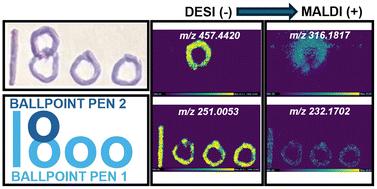
Inks, including ballpoint, gel, fountain pen, laser toner, inkjet, and security inks, have unique chemical formulations and require specific examination methods based on their properties and the surfaces they are deposited on. Despite the increasing use of digital signatures, ballpoint pens are still used for signing legal documents. Common forensic approaches involving visual examination are crucial in forensic analysis due to their non-destructive nature. However, often their effectiveness can rely on the expertise of the forensic analyst. Other common approaches, such as thin layer chromatography (TLC), require sample extraction which is destructive. This work shows a multimodal imaging workflow, including the application (in order of increasing destructiveness) of Desorption Electrospray Ionisation Mass Spectrometry Imaging (DESI MSI) followed by Matrix Assisted Laser Desorption Ionisation Mass Spectrometry Imaging (MALDI MSI) enabling comprehensive ink and substrate analysis in situ. It is important to note that this work was performed in preparation for a real casework study submitted to our group for analysis. The application of DESI MSI in negative ion mode and MALDI MSI in positive ion mode in principle allows for detection and mapping of diverse chemical species (e.g. dyes, polymers, etc.), providing a comprehensive understanding of the chemical composition of the sample. Indeed, it is well documented that each ionisation technique can enable targeting of different molecular species. Statistical approaches used to interrogate the data, allows in-depth analysis of ink/substrates. This approach offers a robust and reliable methodology, which can complement or offer additional information for forgery determination in forensic cases, where the results obtained from conventional methodologies may have not been successful.



 京公网安备 11010802042870号
京ICP备2023020795号-1
京公网安备 11010802042870号
京ICP备2023020795号-1

 分享
分享
 求助内容:
求助内容: 应助结果提醒方式:
 扫码关注我们
