Wei Wei, Yiwei Zhang, Mengdi Yu, Di Shen, Xiyu Sun, Mingshi Fu, Chi Zhang, Zhenzhen Jia and Mingzhen Zhang
{"title":"A novel fluorescent detection strategy for lysozyme in tears based on glycoside bond hydrolysis†","authors":"Wei Wei, Yiwei Zhang, Mengdi Yu, Di Shen, Xiyu Sun, Mingshi Fu, Chi Zhang, Zhenzhen Jia and Mingzhen Zhang","doi":"10.1039/D5AN00331H","DOIUrl":null,"url":null,"abstract":"<p >Dry eye disease (DED) is a prevalent condition characterized by a multifaceted etiology, with its incidence exhibiting an upward trajectory. Consequently, it is imperative to develop a sensitive, straightforward, and convenient method for the analysis of biomarkers associated with DED to facilitate its auxiliary diagnosis. Lysozyme (LYZ), produced by the lacrimal gland, is an antibacterial enzyme believed to play a crucial role in immunity and is associated with DED. In this study, a novel fluorescent sensing platform utilizing neutral red-heparin sodium (NR-HS) was developed with LYZ as the target. The platform operates on the principle of static quenching, where HS effectively quenches the fluorescence of NR. As a hydrolase, LYZ can catalyze the hydrolysis of the glucoside bond in HS, thereby modulating the transformation of the NR-HS fluorescence signal. This provides a straightforward fluorescence method for monitoring LYZ levels. Under optimal conditions, the developed “on–off–on” NR-HS sensing platform demonstrated the capability to detect LYZ within a range of 0.5 to 10 μg mL<small><sup>−1</sup></small>, with a detection limit of 0.42 μg mL<small><sup>−1</sup></small>, and exhibited enhanced selectivity for LYZ. In conclusion, a cost-effective, rapid, and efficient LYZ sensing platform was established, which facilitates the diagnosis of DED and shows potential as a diagnostic detection technique.</p>","PeriodicalId":63,"journal":{"name":"Analyst","volume":" 11","pages":" 2368-2374"},"PeriodicalIF":3.3000,"publicationDate":"2025-04-16","publicationTypes":"Journal Article","fieldsOfStudy":null,"isOpenAccess":false,"openAccessPdf":"","citationCount":"0","resultStr":null,"platform":"Semanticscholar","paperid":null,"PeriodicalName":"Analyst","FirstCategoryId":"92","ListUrlMain":"https://pubs.rsc.org/en/content/articlelanding/2025/an/d5an00331h","RegionNum":3,"RegionCategory":"化学","ArticlePicture":[],"TitleCN":null,"AbstractTextCN":null,"PMCID":null,"EPubDate":"","PubModel":"","JCR":"Q2","JCRName":"CHEMISTRY, ANALYTICAL","Score":null,"Total":0}
引用次数: 0
Abstract
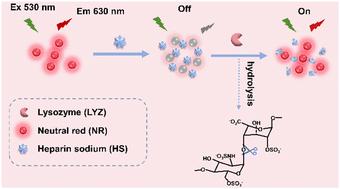
Dry eye disease (DED) is a prevalent condition characterized by a multifaceted etiology, with its incidence exhibiting an upward trajectory. Consequently, it is imperative to develop a sensitive, straightforward, and convenient method for the analysis of biomarkers associated with DED to facilitate its auxiliary diagnosis. Lysozyme (LYZ), produced by the lacrimal gland, is an antibacterial enzyme believed to play a crucial role in immunity and is associated with DED. In this study, a novel fluorescent sensing platform utilizing neutral red-heparin sodium (NR-HS) was developed with LYZ as the target. The platform operates on the principle of static quenching, where HS effectively quenches the fluorescence of NR. As a hydrolase, LYZ can catalyze the hydrolysis of the glucoside bond in HS, thereby modulating the transformation of the NR-HS fluorescence signal. This provides a straightforward fluorescence method for monitoring LYZ levels. Under optimal conditions, the developed “on–off–on” NR-HS sensing platform demonstrated the capability to detect LYZ within a range of 0.5 to 10 μg mL−1, with a detection limit of 0.42 μg mL−1, and exhibited enhanced selectivity for LYZ. In conclusion, a cost-effective, rapid, and efficient LYZ sensing platform was established, which facilitates the diagnosis of DED and shows potential as a diagnostic detection technique.




 京公网安备 11010802042870号
京ICP备2023020795号-1
京公网安备 11010802042870号
京ICP备2023020795号-1

 分享
分享
 求助内容:
求助内容: 应助结果提醒方式:
 扫码关注我们
