{"title":"Mechanistic study on the photocatalytic degradation of rhodamine B via Mn–Schiff-base-modified Keggin-type polyoxometalate composite materials†","authors":"Chang Man, Chunpeng Xu, Jinfeng Wang, Xiangli Li, Tong Li, Yanhua Ma, Shalu Zhang, Yongfeng Qiao and Qiong Wu","doi":"10.1039/D4RA08382B","DOIUrl":null,"url":null,"abstract":"<p >Organic–inorganic hybrid materials have significant potential in the photocatalytic degradation of Rhodamine B (RhB). In this study, five hybrid materials were successfully synthesized by modifying silicotungstic acid (H<small><sub>4</sub></small>SiW<small><sub>12</sub></small>O<small><sub>40</sub></small>, abbreviated SiW<small><sub>12</sub></small>O<small><sub>40</sub></small>) with diverse MnL [L = Salen(L<small><sup>1</sup></small>), 5-Br-Salen(L<small><sup>2</sup></small>), 5-Cl-Salen(L<small><sup>3</sup></small>), 3-Me-Salen(L<small><sup>4</sup></small>), di-<em>t</em>Bu-Salen(L<small><sup>5</sup></small>)] complexes, specifically derivatives featuring various substituents. All the compounds are characterized by IR spectra, elemental analyses and thermogravimetric analyses (TGA). The band gaps of 1.33–1.52 eV and energy bands are obtained through the measurement of UV-Vis DRS and Mott–Schottky. Photocatalytic experiments of (MnL<small><sup>1</sup></small>)<small><sub>4</sub></small>SiW<small><sub>12</sub></small>O<small><sub>40</sub></small> (compound <strong>1</strong>), (MnL<small><sup>2</sup></small>)<small><sub>4</sub></small>SiW<small><sub>12</sub></small>O<small><sub>40</sub></small> (compound <strong>2</strong>), (MnL<small><sup>3</sup></small>)<small><sub>4</sub></small>SiW<small><sub>12</sub></small>O<small><sub>40</sub></small> (compound <strong>3</strong>), (MnL<small><sup>4</sup></small>)<small><sub>4</sub></small>SiW<small><sub>12</sub></small>O<small><sub>40</sub></small> (compound <strong>4</strong>) and (MnL<small><sup>5</sup></small>)<small><sub>4</sub></small>SiW<small><sub>12</sub></small>O<small><sub>40</sub></small> (compound <strong>5</strong>) indicate that compound <strong>2</strong> catalyst exhibits the best photocatalytic properties (RhB degrades to 6% during 70 min) while all of them possess catalytic activity for photodegradation of RhB under UV irradiation. Free radical trapping experiments show that the addition of PBQ (·O<small><sub>2</sub></small><small><sup>−</sup></small> trapping agents) makes the RhB residual ratio increase from 6% to 60% and indicates that ·O<small><sub>2</sub></small><small><sup>−</sup></small> is playing a pivotal role. A possible mechanism of RhB photodegradation in the presence of compound <strong>2</strong> is proposed based on free radical trapping experiments and the energy bands. Future work could focus on fine-tuning the molecular architecture through strategic modification of the organic ligands and precise control of the metal-to-POM ratio, potentially leading to optimized electronic structures and enhanced charge transfer kinetics for superior photocatalytic performance in environmental applications.</p>","PeriodicalId":102,"journal":{"name":"RSC Advances","volume":" 16","pages":" 12364-12371"},"PeriodicalIF":4.6000,"publicationDate":"2025-04-17","publicationTypes":"Journal Article","fieldsOfStudy":null,"isOpenAccess":false,"openAccessPdf":"https://pubs.rsc.org/en/content/articlepdf/2025/ra/d4ra08382b?page=search","citationCount":"0","resultStr":null,"platform":"Semanticscholar","paperid":null,"PeriodicalName":"RSC Advances","FirstCategoryId":"92","ListUrlMain":"https://pubs.rsc.org/en/content/articlelanding/2025/ra/d4ra08382b","RegionNum":3,"RegionCategory":"化学","ArticlePicture":[],"TitleCN":null,"AbstractTextCN":null,"PMCID":null,"EPubDate":"","PubModel":"","JCR":"Q2","JCRName":"CHEMISTRY, MULTIDISCIPLINARY","Score":null,"Total":0}
引用次数: 0
Abstract
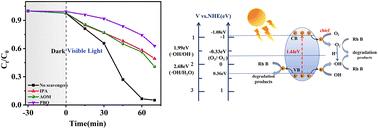
Organic–inorganic hybrid materials have significant potential in the photocatalytic degradation of Rhodamine B (RhB). In this study, five hybrid materials were successfully synthesized by modifying silicotungstic acid (H4SiW12O40, abbreviated SiW12O40) with diverse MnL [L = Salen(L1), 5-Br-Salen(L2), 5-Cl-Salen(L3), 3-Me-Salen(L4), di-tBu-Salen(L5)] complexes, specifically derivatives featuring various substituents. All the compounds are characterized by IR spectra, elemental analyses and thermogravimetric analyses (TGA). The band gaps of 1.33–1.52 eV and energy bands are obtained through the measurement of UV-Vis DRS and Mott–Schottky. Photocatalytic experiments of (MnL1)4SiW12O40 (compound 1), (MnL2)4SiW12O40 (compound 2), (MnL3)4SiW12O40 (compound 3), (MnL4)4SiW12O40 (compound 4) and (MnL5)4SiW12O40 (compound 5) indicate that compound 2 catalyst exhibits the best photocatalytic properties (RhB degrades to 6% during 70 min) while all of them possess catalytic activity for photodegradation of RhB under UV irradiation. Free radical trapping experiments show that the addition of PBQ (·O2− trapping agents) makes the RhB residual ratio increase from 6% to 60% and indicates that ·O2− is playing a pivotal role. A possible mechanism of RhB photodegradation in the presence of compound 2 is proposed based on free radical trapping experiments and the energy bands. Future work could focus on fine-tuning the molecular architecture through strategic modification of the organic ligands and precise control of the metal-to-POM ratio, potentially leading to optimized electronic structures and enhanced charge transfer kinetics for superior photocatalytic performance in environmental applications.
期刊介绍:
An international, peer-reviewed journal covering all of the chemical sciences, including multidisciplinary and emerging areas. RSC Advances is a gold open access journal allowing researchers free access to research articles, and offering an affordable open access publishing option for authors around the world.



 京公网安备 11010802042870号
京ICP备2023020795号-1
京公网安备 11010802042870号
京ICP备2023020795号-1

 分享
分享
 求助内容:
求助内容: 应助结果提醒方式:
 扫码关注我们
