K. Bouferrache, M. A. Ghebouli, B. Ghebouli, M. Fatmi and Sameh I. Ahmed
{"title":"Organic–inorganic hexahalometalate-crystal semiconductor K2(Sn, Se, Te)Br6 hybrid double perovskites for solar energy applications","authors":"K. Bouferrache, M. A. Ghebouli, B. Ghebouli, M. Fatmi and Sameh I. Ahmed","doi":"10.1039/D5RA00862J","DOIUrl":null,"url":null,"abstract":"<p >Hybrid organic, halide, and divalent metal double perovskites K<small><sub>2</sub></small>(Sn, Se, Te)Br<small><sub>6</sub></small> with cubic structures were computationally evaluated using the generalized-gradient approximation (GGA) and modified Becke–Johnson (mBJ-GGA) functionals. The Goldschmidt tolerance factor, octahedral factor, Helmholtz free energy, and formation energy illustrated the structural, chemical, and thermodynamic stabilities of the studied compounds. The equilibrium lattice constants for K<small><sub>2</sub></small>SeBr<small><sub>6</sub></small> and K<small><sub>2</sub></small>SnBr<small><sub>6</sub></small> deviated from the experimental values by 4.3% and 3.1%, respectively. The elastic constants of K<small><sub>2</sub></small>(Sn, Se, Te)Br<small><sub>6</sub></small> were significantly smaller due to their larger reticular distances, lower Coulomb forces, and reduced hardness. The high dynamic lattice anharmonicity of K<small><sub>2</sub></small>(Sn, Se, Te)Br<small><sub>6</sub></small> reduced their electronic conductivity, providing a practical advantage in the presence of a thermoelectric field. K<small><sub>2</sub></small>(Se, Te)Br<small><sub>6</sub></small> were predicted to have indirect bandgaps of X–L nature, while K<small><sub>2</sub></small>SnBr<small><sub>6</sub></small> exhibited a direct <em>Γ</em>–<em>Γ</em> bandgap. The power conversion efficiency (PCE) for photovoltaic devices with K<small><sub>2</sub></small>(Sn, Se, Te)Br<small><sub>6</sub></small> perovskite compounds as solar absorbers reached 20.51%. Their absorption in the visible region provided an advantage in energy harvesting. The electronic transitions in the studied double perovskites took place between the Br-4p and K-4s orbitals. Thus, these hybrid organic–inorganic halide perovskites proved to be excellent semiconductors for photovoltaic applications and demonstrated optimized photovoltaic efficiency.</p>","PeriodicalId":102,"journal":{"name":"RSC Advances","volume":" 15","pages":" 11923-11933"},"PeriodicalIF":4.6000,"publicationDate":"2025-04-17","publicationTypes":"Journal Article","fieldsOfStudy":null,"isOpenAccess":false,"openAccessPdf":"https://pubs.rsc.org/en/content/articlepdf/2025/ra/d5ra00862j?page=search","citationCount":"0","resultStr":null,"platform":"Semanticscholar","paperid":null,"PeriodicalName":"RSC Advances","FirstCategoryId":"92","ListUrlMain":"https://pubs.rsc.org/en/content/articlelanding/2025/ra/d5ra00862j","RegionNum":3,"RegionCategory":"化学","ArticlePicture":[],"TitleCN":null,"AbstractTextCN":null,"PMCID":null,"EPubDate":"","PubModel":"","JCR":"Q2","JCRName":"CHEMISTRY, MULTIDISCIPLINARY","Score":null,"Total":0}
引用次数: 0
Abstract
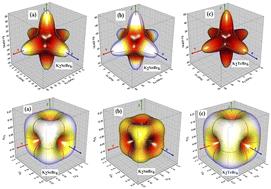
Hybrid organic, halide, and divalent metal double perovskites K2(Sn, Se, Te)Br6 with cubic structures were computationally evaluated using the generalized-gradient approximation (GGA) and modified Becke–Johnson (mBJ-GGA) functionals. The Goldschmidt tolerance factor, octahedral factor, Helmholtz free energy, and formation energy illustrated the structural, chemical, and thermodynamic stabilities of the studied compounds. The equilibrium lattice constants for K2SeBr6 and K2SnBr6 deviated from the experimental values by 4.3% and 3.1%, respectively. The elastic constants of K2(Sn, Se, Te)Br6 were significantly smaller due to their larger reticular distances, lower Coulomb forces, and reduced hardness. The high dynamic lattice anharmonicity of K2(Sn, Se, Te)Br6 reduced their electronic conductivity, providing a practical advantage in the presence of a thermoelectric field. K2(Se, Te)Br6 were predicted to have indirect bandgaps of X–L nature, while K2SnBr6 exhibited a direct Γ–Γ bandgap. The power conversion efficiency (PCE) for photovoltaic devices with K2(Sn, Se, Te)Br6 perovskite compounds as solar absorbers reached 20.51%. Their absorption in the visible region provided an advantage in energy harvesting. The electronic transitions in the studied double perovskites took place between the Br-4p and K-4s orbitals. Thus, these hybrid organic–inorganic halide perovskites proved to be excellent semiconductors for photovoltaic applications and demonstrated optimized photovoltaic efficiency.
采用广义梯度近似(GGA)和改进的Becke-Johnson (mBJ-GGA)泛函数对具有立方结构的有机、卤化物和二价金属双钙钛矿K2(Sn, Se, Te)Br6进行了计算评价。Goldschmidt容差因子、八面体因子、亥姆霍兹自由能和生成能说明了所研究化合物的结构、化学和热力学稳定性。K2SeBr6和K2SnBr6的平衡晶格常数分别偏离实验值4.3%和3.1%。由于K2(Sn, Se, Te)Br6具有较大的网距、较低的库仑力和较低的硬度,其弹性常数明显减小。K2(Sn, Se, Te)Br6的高动态晶格非调和性降低了它们的电子导电性,在热电场存在下提供了实际优势。预计K2(Se, Te)Br6具有X-L性质的间接带隙,而K2SnBr6具有直接Γ -Γ带隙。以K2(Sn, Se, Te)Br6钙钛矿化合物为太阳能吸收剂的光伏器件的功率转换效率(PCE)达到20.51%。它们在可见光区的吸收为能量收集提供了优势。所研究的双钙钛矿中的电子跃迁发生在Br-4p和K-4s轨道之间。因此,这些杂化有机-无机卤化物钙钛矿被证明是光伏应用的优秀半导体,并展示了优化的光伏效率。
期刊介绍:
An international, peer-reviewed journal covering all of the chemical sciences, including multidisciplinary and emerging areas. RSC Advances is a gold open access journal allowing researchers free access to research articles, and offering an affordable open access publishing option for authors around the world.



 京公网安备 11010802042870号
京ICP备2023020795号-1
京公网安备 11010802042870号
京ICP备2023020795号-1

 分享
分享
 求助内容:
求助内容: 应助结果提醒方式:
 扫码关注我们
