Immobilization of lead and zinc in contaminated soil using taro stem-derived biochar and apatite amendments: a comparative study of application ratios and pyrolysis temperatures†
Truong Xuan Vuong, Duc Phuong Nguyen, Vu Huyen Ngoc Nguyen, Thi Thu Ha Pham and Thi Thu Thuy Nguyen
{"title":"Immobilization of lead and zinc in contaminated soil using taro stem-derived biochar and apatite amendments: a comparative study of application ratios and pyrolysis temperatures†","authors":"Truong Xuan Vuong, Duc Phuong Nguyen, Vu Huyen Ngoc Nguyen, Thi Thu Ha Pham and Thi Thu Thuy Nguyen","doi":"10.1039/D5RA00912J","DOIUrl":null,"url":null,"abstract":"<p >Soil contamination by heavy metals presents a substantial environmental challenge. Remediation strategies employing biochar and apatite offer promise for restoring compromised sites. However, the efficacy of apatite and biochar derived from various biomass sources remains an under-investigated area. Taro stem-derived biochar produced at 300 and 500 °C (TSB300 and TSB500) and apatite amendments were incubated in contaminated soil for one month at various ratios (biochar 3%, 6%, 10%, mixture of biochar/apatite 3 : 3%, and 6 : 6% w/w) to investigate their potential to immobilize Pb and Zn. The initial concentrations of Pb and Zn in the contaminated soil were 4165.1 ± 19.6 mg kg<small><sup>−1</sup></small> and 3424.9 ± 20.4 mg kg<small><sup>−1</sup></small>, respectively. Soil samples were subjected to Tessier's sequential extraction for analysis of Pb and Zn in five chemical fractions (F1: exchangeable fraction; F2: carbonate fraction; F3: Fe/Mn oxide fraction; F4: organic carbon fraction and F5: residual fraction). The results indicated that one-month biochar and/or apatite amendment significantly increased soil pH, organic carbon (OC), and electrical conductivity (EC) compared to the control (<em>p</em> < 0.05). Amendments also notably reduced exchangeable fractions of Pb and Zn (F1) up to 71.8% and 61.5%, respectively, while enhancing their presence in more stable fractions (F4 and F5). This immobilization effect peaked at the 10% biochar application and 6 : 6% biochar–apatite combination. These findings suggest that TSB300, TSB500, and their blends with apatite hold promise for immobilizing Pb and Zn in heavily contaminated soil, potentially mitigating environmental risks.</p>","PeriodicalId":102,"journal":{"name":"RSC Advances","volume":" 15","pages":" 11975-12000"},"PeriodicalIF":4.6000,"publicationDate":"2025-04-16","publicationTypes":"Journal Article","fieldsOfStudy":null,"isOpenAccess":false,"openAccessPdf":"https://pubs.rsc.org/en/content/articlepdf/2025/ra/d5ra00912j?page=search","citationCount":"0","resultStr":null,"platform":"Semanticscholar","paperid":null,"PeriodicalName":"RSC Advances","FirstCategoryId":"92","ListUrlMain":"https://pubs.rsc.org/en/content/articlelanding/2025/ra/d5ra00912j","RegionNum":3,"RegionCategory":"化学","ArticlePicture":[],"TitleCN":null,"AbstractTextCN":null,"PMCID":null,"EPubDate":"","PubModel":"","JCR":"Q2","JCRName":"CHEMISTRY, MULTIDISCIPLINARY","Score":null,"Total":0}
引用次数: 0
Abstract
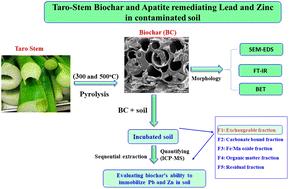
Soil contamination by heavy metals presents a substantial environmental challenge. Remediation strategies employing biochar and apatite offer promise for restoring compromised sites. However, the efficacy of apatite and biochar derived from various biomass sources remains an under-investigated area. Taro stem-derived biochar produced at 300 and 500 °C (TSB300 and TSB500) and apatite amendments were incubated in contaminated soil for one month at various ratios (biochar 3%, 6%, 10%, mixture of biochar/apatite 3 : 3%, and 6 : 6% w/w) to investigate their potential to immobilize Pb and Zn. The initial concentrations of Pb and Zn in the contaminated soil were 4165.1 ± 19.6 mg kg−1 and 3424.9 ± 20.4 mg kg−1, respectively. Soil samples were subjected to Tessier's sequential extraction for analysis of Pb and Zn in five chemical fractions (F1: exchangeable fraction; F2: carbonate fraction; F3: Fe/Mn oxide fraction; F4: organic carbon fraction and F5: residual fraction). The results indicated that one-month biochar and/or apatite amendment significantly increased soil pH, organic carbon (OC), and electrical conductivity (EC) compared to the control (p < 0.05). Amendments also notably reduced exchangeable fractions of Pb and Zn (F1) up to 71.8% and 61.5%, respectively, while enhancing their presence in more stable fractions (F4 and F5). This immobilization effect peaked at the 10% biochar application and 6 : 6% biochar–apatite combination. These findings suggest that TSB300, TSB500, and their blends with apatite hold promise for immobilizing Pb and Zn in heavily contaminated soil, potentially mitigating environmental risks.
期刊介绍:
An international, peer-reviewed journal covering all of the chemical sciences, including multidisciplinary and emerging areas. RSC Advances is a gold open access journal allowing researchers free access to research articles, and offering an affordable open access publishing option for authors around the world.





 京公网安备 11010802042870号
京ICP备2023020795号-1
京公网安备 11010802042870号
京ICP备2023020795号-1

 分享
分享
 求助内容:
求助内容: 应助结果提醒方式:
 扫码关注我们
